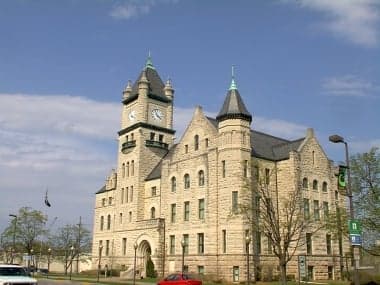
Photo: Wikipedia
Political ClimatePolitical Climate in Douglas County
Showing district-level results — no local-only data available.
Local Political AnalysisPolitical Analysis of Douglas County
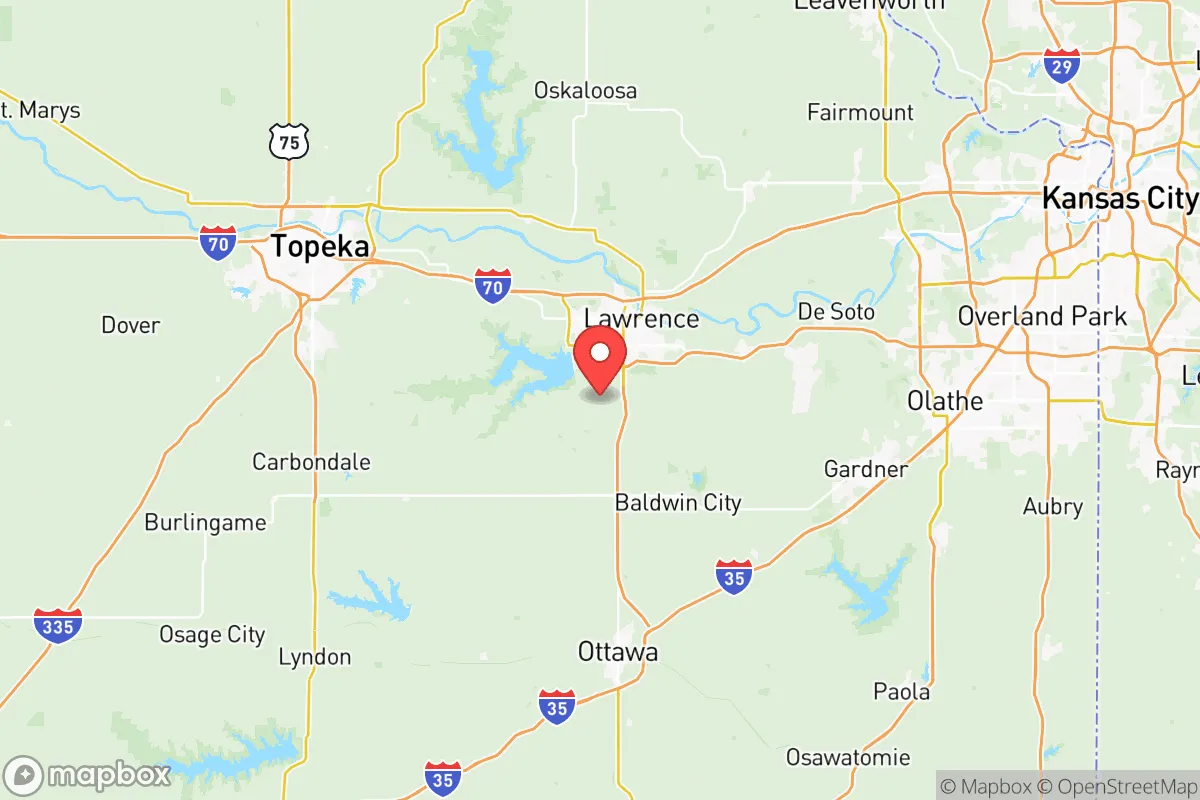
Douglas County, Kansas, is a deep blue island in a sea of red, leaning Democratic by a significant margin even as the surrounding state of Kansas sits at a Cook PVI of R+10. The county itself has a PVI of R+9, a figure that can be misleading, as it reflects the county’s vote relative to the national average rather than its internal partisan tilt. In practice, Douglas County votes roughly 15 to 20 points more Democratic than the state as a whole, a split driven almost entirely by the presence of Lawrence and the University of Kansas. The surrounding rural towns and townships lean heavily Republican, but the Democratic margin from Lawrence is so overwhelming that it flips the entire county. Baldwin City, for example, tends to vote more conservatively, while swing areas like the unincorporated parts of western Douglas County can break either way, but the county-wide result is rarely in doubt.
How it compares
Compared to the rest of Kansas, Douglas County is an outlier. The state’s R+10 PVI reflects a solidly Republican lean, with most counties voting GOP by double digits in statewide races. Johnson County, the state’s largest, is purple trending blue, while Sedgwick County (Wichita) leans Republican. In contrast, Douglas County consistently votes Democratic by margins similar to those seen in deep-blue urban counties like Wyandotte. In the 2020 presidential election, Joe Biden carried Douglas County by roughly 19 points, even as Donald Trump won Kansas by 15 points. That 34-point gap is one of the largest in the state. State-level races show the same pattern: Democratic candidates can reliably count on Douglas County for their biggest margins, though they often still lose statewide. The county’s electorate is younger, more educated, and far less rural than the Kansas average, which explains the divergence.
What this means for residents
For conservative residents in Douglas County, life is politically comfortable but socially isolating. You can vote Republican without much trouble—the county GOP is active, and local offices like the County Commission still see competitive races—but you’ll be in the minority in Lawrence. In places like Baldwin City or Lecompton, conservative views are more common, and the social atmosphere reflects that. For liberal residents, the county feels like a sanctuary within a red state. Lawrence’s city council, the county commission, and the school board are all reliably progressive, and issues like affordable housing, environmental policy, and police reform get serious local attention. That said, state preemption laws override many local ordinances—like the ban on plastic bags or local gun regulations—so the reality is constant tension between local will and state law. The practical effect is that whether you’re conservative or liberal, your vote matters a lot at the county level and very little in statewide races.
One cultural distinction that often surprises newcomers is the fierce local independence. Douglas County has a long history of being contrarian—it was the home of the Free State movement in the 1850s, and that stubborn streak is still visible today. Lawrence residents tend to wear their blue-city status as a badge of honor, while rural residents take equal pride in their red- county traditions. The result is a place where political conversations can feel raw but are rarely boring. If you’re moving here, expect to navigate two different worlds: the liberal, bike- friendly bubble of Lawrence and the conservative, agricultural life of the surrounding townships. That split is the real story of Douglas County, and it’s never going to change.

State Political ClimatePolitical Climate in Kansas
State Political AnalysisPolitical Environment in the State
Kansas is a solidly Republican state with a Cook PVI of R+9, but its politics are far from monolithic. The state has trended rightward over the past two decades, driven by the exodus of moderate Republicans from the legislature and the growing dominance of the conservative wing of the GOP. However, the state’s political reality is a constant tug-of-war between the deeply red rural and exurban areas and the increasingly blue urban cores of Kansas City, Lawrence, and Manhattan, creating a dynamic that feels more like a battleground than a lockstep red state.
Urban vs. rural divide
The political map of Kansas is a classic tale of two states. The eastern third, anchored by the Kansas City metro area (Johnson, Wyandotte, and Leavenworth counties), is the state’s Democratic stronghold. Johnson County, once a reliably Republican suburb, has shifted notably left in recent cycles, with its more affluent, educated voters increasingly favoring Democrats in presidential and Senate races. In 2020, Joe Biden won Johnson County by about 8 points, a stark contrast to the rest of the state. Lawrence, home to the University of Kansas, is a deep blue island, while Manhattan (Kansas State University) leans Republican but is more moderate than the surrounding Flint Hills. The rest of the state—the vast, rural plains, the conservative Wichita suburbs, and the small towns of western Kansas—votes overwhelmingly Republican. The real political action is in the suburbs of Kansas City and Wichita, where the fight for the state’s future is being waged. For example, the 3rd Congressional District, which covers Johnson County, is now a competitive seat, while the 1st District (the “Big First”) covering western Kansas is one of the most Republican districts in the nation.
Policy environment
Kansas’s policy environment is a mix of conservative governance and pragmatic compromise. The state has no state income tax on Social Security benefits and a flat state income tax rate of 5.7% (as of 2026), following the phase-out of the “march to zero” experiment under Governor Sam Brownback. Property taxes are relatively high, especially in Johnson County, to fund local schools. The state is a “right-to-work” state, and its regulatory posture is generally business-friendly, with limited environmental and labor regulations. On education, Kansas has a history of school funding lawsuits, with the state Supreme Court often forcing the legislature to increase funding for K-12 schools. The state has a robust school choice program, including open enrollment and tax-credit scholarships for private schools. Healthcare policy is a mixed bag: Kansas did not expand Medicaid under the Affordable Care Act, leaving a coverage gap for about 150,000 low-income adults, though there is ongoing bipartisan pressure to do so. Election laws are moderately restrictive: the state requires a photo ID to vote and has a voter registration deadline 21 days before an election, but it also offers early voting and no-excuse absentee mail voting.
Recent policy direction
Over the past five years, Kansas has moved decisively to the right on several fronts. In 2022, voters overwhelmingly rejected a constitutional amendment that would have removed the right to abortion from the state constitution, preserving the current legal framework that allows abortion up to 22 weeks. This was a major defeat for the anti-abortion movement and a sign that Kansans, even in a red state, value a degree of bodily autonomy. On gun rights, Kansas is a “constitutional carry” state (permitless carry for adults 21 and older) and has a “stand your ground” law. The legislature has also passed laws protecting the Second Amendment from federal overreach, including a 2013 law that nullifies any federal gun control measure that doesn’t exist in state law. On parental rights, the state passed a “Parents’ Bill of Rights” in 2021, requiring schools to notify parents of any changes to a student’s mental, emotional, or physical health. On speech and privacy, Kansas has no broad surveillance law, but local police have access to license plate readers and body cameras. Property rights are strong, with no state-level rent control and a relatively low property tax cap. On voting, the legislature has tightened ballot access, including a 2021 law that shortened the deadline for returning mail ballots and banned the mass mailing of ballot applications. The overall direction is toward more conservative governance, but with a pragmatic streak that occasionally surprises.
Civil unrest & political movements
Kansas has seen its share of political flashpoints, but they tend to be more legal and legislative than street-level. The most visible recent movement was the 2022 abortion rights campaign, which saw massive grassroots organizing and a record turnout for a primary election. On the right, the “Free State” movement, which advocates for limited government and gun rights, has a strong presence in rural areas, particularly around the state’s gun-friendly culture. Immigration politics are relatively quiet, as Kansas is not a border state, but there have been local debates over sanctuary policies. In 2019, the legislature passed a law requiring local law enforcement to cooperate with federal immigration authorities, effectively banning sanctuary cities. There have been no major secession or nullification movements, though the state’s 2013 gun nullification law is a notable example of state-level resistance to federal authority. Election integrity has been a hot topic since 2020, with the Republican-controlled legislature passing several bills to tighten voting procedures, though no widespread fraud was ever documented. The most visible protest in recent memory was the 2020 George Floyd protests in Kansas City and Lawrence, which were largely peaceful. Overall, the political climate is more about legislative battles than street protests, though the abortion vote showed that grassroots energy can still surprise.
Projection
Over the next 5-10 years, Kansas is likely to remain a Republican-leaning state, but the margin will continue to narrow. The key demographic shift is the growth of Johnson County, which is becoming more diverse and more educated, and is trending toward the Democrats. If this trend continues, the state could become a true swing state in presidential elections within a decade, similar to what happened in Arizona or Georgia. However, the rural areas are not shrinking fast enough to flip the state blue, and the Republican legislature is likely to continue drawing congressional maps that favor the GOP. The biggest wildcard is the ongoing battle over school funding and Medicaid expansion, which could bring more moderate voters to the polls. A new resident moving in now should expect a state that is politically competitive at the local level, with a Republican tilt that is slowly eroding. The state’s culture will remain conservative on most social issues, but the urban-rural divide will only deepen, making for lively local elections and a constant push-pull on policy.
For a new resident, the bottom line is this: Kansas is a state where your political experience will depend heavily on where you live. If you settle in Johnson County, you’ll find a politically diverse, suburban environment with a mix of conservative and liberal neighbors. If you move to rural western Kansas, you’ll be in deep red territory where conservative values are the norm. The state’s tax burden is moderate, its gun laws are permissive, and its education system is a constant source of debate. The 2022 abortion vote showed that Kansans are willing to buck party lines on certain issues, so don’t assume the state is a monolith. Whether you’re a conservative looking for a business-friendly environment or a liberal seeking a community that values education and healthcare access, Kansas has a place for you—just be prepared for the political climate to vary dramatically from one county to the next.
* Values derived from national, state, county, city and local statistics and may differ in a specific area. Last updated: 2026-07-07T06:07:47.000Z
Narrative content on this page is AI-generated and may contain mistakes. Verify any details that matter before acting on them.
ReloMaps may earn a commission from affiliate links at no extra cost to you.

