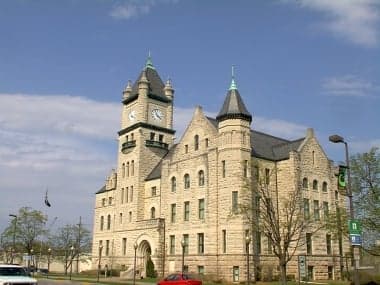
Photo: Wikipedia
Demographics of Douglas County
Affluence Level in Douglas County
A middle-class area roughly in line with national averages across income, home values, education, and employment.
People of Douglas County
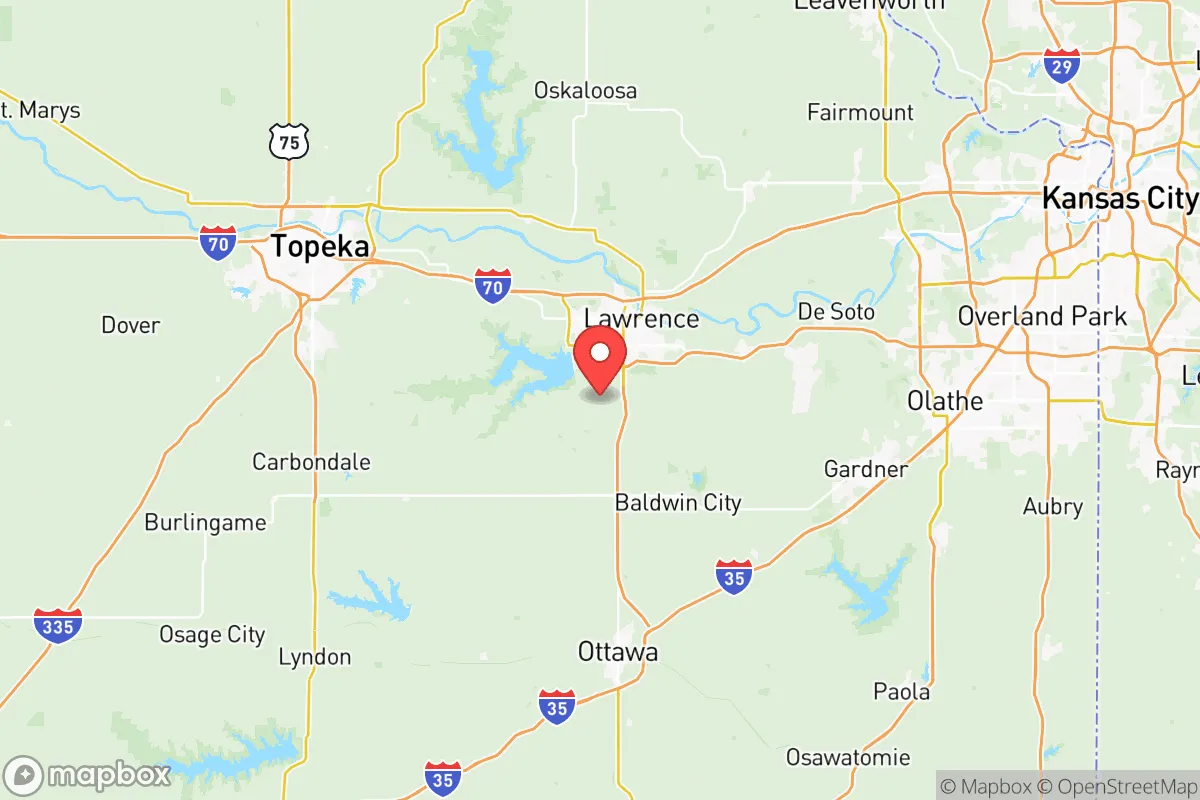
Douglas County, Kansas, is home to 119,547 residents, a population that is predominantly white (76.5%) but notably more educated and politically progressive than the state average, with 52.0% holding a college degree. The county’s identity is overwhelmingly shaped by the University of Kansas in Lawrence, which draws a steady flow of students, faculty, and professionals, creating a distinctive blend of small-town Midwestern roots and a liberal, academic culture. While the foreign-born share is low at 4.0%, the county has seen modest growth in Hispanic (7.1%), Black (4.0%), and East/Southeast Asian (3.6%) communities, alongside a small Indian-subcontinent population (1.0%). This is a place where the historic character of a Kansas river town meets the demographic churn of a university hub, producing a population that is both stable and slowly diversifying.
Settlement & growth (pre-1960)
Before American settlement, the area now known as Douglas County was home to the Kaw (Kansa) Nation, who lived along the Kansas River and its tributaries. The Osage also used the region for hunting. The first permanent American settlers arrived in the 1850s, drawn by the Kansas-Nebraska Act of 1854, which opened the territory to settlement and ignited the “Bleeding Kansas” conflict over slavery. The town of Lawrence was founded in 1854 by the New England Emigrant Aid Company, an anti-slavery organization that recruited settlers from New England and the Upper Midwest to tip the territory toward free-state status. These early settlers were overwhelmingly Yankee—New Englanders of English and Scots-Irish descent—who brought abolitionist politics, Congregationalist churches, and a commitment to education.
The county’s early economy was agricultural, with wheat and corn farms spreading across the fertile Wakarusa Valley. The town of Lecompton, founded in 1854, briefly served as the territorial capital and became a flashpoint for pro-slavery forces, but Lawrence’s free-state settlers ultimately prevailed. After the Civil War, the population grew steadily as railroads reached the area. The Atchison, Topeka and Santa Fe Railway connected Lawrence in the 1860s, spurring trade and attracting a wave of German and Irish immigrants who worked on the railroad or took up farming. Small settlements like Baldwin City (founded 1858) and Eudora (founded 1857) grew as agricultural service centers, with Eudora attracting a notable German-speaking community that maintained its Lutheran traditions for generations.
The University of Kansas, established in Lawrence in 1865, became the county’s defining institution. It drew faculty and students from across the Midwest and East Coast, creating a professional class that set the county apart from its more rural neighbors. By 1900, Douglas County had a population of about 25,000, with Lawrence as the clear urban center. The early 20th century saw little new immigration; the county remained overwhelmingly native-born white, with a small Black community concentrated in Lawrence’s Pinckney neighborhood, descendants of freed slaves who had moved to the area after the Civil War. The Dust Bowl and Great Depression of the 1930s caused some out-migration, but the university’s stability cushioned the county from the worst of the rural exodus. By 1960, the population had reached about 45,000, still predominantly white and native-born, with Lawrence’s character as a college town firmly established.
Modern era (post-1965)
The 1965 Hart-Cellar Act had a limited direct impact on Douglas County, as the region was not a primary destination for post-1965 immigration. The foreign-born share remains low at 4.0%, well below the national average. However, the county has experienced significant domestic demographic change driven by the university’s growth. From the 1970s onward, the University of Kansas expanded its enrollment, attracting students from across the country and, increasingly, from abroad. This influx brought a steady stream of East/Southeast Asian graduate students and faculty, particularly in STEM fields, who settled in Lawrence’s Old West Lawrence and Haskell University neighborhoods. The Indian-subcontinent community, though small at 1.0%, grew through the tech and medical sectors, with families concentrated near the KU Medical Center campus and in newer subdivisions like Alvamar.
The Hispanic population, now 7.1%, began growing in the 1990s as Mexican and Central American immigrants arrived to work in construction, landscaping, and the service industry. This community is most visible in Lawrence’s East Lawrence neighborhood and in the rural areas around Lecompton and Baldwin City, where agricultural labor remains a draw. The Black population, at 4.0%, has remained relatively stable, with the historic Pinckney neighborhood still a cultural anchor, though many Black residents have moved to newer subdivisions in west Lawrence. Suburbanization has reshaped the county since the 1980s, with West Lawrence and the area around Clinton Lake seeing rapid growth as families and professionals sought newer housing and better schools. This suburban expansion has been driven by domestic migration from the Kansas City metro area and from other parts of Kansas, as well as by KU alumni who stay after graduation.
The county’s racial and ethnic composition has shifted modestly but steadily. In 1990, the population was about 90% white; by 2020, it had dropped to 76.5%. The Hispanic share grew from 2% to 7.1%, and the East/Southeast Asian share from 1% to 3.6%. The Indian-subcontinent population, while small, has doubled since 2000. The county remains less diverse than the national average, but the trend is toward slow diversification, driven almost entirely by the university and the professional jobs it creates. The conservative-leaning audience considering relocation should note that Douglas County is a political outlier in Kansas—it consistently votes Democratic, and its culture is shaped by academic liberalism, environmentalism, and a strong emphasis on public education.
The future
Douglas County’s population is projected to continue growing slowly, likely reaching 130,000 to 140,000 by 2040. The primary driver will remain the University of Kansas, which is expected to maintain or slightly increase enrollment. The county will become more diverse, but at a gradual pace. The Hispanic share could reach 10-12% by 2040, driven by natural increase and continued immigration for service-sector jobs. The East/Southeast Asian and Indian-subcontinent populations will likely grow as KU expands its international recruitment and as tech and healthcare sectors attract skilled immigrants. The white share will continue to decline, but the county will remain majority white for the foreseeable future.
New residential development is concentrated in West Lawrence and along the K-10 highway corridor toward the Johnson County line, where commuters to the Kansas City metro area are building homes. The rural towns—Eudora, Baldwin City, and Lecompton—are likely to see modest growth as bedroom communities, but their populations will remain small and predominantly white. The county’s cultural identity will remain anchored in Lawrence’s liberal, university-town ethos, which may create friction with the more conservative rural areas. For someone moving in now, Douglas County offers a highly educated, politically engaged population with a strong sense of place, but it is not a place of rapid demographic transformation—it is a stable, slowly diversifying college county where the university sets the tone.
In sum, Douglas County is becoming a more diverse, more suburban version of its historic self, but the pace of change is measured. The population is growing, educated, and increasingly non-white, yet the county’s character remains defined by its Yankee-founded, university-centered roots. For a family or individual seeking a community with strong schools, a vibrant downtown, and a politically progressive environment, Douglas County offers a distinctive Midwestern experience that is unlikely to change dramatically in the coming decades.

* Values derived from national, state, county, city and local statistics and may differ in a specific area. Last updated: 2026-07-07T06:07:47.000Z
Narrative content on this page is AI-generated and may contain mistakes. Verify any details that matter before acting on them.
ReloMaps may earn a commission from affiliate links at no extra cost to you.

