
Photo: Wikipedia
Personal Sovereignty in Justin, TX
Strong independent fundamentals that actively favor personal liberty and low regulation.
What does Personal Sovereignty tell us?
Personal Sovereignty measures your capacity for self-reliance and independence with minimal government friction. Higher scores mean fewer barriers between you and the way you want to live... but it assumes you have the space you need and good neighbors.
What does this tell us?
Personal Sovereignty measures your capacity for self-reliance and independence with minimal government friction. Higher scores mean fewer barriers between you and the way you want to live... but it assumes you have the space you need and good neighbors.
State Policy
Energy independence: Net exporter (195% of energy produced in-state)
Personal Liberty
Homesteading

Personal Liberty Analysis
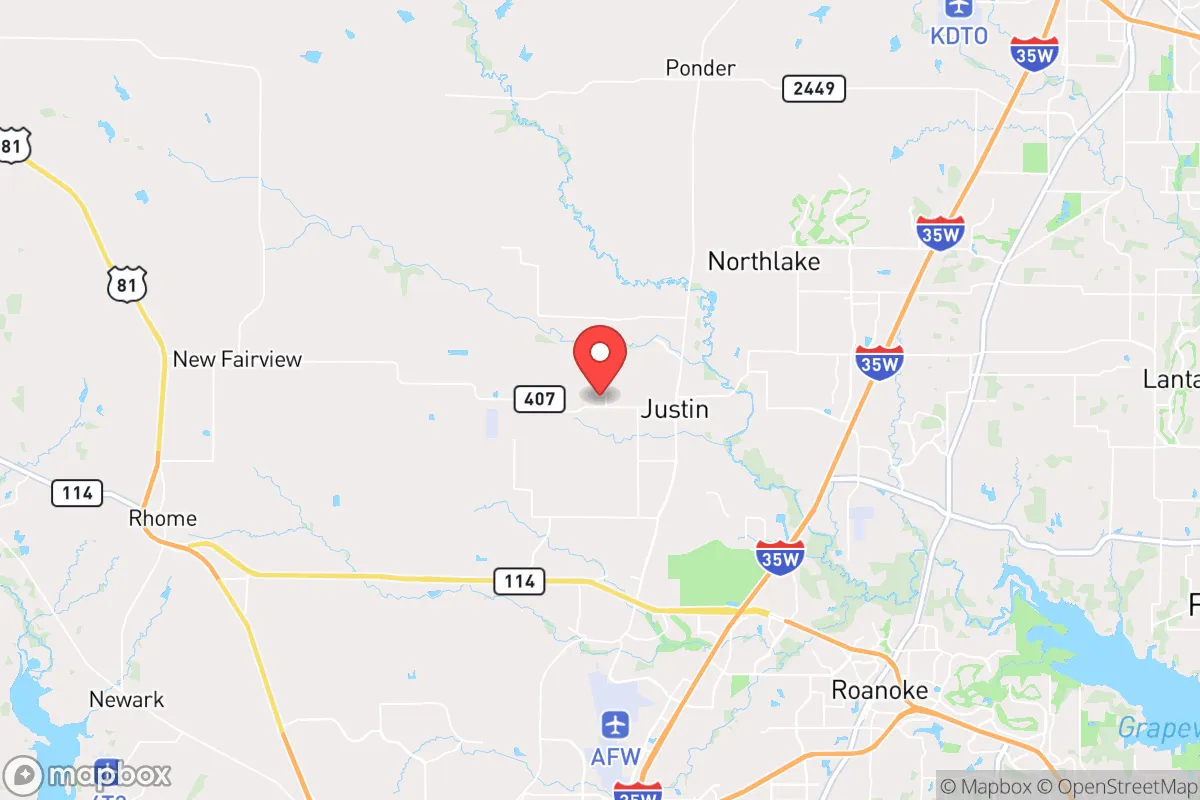
Justin, Texas, offers a personal sovereignty environment that is shaped overwhelmingly by state-level policy rather than local municipal action, creating a baseline of autonomy that is among the strongest in the nation. As a rapidly growing exurban community straddling Denton and Tarrant counties, Justin benefits from Texas’s constitutional protections on self-defense, its absence of a state income tax, and a regulatory culture that generally defers to property owners. For a relocation audience prioritizing independence, the key trade-off is between the light-touch state framework and the inevitable encroachment of suburban homeowners’ association (HOA) covenants and municipal ordinances as the town expands from roughly 4,000 residents toward a projected build-out of 20,000+.
Tax burden and regulatory posture: what you keep and what you navigate
Texas imposes no state income tax, meaning every dollar earned in Justin stays with the earner — a structural advantage that directly supports personal financial sovereignty. The town’s property tax rate is competitive for the Dallas-Fort Worth metroplex: the combined city, county, school district, and special district rate typically falls between 2.5% and 2.8% of assessed value, with the largest portion going to the Northwest Independent School District (NISD). While this is not a low-tax haven by national standards, the absence of income tax means the effective total tax burden on a household earning $100,000 is roughly 5-7% lower than in a state with a 5% income tax and similar property rates. Regulatory posture at the city level remains light-touch for now. Justin has no citywide rental inspection program, no rent control, and no business license requirement for most home-based enterprises. However, most new subdivisions are governed by HOAs that impose deed restrictions on parking, fencing, outbuildings, and landscaping — a practical limit on property autonomy that buyers should verify before purchase. The town’s zoning code permits agricultural uses on parcels of 5 acres or more, but residential lots under 1 acre are typically restricted to single-family dwellings with no livestock.
Self-defense and gun law specifics: constitutional carry and castle doctrine
Texas law provides one of the strongest self-defense frameworks in the United States, and Justin residents operate under these state-level protections without significant local interference. Since 2021, constitutional carry (permitless carry) has been legal for any person 21 or older who may lawfully possess a firearm, allowing open or concealed carry without a license. The town has no local ordinances restricting firearm possession, and there are no city-specific waiting periods, magazine capacity limits, or assault weapon bans. Texas’s castle doctrine eliminates any duty to retreat before using deadly force in a home, vehicle, or workplace, and the “stand your ground” statute extends that principle to any place where a person is lawfully present. For residents who prioritize self-defense autonomy, Justin’s location in Denton County (north of the city) places them under the jurisdiction of a sheriff’s office that is publicly supportive of Second Amendment rights; Tarrant County (south of the city) has a similar posture. The nearest gun ranges and firearms retailers are within a 15-minute drive in Roanoke and Keller. One practical consideration: Texas law prohibits carrying firearms on K-12 school premises (including NISD campuses) and in certain government buildings, but these restrictions are standard statewide and do not reflect local overreach.
Self-reliance and homesteading viability: lot sizes, zoning, and off-grid feasibility
Justin’s zoning code and lot size patterns create a split between traditional homesteading potential and modern suburban constraints. The town’s extraterritorial jurisdiction (ETJ) and unincorporated areas of Denton and Tarrant counties offer the best opportunities for self-reliance. Parcels of 5 acres or more are zoned for agricultural use, allowing horses, cattle, goats, and poultry without special permits. Smaller lots (1-5 acres) typically permit chickens and small livestock but prohibit larger animals. Off-grid feasibility is limited by state and local building codes: Texas does not require a building permit for structures under 200 square feet, but any permanent dwelling must meet International Residential Code (IRC) standards, including septic system approval from the county health department. Rainwater harvesting is legal and encouraged — Texas law (HB 3391) prohibits HOAs from banning rainwater collection systems — and solar panels are permitted without restriction. However, going fully off-grid (no utility connection) is impractical in most of Justin’s incorporated area because subdivision covenants typically require connection to municipal water and electricity. For those seeking true homesteading autonomy, the best strategy is to purchase land in the unincorporated ETJ (e.g., along FM 156 or FM 407) where county regulations are minimal and no HOA applies. The town’s water utility is reliable but sourced from the Trinity Aquifer; well drilling is permitted on parcels of 1 acre or more in unincorporated areas, subject to a $500 permit and groundwater district approval.
Personal liberties: parental rights, medical autonomy, speech, and property
Texas law provides broad protections for parental rights, medical autonomy, and property use, and Justin residents benefit from these without significant local variance. The state’s Parental Bill of Rights (SB 1878, 2023) affirms that parents have the fundamental right to direct their children’s education, healthcare, and moral upbringing, and it requires school districts — including NISD — to obtain parental consent before administering any mental health or medical survey. Medical autonomy is strong: Texas has no state-level vaccine mandate for adults, and while schools require certain immunizations for enrollment, exemptions are available for medical, religious, and conscientious reasons (the latter via a signed affidavit). Speech protections are robust under both the U.S. and Texas constitutions, and Justin has no local ordinances restricting political signage, leafleting, or public assembly beyond standard time-place-manner rules. Property rights are reinforced by Texas’s private property rights law (HB 2730), which requires government entities to compensate landowners for any regulatory taking that reduces property value by 25% or more. One notable local nuance: Justin’s city council has considered but not enacted a “no camping” ordinance that would restrict sleeping in vehicles on public property — a measure that affects personal autonomy for those living in RVs or vans. As of 2026, no such ordinance is in effect, but it remains a topic of discussion as the town grows.
Overall, Justin offers a personal sovereignty profile that is strong by national standards but tempered by the realities of exurban growth. The combination of no state income tax, constitutional carry, castle doctrine, parental rights protections, and minimal local regulation places it well above the median for U.S. towns of similar size. The primary constraints on autonomy come not from government overreach but from private covenants (HOAs) and the practical demands of suburban infrastructure. For a relocation audience that values independence, the strategic move is to target unincorporated parcels or older neighborhoods without HOAs, where the full force of Texas’s light-touch governance can be realized. Compared to nearby cities like Keller or Southlake, Justin retains a noticeably more permissive regulatory environment — but that window is closing as development accelerates. Those who prioritize maximum personal sovereignty should act before the next wave of municipal ordinances and deed restrictions solidifies.

* Values derived from national, state, county, city and local statistics and may differ in a specific area. Last updated: 2026-11-23T19:49:14.000Z
Narrative content on this page is AI-generated and may contain mistakes. Verify any details that matter before acting on them.
ReloMaps may earn a commission from affiliate links at no extra cost to you.

