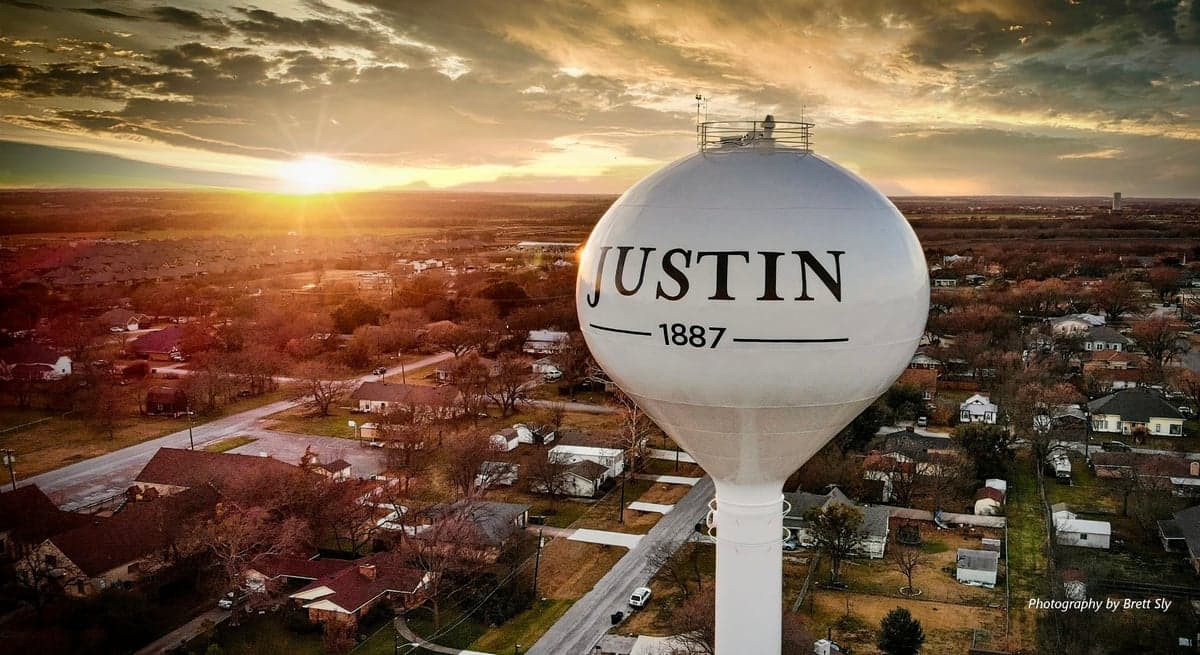
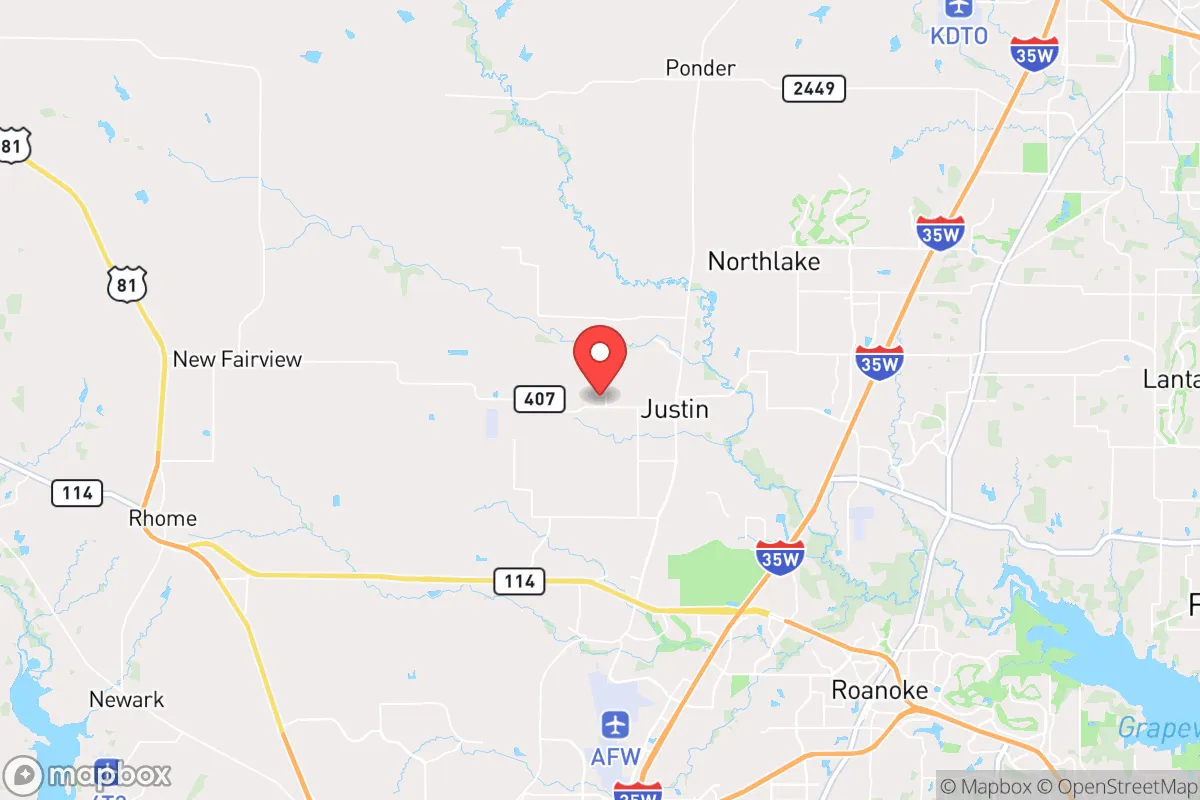
Photo: Wikipedia
Demographics of Justin, TX
Affluence Level in Justin, TX
An upper-middle-class area. Household wealth, education levels, and homeownership run ahead of national benchmarks.
People of Justin, TX
The people of Justin, Texas today form a small, tight-knit community of roughly 5,068 residents, characterized by a predominantly White population (60.8%) with a substantial Hispanic minority (23.5%) and smaller Black (3.4%) and East/Southeast Asian (0.7%) communities. The city retains a distinctly rural-suburban character, with a low foreign-born share of just 1.0% and a relatively high college-educated rate of 36.0%, reflecting its evolution from an agricultural crossroads into a commuter-friendly exurb of Fort Worth. Residents often describe the town as a place where families know their neighbors, and the local identity is rooted in a blend of historic ranching heritage and newer residential development.
How the city was settled and grew
Justin’s population history begins in the late 19th century, when the area was part of the Peters Colony land grant system that drew Anglo-American settlers to North Texas. The town was officially platted in 1886 along the newly laid tracks of the Fort Worth and Denver Railway, which made it a shipping point for cotton, grain, and livestock. The earliest residents were primarily farmers and ranchers of English, Scots-Irish, and German descent, who built modest homes in what is now the Old Town Justin district, centered around the original rail depot and Main Street. A second wave of settlement came in the early 1900s, when tenant farmers and sharecroppers—many of them White families from the Deep South—moved into the area to work the cotton fields. These families concentrated in the South Justin area, along what is now Farm-to-Market Road 156, where small homesteads and churches still mark the landscape. The town remained overwhelmingly White and agricultural through the mid-20th century, with a population that hovered around 500 until the 1970s.
Modern era (post-1965)
The modern demographic transformation of Justin began in earnest after the 1965 Hart-Cellar Act, though its effects were initially muted due to the town’s rural isolation. The real shift came in the 1980s and 1990s, as suburban sprawl from Fort Worth pushed northward along Interstate 35W. New subdivisions such as Justin Crossing and Heritage Park attracted White middle-class families seeking larger lots and lower property taxes than Denton or Fort Worth proper. At the same time, a growing Hispanic population—many of Mexican-American heritage, some with roots in South Texas—moved into the Northwest Justin area, drawn by construction and service jobs in the expanding Dallas-Fort Worth metroplex. The Hispanic share rose from roughly 5% in 1990 to 23.5% by the 2020 census, while the Black population grew modestly to 3.4%, primarily in the East Justin corridor near U.S. Highway 377. The East/Southeast Asian community remains small at 0.7%, with most families settling in newer subdivisions like Prairie Springs after 2010. The Indian-subcontinent population is negligible at 0.1%, reflecting the town’s limited appeal to highly skilled immigrant professionals who tend to cluster in more urban job centers.
The future
Justin’s population is projected to grow significantly over the next 10–20 years, driven by continued exurban expansion from Fort Worth and the development of large master-planned communities. The city’s 2020 population of 5,068 is expected to double or triple by 2040, as new neighborhoods like Lantana Ridge and Pecan Creek Estates come online. This growth will likely make the population slightly more diverse, though the White share is expected to remain dominant. The Hispanic share may rise toward 30% as younger families move in, while the Black and East/Southeast Asian shares could each approach 5–7% as the area becomes more affordable relative to Denton and Frisco. The foreign-born share, currently very low at 1.0%, may increase modestly but will likely stay below 5%, as Justin lacks the industrial or tech job base that attracts international migrants. The cultural identity of the town is evolving from a quiet ranching community into a family-oriented exurb, with new residents drawn by good schools, lower crime rates, and a slower pace of life compared to the core suburbs.
For someone moving in now, Justin offers a stable, predominantly White and Hispanic community with a strong family focus, low crime, and a growing but still manageable population. The town is becoming more diverse in absolute terms, but remains less ethnically varied than the broader Dallas-Fort Worth region. New arrivals will find a place where traditional values and neighborly connections still matter, and where the biggest change ahead is simply more of the same—more houses, more families, and more traffic on the main roads, but a fundamentally conservative, small-town character that is likely to persist through the next decade.

* Values derived from national, state, county, city and local statistics and may differ in a specific area. Last updated: 2026-11-23T19:49:14.000Z
Narrative content on this page is AI-generated and may contain mistakes. Verify any details that matter before acting on them.
ReloMaps may earn a commission from affiliate links at no extra cost to you.

