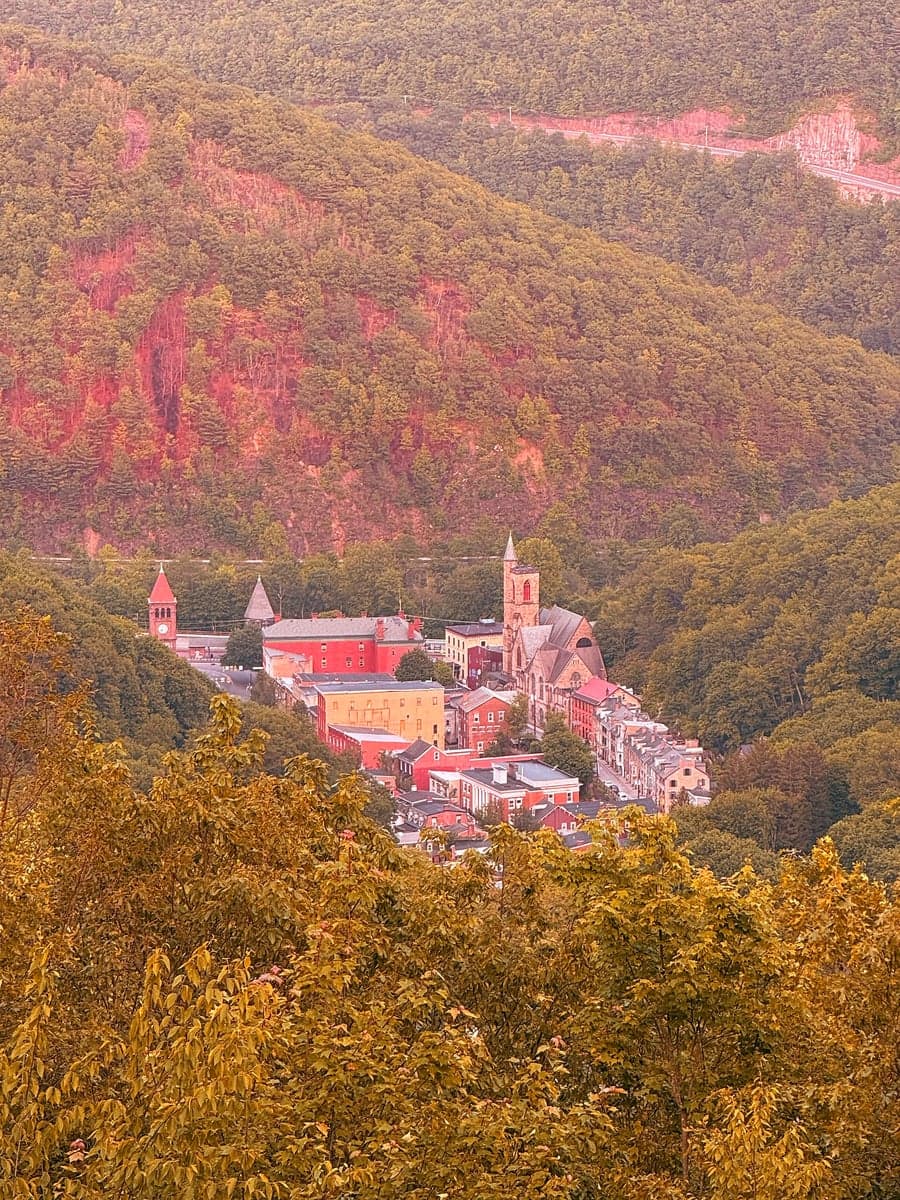
Photo: Wikipedia
Political ClimatePolitical Climate in Jim Thorpe, PA
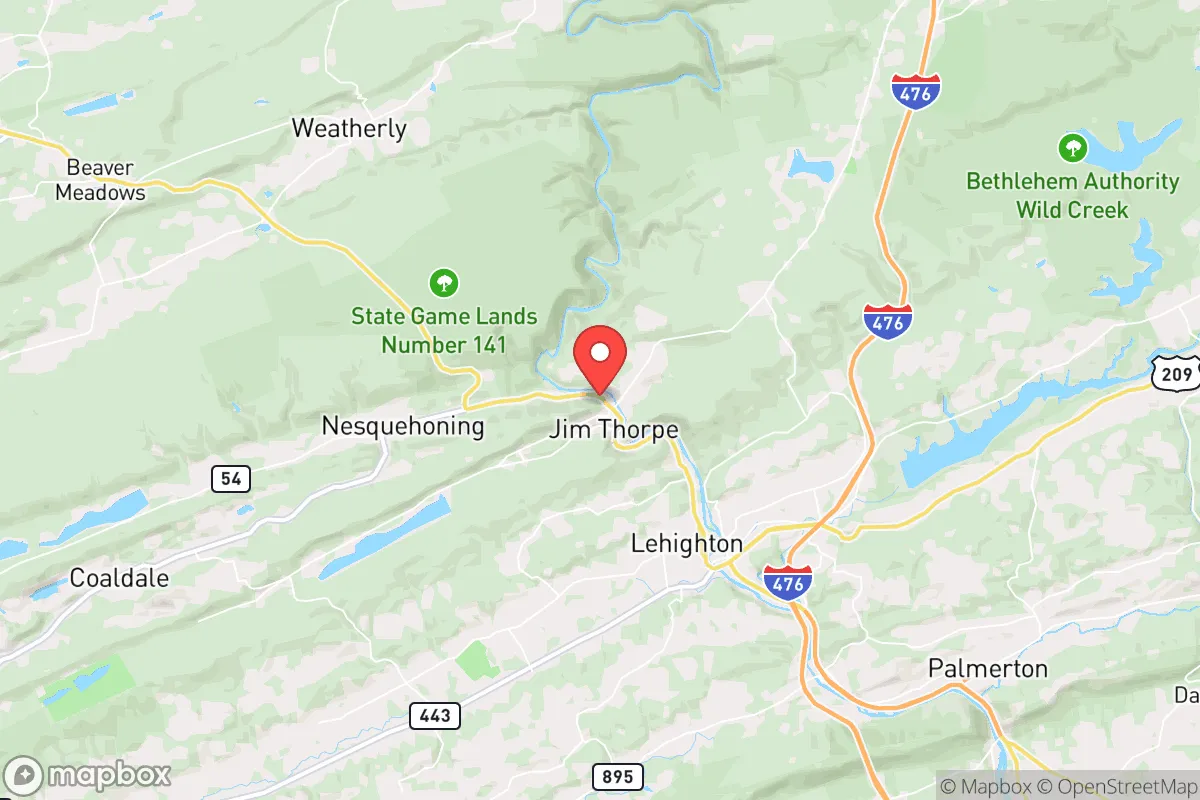
District shown is the primary district for this city’s centroid. Cities may span multiple districts.
Local Political AnalysisPolitical Analysis of Jim Thorpe, PA
Jim Thorpe, Pennsylvania, leans slightly Republican with a Cook PVI of R+1, making it a classic swing area in a state that’s dead-even at EVEN. But don’t let that single number fool you—this town has a political pulse that’s more nuanced than the raw math suggests. Over the last decade, the area has shifted rightward in presidential races, mirroring trends in rural Carbon County, but local elections often hinge on personality and development issues rather than straight party lines. If you’re moving here, you’re stepping into a place where the national mood rubs up against a fiercely independent local streak.
How it compares
Compared to Pennsylvania as a whole, Jim Thorpe is a microcosm of the state’s broader divide—just tilted a bit redder. The state’s EVEN rating means it’s a true battleground, with Philadelphia and Pittsburgh pulling left and the rural middle pulling right. Jim Thorpe sits in that rural middle, but its historic tourism economy and growing population of remote workers from blue areas like New York City and Philadelphia have injected a subtle liberalizing influence. Nearby towns like Lehighton (R+3) and Nesquehoning (R+5) are more reliably Republican, while Allentown, about 30 minutes south, is a Democratic stronghold with a PVI of D+5. In practice, this means Jim Thorpe’s politics feel more like a conversation than a confrontation—you’ll see Trump signs on one block and Biden signs on the next, especially during local races where school funding and zoning laws dominate the debate.
What this means for residents
For conservative residents, Jim Thorpe offers a comfortable baseline: most county offices are held by Republicans, and gun rights and lower taxes are generally respected. You won’t feel out of place at a town hall meeting, and the local GOP is active but not overbearing. For liberal residents, the reality is more about finding your niche. The town’s arts scene and the influx of weekenders from the cities have created a visible progressive presence, especially around environmental issues like preserving the Lehigh Gorge and opposing fracking expansions. You’ll find like-minded folks at the farmers’ market or the Mauch Chunk Opera House, but you’ll also need to engage respectfully with neighbors who see things differently. The practical upshot? Political arguments are rare in day-to-day life—most people here care more about potholes and property taxes than cable news talking points.
Culturally, Jim Thorpe stands apart from much of rural Pennsylvania because of its tourism identity. The town’s Victorian architecture and railroad history draw visitors year-round, which has made local leaders more pragmatic about zoning and business regulations than you’d find in a typical R+1 county. There’s a live-and-let-live vibe that softens the edges of the political divide. If you’re moving here, expect a place where your vote might not decide the election, but your voice at a borough council meeting absolutely can. The trajectory is toward a slow, steady purple—more transplants, more diversity of thought, but still anchored by a deep-rooted sense of place that resists being pigeonholed.

State Political ClimatePolitical Climate in Pennsylvania
State Political AnalysisPolitical Environment in the State
Pennsylvania is the ultimate swing state, with a Cook PVI of EVEN that perfectly captures its knife-edge balance. Over the past 20 years, it has shifted from a reliably blue-leaning state in presidential races (voting Democratic from 1992 through 2012) to a true battleground where margins are measured in tens of thousands of votes. The dominant coalitions are a shrinking but still potent union-and-urban Democratic base in Philadelphia and Pittsburgh, versus a growing, energized conservative coalition in the exurbs, small towns, and vast rural stretches of the "T" — the central and northern spine of the state. The 2020 and 2024 elections saw razor-thin margins, with Trump flipping counties like Luzerne (Wilkes-Barre) and Erie back to red after decades of blue, while Biden held the line in the Philly suburbs like Delaware and Montgomery counties. This isn't a state that's drifting; it's locked in a demographic tug-of-war.
Urban vs. rural divide
The political map of Pennsylvania is a study in stark contrasts. Philadelphia and its collar counties — Montgomery, Delaware, Chester, and Bucks — are the engine of the Democratic vote, delivering margins of 300,000+ votes that Democrats need to offset the rest of the state. Pittsburgh and its immediate suburbs (Allegheny County) are also reliably blue, though less overwhelmingly so. The rest of the state is a sea of red. The I-80 corridor from the New York border to Ohio is solidly Republican, anchored by counties like Lycoming (Williamsport), Centre (State College, though Penn State's student population creates a blue island), and Venango (Oil City). The southeastern corner outside Philly — Lancaster, York, and Lebanon counties — are deep red, driven by a mix of conservative Mennonite and Amish communities, suburban retirees, and working-class voters. The Lehigh Valley (Allentown, Bethlehem, Easton) is a true swing microcosm: Northampton and Lehigh counties voted for Obama twice, then Trump in 2016, then Biden in 2020, then Trump again in 2024. That's the state in miniature.
Policy environment
Pennsylvania's policy landscape is a patchwork of divided government. The state has a flat income tax of 3.07%, one of the lowest in the nation, and a sales tax of 6% (8% in Philadelphia and Allegheny County for certain items). Property taxes are high, averaging around 1.5% of home value, and are the primary funding mechanism for local schools — a perennial source of tension. The regulatory posture is moderate: Pennsylvania is not Texas or Florida on deregulation, but it's not California either. The state has a robust oil and gas industry (Marcellus Shale), with a severance tax that is lower than neighboring Ohio and West Virginia, though environmental regulations are stricter. Education policy is a flashpoint: the state has a patchwork of 500 school districts, with a 2023 court ruling declaring the funding system unconstitutional, which will likely lead to more state aid for poorer districts. Election laws are moderately restrictive: no-excuse mail-in voting was enacted in 2019 (Act 77) but has been a source of constant litigation, with Republicans pushing for voter ID requirements and Democrats defending mail-in access. The state does not have a right-to-work law, and union membership remains above the national average, particularly in public-sector and construction trades.
Recent policy direction
The last five years have seen Pennsylvania lurch in both directions simultaneously, depending on which party holds the governor's mansion and the legislature. Under Democratic Governor Josh Shapiro (elected 2022), the state has moved left on some fronts while the Republican-controlled legislature blocks others. On gun and self-defense law: Pennsylvania is a "shall-issue" state for concealed carry, with no permit required for open carry (except in Philadelphia). In 2024, the legislature passed a bill to allow permitless concealed carry, but Shapiro vetoed it. On parental and education rights: the state has seen fierce battles over school curriculum, with conservative parents pushing for transparency in sex education and library books, while the state Department of Education has resisted. On speech and privacy: Pennsylvania has no broad privacy law like California's CCPA, but it does have a strong wiretapping law (two-party consent), which affects recording conversations. On medical and bodily autonomy: abortion remains legal up to 24 weeks, with no major restrictions passed since Roe fell, thanks to Shapiro's veto pen. On property rights: the state has a strong eminent domain framework, but the Marcellus Shale boom has created tensions over mineral rights and fracking on private land. On taxation: the flat income tax has been stable, but there is growing pressure from both parties to cut property taxes or shift to a consumption-based model. On voting and ballot access: Act 77's no-excuse mail-in voting remains law, but the state Supreme Court has ruled that undated or misdated mail ballots can be thrown out — a source of ongoing litigation. The overall direction is a stalemate: neither side can fully enact its agenda, so policy moves in fits and starts.
Civil unrest & political movements
Pennsylvania has been a hotbed of political activism on both sides. The 2020 election aftermath saw massive protests in Philadelphia and Harrisburg, with Trump supporters gathering at the state capitol to challenge the results. The "Stop the Steal" movement was particularly strong in rural counties like Bedford and Franklin, where local election boards faced intense pressure. On the left, the Black Lives Matter protests in Philadelphia in 2020 were among the largest in the country, leading to property damage and a lasting debate over policing. Immigration politics are less visible than in border states, but sanctuary city policies in Philadelphia have been a flashpoint: the city refuses to cooperate with ICE detainers, and the state legislature has repeatedly tried to pass a ban on sanctuary policies, so far unsuccessfully. There is no serious secession or nullification movement, but there is a strong "Second Amendment sanctuary" movement in over 30 counties, where local sheriffs have pledged not to enforce certain gun laws. Election integrity remains a live issue: the 2024 election saw lawsuits over voter roll maintenance and mail ballot procedures, with both parties preparing for a long legal fight in 2026 and 2028. A new resident in a rural area will see "Trump Won" flags and signs at gun shows; in Philly, they'll see "Abolish ICE" bumper stickers. The divide is visible and real.
Projection
Over the next 5-10 years, Pennsylvania is likely to remain a toss-up, but the demographic trends favor a slow shift rightward. The population is aging and white, with the fastest-growing counties being the exurbs of Philadelphia (Chester, Berks) and the Poconos (Monroe, Pike), which are trending redder as they fill with retirees and remote workers from New York and New Jersey. The urban cores of Philadelphia and Pittsburgh are losing population, while the suburbs are diversifying but also becoming more conservative as working-class voters move out. In-migration is modest compared to Sun Belt states, but the people coming in tend to be older and more conservative. The wild card is the youth vote: Penn State and the University of Pittsburgh have large student populations that lean left, but they are transient. The state's electoral votes (19) will remain critical, and the national parties will pour money in. For a new resident, the practical reality is that you will live in a state where your vote truly matters, but where the political climate is perpetually tense. Expect continued gridlock in Harrisburg, with no major policy shifts unless one party wins a trifecta — which hasn't happened since 2010.
For a conservative relocator, Pennsylvania offers low taxes, strong gun rights (with caveats), and a robust economy in energy and agriculture, but you'll need to accept that your vote will be contested and that the state's largest cities will be run by Democrats. For a liberal relocator, the state offers strong unions, abortion access, and a vibrant urban culture, but you'll face a legislature that is often hostile to your priorities. The bottom line: Pennsylvania is not a place to move if you want a settled political environment. It's a place to move if you want to be in the fight — and if you're okay with your neighbors on either side being equally passionate about the opposite outcome.
* Values derived from national, state, county, city and local statistics and may differ in a specific area. Last updated: 2026-10-15T00:20:08.000Z
Narrative content on this page is AI-generated and may contain mistakes. Verify any details that matter before acting on them.
ReloMaps may earn a commission from affiliate links at no extra cost to you.

