
Photo: Wikipedia
Demographics of Jim Thorpe, PA
Affluence Level in Jim Thorpe, PA
A middle-class area roughly in line with national averages across income, home values, education, and employment.
People of Jim Thorpe, PA
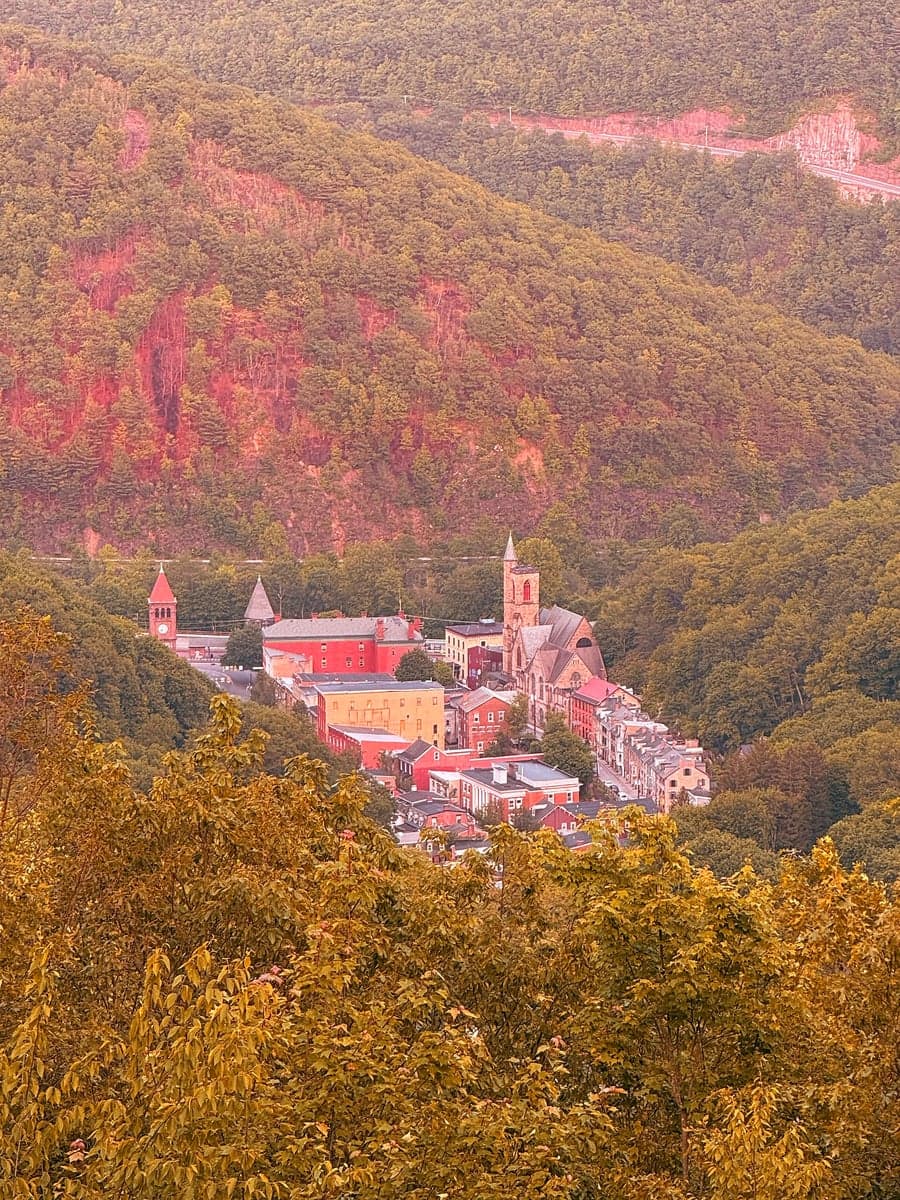
The people of Jim Thorpe, Pennsylvania, today number 4,534 and form one of the most ethnically homogeneous communities in the state, with a population that is 99.0% white and only 0.4% foreign-born. This is a tight-knit, historically rooted town where family names trace back to 19th-century immigrant waves, and the local identity is deeply tied to the region's coal and railroad heritage. Despite its small size, the borough punches above its weight as a tourist destination, drawing visitors to its historic downtown and scenic Lehigh Gorge setting, which has begun to attract a modest influx of second-home buyers and remote workers.
How the city was settled and grew
Jim Thorpe was originally founded as two separate boroughs—Mauch Chunk and East Mauch Chunk—in the early 19th century, with the current name adopted in 1954. The area's first significant population wave arrived in the 1820s and 1830s, drawn by the discovery of anthracite coal and the construction of the Lehigh Canal. Irish immigrants were the first major group to settle, building the canal and working the early mines; they concentrated in the Historic District along Broadway and in the working-class neighborhoods near the Lehigh River, such as Lower Mauch Chunk. By the 1850s and 1860s, a second wave of German and Welsh immigrants arrived, many skilled as miners and engineers, establishing themselves in the East Mauch Chunk side of town, particularly around Center Avenue and the hillside streets above the railroad yards. The railroad boom of the 1870s, led by the Lehigh Valley Railroad, brought a smaller influx of Italian and Eastern European laborers, who settled in the Packer Hill neighborhood, named after the railroad magnate Asa Packer. By 1900, the population had peaked near 5,000, and the town's ethnic enclaves were firmly established: Irish in the river wards, Germans and Welsh on the east side, and Italians on the hill. The decline of coal after World War I halted large-scale immigration, and the borough's demographic character has remained remarkably stable ever since.
Modern era (post-1965)
After the 1965 Hart-Cellar Act, Jim Thorpe saw virtually no new international immigration, a pattern that continues today with a foreign-born share of just 0.4%. The post-1965 period instead brought domestic shifts. The collapse of the coal industry in the 1950s and 1960s triggered a steady out-migration of younger residents, leaving an aging, predominantly white population. The 1970s and 1980s saw a modest counter-movement of urban escapees from New York and Philadelphia, attracted by cheap housing and the town's Victorian architecture; these newcomers concentrated in the Historic District, buying and restoring row houses along Race Street and Broadway. This trend accelerated after the 1990s, when the borough rebranded as a tourist destination, and the Upper Mauch Chunk neighborhood—the hillside area above the downtown—became a favored location for second-home owners and retirees. The Hispanic population, currently 0.9%, is a very recent and small presence, mostly concentrated in a handful of rental units near the Packer Hill area, while the Black population remains at 0.0%. The college-educated share, at 27.2%, is slightly below the national average, reflecting the town's working-class roots and the limited local job market outside tourism and services.
The future
Jim Thorpe's population is projected to remain stable or decline slightly over the next decade, as the aging white population is not being replaced by younger families or immigrants. The borough's extreme homogeneity—99.0% white—is unlikely to change significantly, given the lack of economic drivers to attract diverse populations and the high cost of housing in the Historic District, which has priced out many working-class families. The most notable demographic trend is the gradual increase in remote workers and second-home buyers, who are drawn by the town's scenery and proximity to New York and Philadelphia; these newcomers are settling in the Historic District and Upper Mauch Chunk, often displacing long-term residents. This is creating a cultural tension between preservation-minded newcomers and the established, more insular local community. The next 10-20 years will likely see a continued slow decline in year-round population, with the borough becoming more of a seasonal and weekend destination, while the core of full-time residents remains overwhelmingly white, older, and rooted in the town's coal-and-railroad past.
For someone moving in now, Jim Thorpe offers a deeply historic, scenic, and safe environment, but it is not a place of demographic change or diversity. The community is welcoming to those who respect its traditions, but newcomers should expect a population that is aging, culturally insular, and unlikely to become more diverse in the foreseeable future. The borough's future lies in balancing its tourist economy with the preservation of its tight-knit, historically white character.

* Values derived from national, state, county, city and local statistics and may differ in a specific area. Last updated: 2026-10-15T00:20:08.000Z
Narrative content on this page is AI-generated and may contain mistakes. Verify any details that matter before acting on them.
ReloMaps may earn a commission from affiliate links at no extra cost to you.

