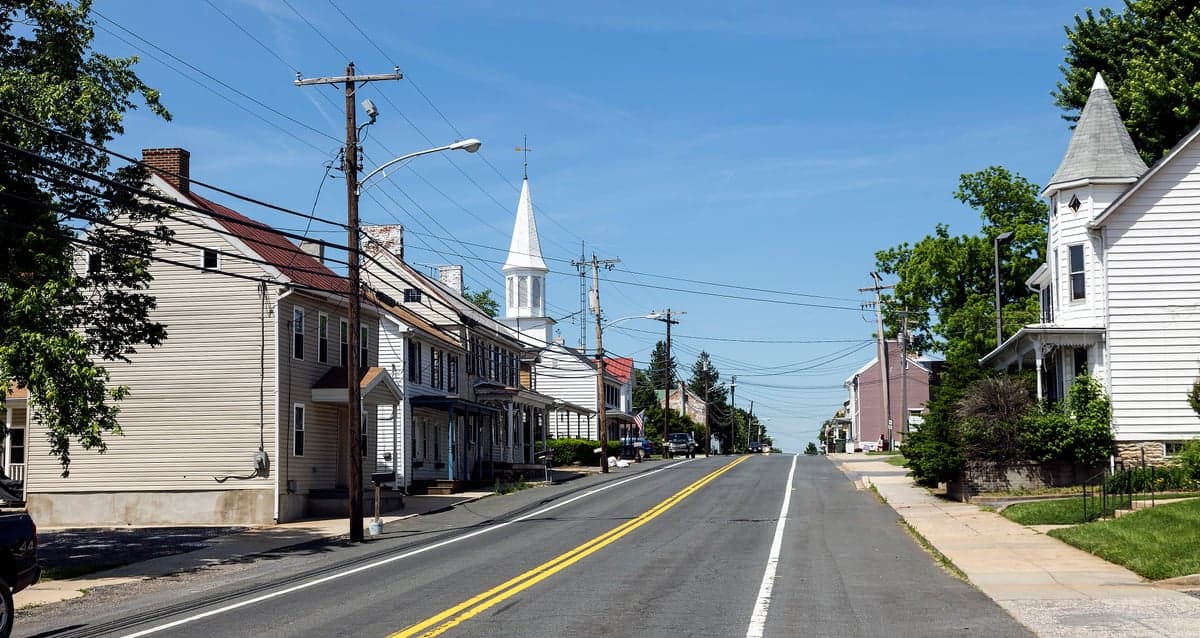
Photo: Wikipedia
Political ClimatePolitical Climate in Jefferson, MD
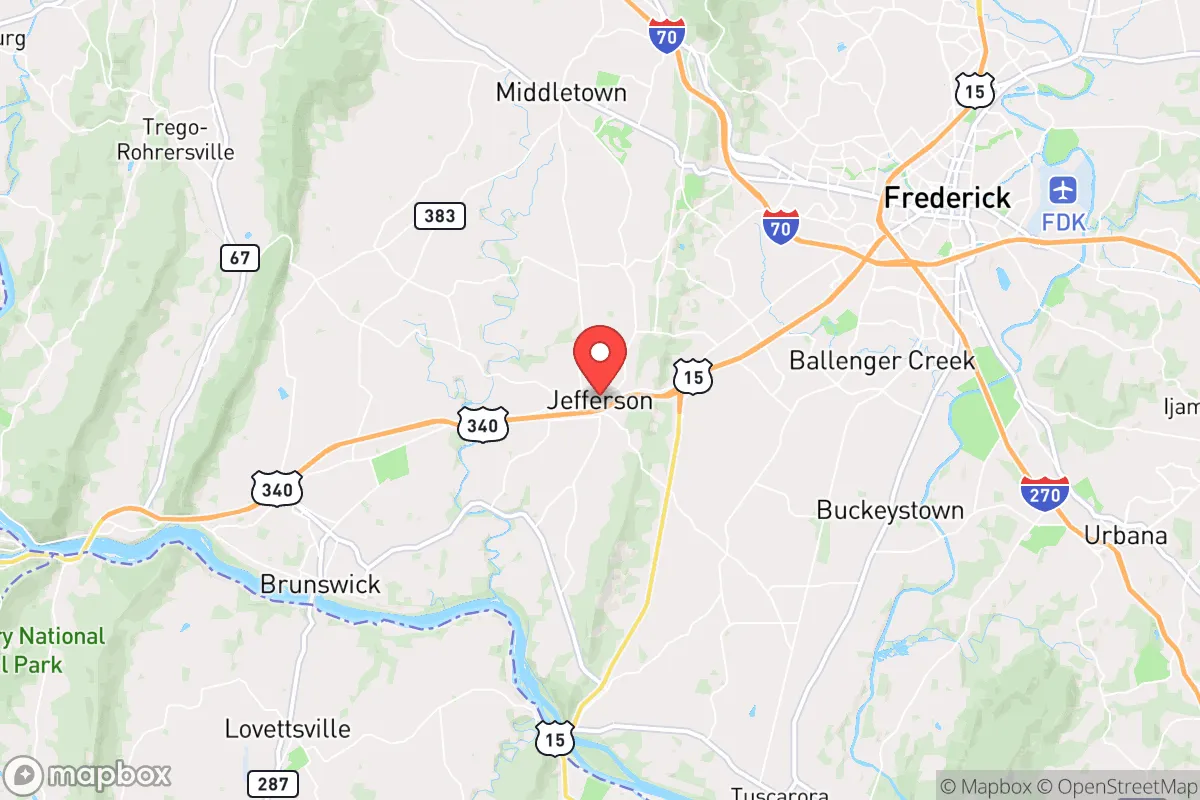
District shown is the primary district for this city’s centroid. Cities may span multiple districts.
Local Political AnalysisPolitical Analysis of Jefferson, MD
Jefferson, Maryland, sits in a political pocket that feels noticeably more moderate than the rest of the state. While Maryland as a whole carries a Cook PVI of D+17 — one of the most reliably Democratic states in the country — Jefferson’s own PVI of D+3 tells a different story. This isn't a deep-blue stronghold; it's a swing-adjacent community where elections are genuinely competitive. Over the past decade, the area has drifted slightly left, but it's still a place where a Republican candidate can win a local race or a Democratic one can lose if they take the vote for granted. The trajectory is toward a slow, steady blue shift, driven by newcomers from the D.C. suburbs, but the pace is glacial compared to the rest of Maryland.
How it compares
Drive 15 minutes east to Frederick City, and you're in a solidly Democratic environment (PVI around D+12). Head west toward Harpers Ferry or south to rural Loudoun County, Virginia, and the political landscape flips again — more conservative, more libertarian-leaning. Jefferson itself is a kind of fulcrum. In the 2024 presidential election, Frederick County as a whole went for the Democratic candidate by about 10 points, but Jefferson precincts were closer to a 5-point margin. That's a world away from the statewide 20-point Democratic advantage. The contrast is even sharper with nearby towns like Brunswick (more blue-collar, slightly more conservative) or Boonsboro (decidedly redder). Jefferson's D+3 rating means it's one of the few places in Maryland where a door-knocking campaign from either party can actually shift the outcome.
What this means for residents
For conservative residents, Jefferson offers a rare refuge in a deep-blue state. You can attend a local Republican club meeting without feeling like a minority, and your vote in county-level races actually carries weight. The downside? Statewide policies — like Maryland's strict gun laws, progressive tax structure, and renewable energy mandates — still apply, and there's little hope of flipping the state legislature. For liberal residents, Jefferson feels like a comfortable bubble where your views are the local norm, but you're still close enough to Frederick or D.C. for a more intense political scene. The practical effect is that local governance tends to be pragmatic. Zoning debates, school funding, and infrastructure projects get hashed out with less ideological baggage than in Annapolis. You won't see the kind of culture-war fights that dominate county commissions in, say, Carroll County to the north.
One cultural distinction worth noting: Jefferson's identity is still rooted in its agricultural and small-town history, which tempers the progressive impulses of newer arrivals. The annual Jefferson Ruritan Club events and the local volunteer fire company are as much a part of the social fabric as any political affiliation. This creates a "live and let live" atmosphere that's increasingly rare in Maryland. You'll find Trump signs and Harris signs on the same block, and people generally get along. The long-term outlook? If the D.C. exurban sprawl continues, Jefferson's D+3 could drift toward D+7 or D+8 over the next decade. But for now, it remains one of the state's most politically balanced communities — a place where your vote actually feels like it matters, no matter which party you belong to.

State Political ClimatePolitical Climate in Maryland
State Political AnalysisPolitical Environment in the State
Maryland is one of the most reliably Democratic states in the country, with a Cook Partisan Voting Index of D+17, meaning it votes about 17 points more Democratic than the national average. The state hasn't voted for a Republican presidential candidate since George H.W. Bush in 1988, and Democrats hold supermajorities in both chambers of the General Assembly. Over the past 20 years, the state has shifted further left, driven primarily by explosive population growth in the Washington, D.C., suburbs and the steady urbanization of the Baltimore metro area, while rural and exurban counties have become more Republican in response.
Urban vs. rural divide
The political map of Maryland is a textbook case of the urban-rural split. The entire state's Democratic margin is generated by the densely populated Washington, D.C., suburbs — Montgomery County and Prince George's County — which together cast roughly a third of the state's votes and consistently deliver 75-85% Democratic margins. Baltimore City is another Democratic stronghold, voting over 85% Democratic in recent cycles. The Baltimore suburbs — Baltimore County, Howard County, and Anne Arundel County — are more competitive but still lean Democratic, with Howard County trending blue as its population becomes more diverse and educated. The rural Eastern Shore and Western Maryland are the Republican heartland. Garrett County in the far west votes about 70% Republican, and Carroll County north of Baltimore is a reliable GOP base. A notable recent flip: Frederick County, once a Republican stronghold, has become a true swing county as D.C. commuters push north along the I-270 corridor, voting for Joe Biden in 2020 after backing Trump in 2016.
Policy environment
Maryland's policy environment is shaped by Democratic control of the governorship and legislature, with a tax-and-spend orientation that funds robust public services. The state has a progressive income tax with rates from 2% to 5.75%, plus local county income taxes that push the top combined rate to around 8.95%. Property taxes are moderate, but the state's high cost of living — especially in the D.C. suburbs — is a major factor for relocators. Education policy is a priority: Maryland consistently ranks in the top 5 nationally for K-12 spending per pupil, and the Blueprint for Maryland's Future law (2021) commits billions more to early childhood education, teacher pay, and career training. Healthcare is heavily regulated, with a state-based insurance exchange and expanded Medicaid under the Affordable Care Act. Election laws are among the most accessible in the country: no-excuse mail-in voting, same-day registration, and early voting are all standard. The state also has some of the strictest gun laws in the nation, including a ban on assault weapons, a handgun permit requirement that requires a "good and substantial reason" (though a 2022 Supreme Court ruling is challenging that), and universal background checks.
Recent policy direction
Over the past five years, Maryland has moved decisively left on several fronts. On gun and self-defense law, the General Assembly passed the Gun Safety Act of 2023, which bans firearms in most public places and requires a permit for concealed carry, directly responding to the Bruen decision. Parental and education rights have been a flashpoint: the state passed a law requiring all public schools to implement comprehensive sex education, including LGBTQ+ content, and the Board of Education adopted a policy that allows transgender students to participate in sports and use facilities matching their gender identity — both controversial among conservative families. On medical and bodily autonomy, Maryland has become a safe haven for abortion access, passing the Abortion Care Access Act in 2022, which expands who can perform abortions and requires most insurance plans to cover them without cost-sharing. Property rights are relatively strong, but the state's regulatory environment — especially around development in the Chesapeake Bay watershed — can be burdensome. Taxation is trending higher: the 2024 legislative session saw a new digital advertising tax and a proposed wealth tax on high earners, though the latter failed. Voting and ballot access continues to expand: the state now automatically mails a ballot application to every registered voter, and same-day registration is available at early voting centers.
Civil unrest & political movements
Maryland has a history of organized political activism on both sides. The 2020 George Floyd protests in Baltimore and the D.C. suburbs were large and occasionally violent, leading to property damage and a lasting debate over policing. The state's sanctuary policies are a major point of contention: Maryland has a "Trust Act" (2017) that limits local law enforcement's cooperation with federal immigration authorities, and several counties — including Montgomery and Prince George's — have declared themselves sanctuary jurisdictions. This has fueled a growing conservative backlash, particularly in the rural counties and on the Eastern Shore, where "Second Amendment sanctuary" resolutions have been passed in over a dozen counties. Election integrity has been a hot topic since 2020: while the state's mail-in voting system ran smoothly, conservative activists have raised concerns about ballot harvesting and the state's voter roll maintenance. The 2022 gubernatorial race saw a competitive Republican primary, with the more moderate Dan Cox losing to Democrat Wes Moore, but the GOP base remains energized in the rural areas. You'll see "Don't Tread on Me" flags and "Fight the Blueprint" signs in Western Maryland, while "Black Lives Matter" and "Protect Trans Kids" signs are common in the D.C. suburbs.
Projection
Over the next 5-10 years, Maryland's political trajectory is likely to continue leftward, but at a slower pace. The D.C. suburbs are still growing, with Montgomery County adding about 10,000 residents per year, and the demographic shift in Frederick County shows no signs of reversing. However, the state is also seeing an influx of conservative-leaning relocators from Northern Virginia and D.C. proper, who are priced out of the capital but still want to be within commuting distance — this could modestly boost the GOP in places like Harford County and Carroll County. The biggest wild card is the state's fiscal health: the Blueprint for Maryland's Future will require massive new spending, and the state's pension system is underfunded. If taxes rise significantly to pay for it, you could see a backlash that flips some suburban districts. But overall, expect Maryland to remain a solidly blue state, with the Democratic primary becoming the real battleground for most state-level offices.
For a conservative relocator, the bottom line is this: Maryland offers a high quality of life with excellent schools, strong job markets in the D.C. and Baltimore corridors, and beautiful natural areas, but you'll be living in a state where your political views are in the minority. You'll pay higher taxes, face strict gun laws, and see policies on education and social issues that may conflict with your values. The upside is that the state's political diversity means you'll find like-minded communities in the rural counties and exurbs, and the state's strong economy and public services are a tangible benefit. For a liberal relocator, Maryland is a comfortable fit: progressive policies are the norm, and the state's commitment to education, healthcare, and civil rights is genuine. Just be prepared for the cost of living, especially in the D.C. suburbs, and for the cultural divide between the urban core and the rural periphery.
* Values derived from national, state, county, city and local statistics and may differ in a specific area. Last updated: 2026-07-22T02:17:08.000Z
Narrative content on this page is AI-generated and may contain mistakes. Verify any details that matter before acting on them.
ReloMaps may earn a commission from affiliate links at no extra cost to you.

