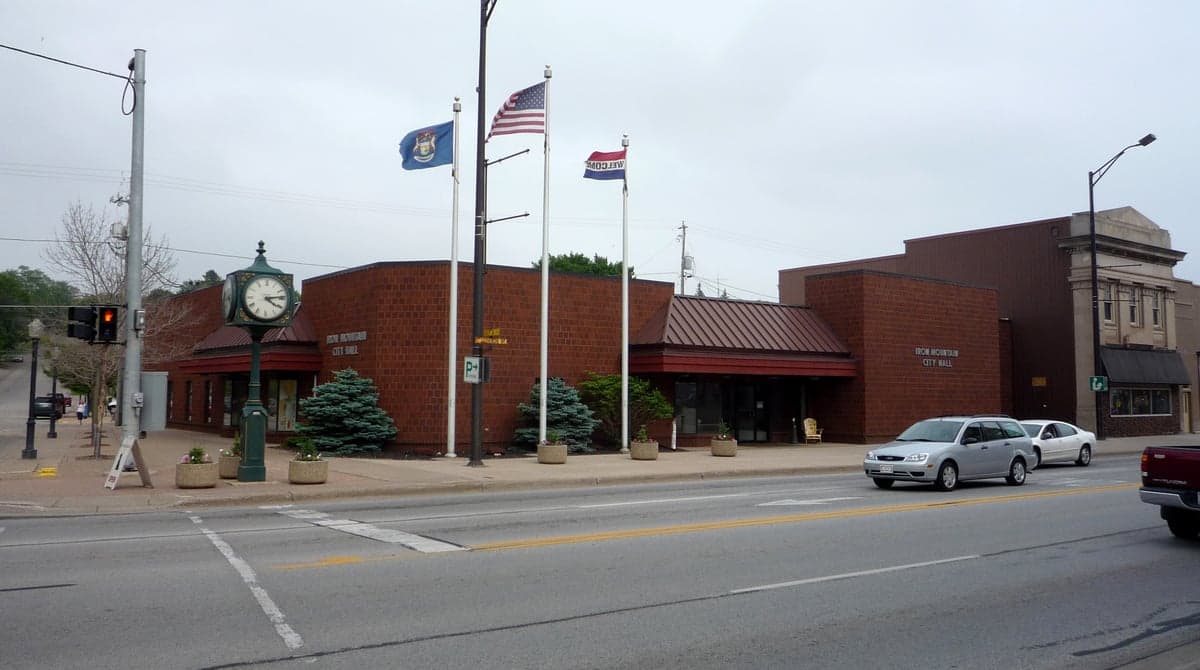
Photo: Wikipedia
Political ClimatePolitical Climate in Iron Mountain, MI
District shown is the primary district for this city’s centroid. Cities may span multiple districts.
Inherited from parent county — no local data available.
* Lean and PVI are calculated from Iron Mountain, MI’s own 2020 presidential results (precinct returns summed to the city), with 2024 estimated from the surrounding county’s 2020–2024 shift, Cook-style. Sources: state election offices; VEST 2020 precinct results (CC BY 4.0).
Political rankings in Michigan
- Most Conservative Cities in Michigan
- Most Liberal Cities in Michigan
- Best Liberal-Leaning Towns in the Midwest
- Safest Liberal-Leaning Towns in the Midwest
- Safest Conservative-Leaning Towns in the Midwest
- Affordable Small Towns for Conservatives
- Most Affordable Liberal-Leaning Small Towns in the U.S.
- Safest Conservative-Leaning Cities in the U.S.
- Most Conservative Counties in Michigan
- Most Liberal Counties in Michigan
Local Political AnalysisPolitical Analysis of Iron Mountain, MI
Iron Mountain leans heavily Republican, with a Cook PVI of R+18 that puts it far to the right of Michigan as a whole, which sits at EVEN. This isn't a recent shift—the area has been reliably red for decades, though the margin has widened since the 2010s as rural and industrial communities across the Upper Peninsula have moved further from the state's more competitive center. In the 2024 presidential race, Dickinson County, which contains Iron Mountain, voted for the Republican candidate by roughly 30 points, a gap that mirrors the local PVI and underscores how insulated the area is from statewide swings.
How it compares
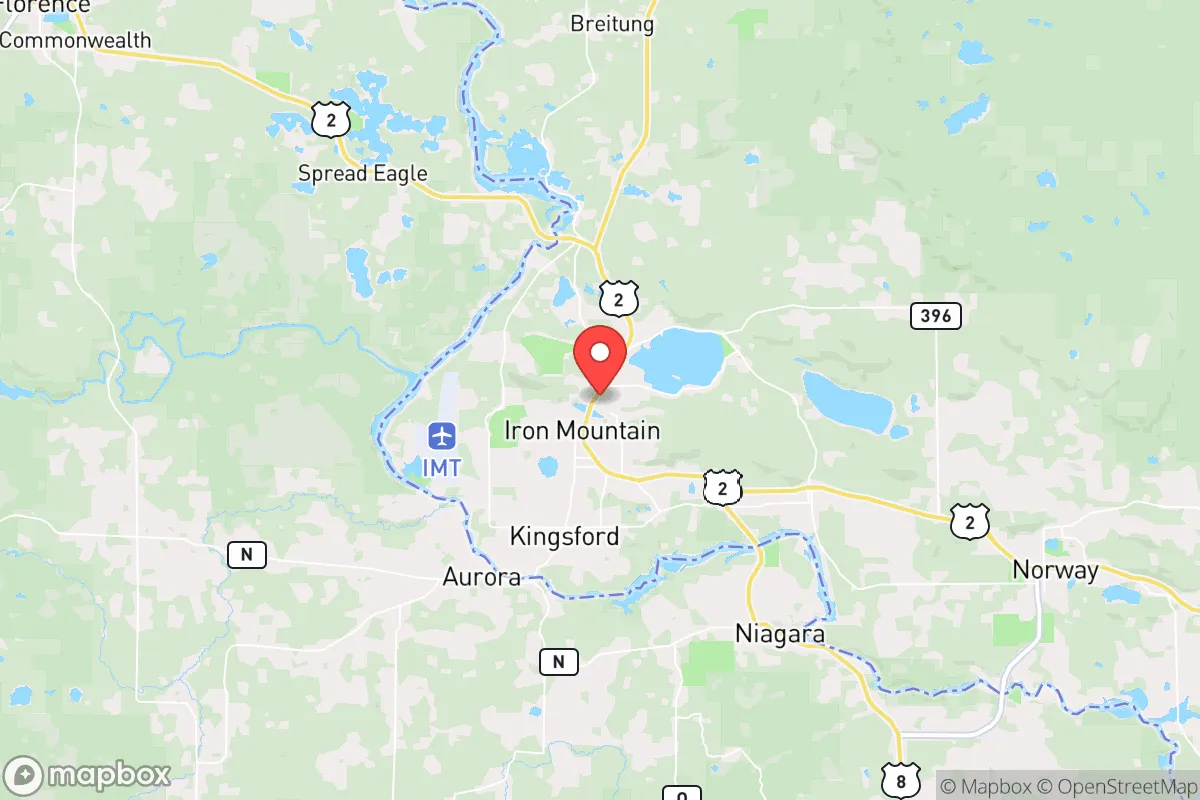
Compared to Michigan as a whole, Iron Mountain is an outlier. The state's EVEN rating reflects a battleground where Detroit, Ann Arbor, and Grand Rapids suburbs pull in opposite directions. Iron Mountain, by contrast, sits in the western Upper Peninsula, a region that votes more like rural Wisconsin or northern Minnesota than the rest of Michigan. Nearby cities like Escanaba (roughly 50 miles south) and Marquette (about 80 miles east) are more moderate—Marquette County has trended blue in recent cycles, voting for Democrats by single digits in 2024. Even within Dickinson County, Iron Mountain itself is slightly more moderate than the outlying townships, but the difference is marginal. The area's political identity is shaped by its economy—timber, mining, and manufacturing—and a cultural conservatism that aligns with the broader UP pattern, where union membership historically coexists with social traditionalism.
What this means for residents
For conservative residents, Iron Mountain offers a comfortable fit. Local government, school boards, and county commissions are reliably Republican, and policy debates tend to focus on taxes, land use, and infrastructure rather than the culture-war issues that dominate state-level politics. The area's R+18 lean means that Republican primaries are often the decisive elections, especially for county-level seats. For liberal residents, the reality is more isolating. There is no organized Democratic presence to speak of—the local party is small and largely inactive—and progressive viewpoints are rarely voiced in public forums. That said, the community is generally polite; political disagreements don't usually escalate into hostility, and most people keep their views private. The practical effect is that liberal residents often feel they have to self-censor in social or professional settings, particularly around hot-button issues like gun rights or abortion.
Culturally, Iron Mountain is distinct from the rest of Michigan in ways that go beyond voting. The area's Finnish and Scandinavian heritage, combined with a strong outdoor recreation ethic, creates a social fabric that values self-reliance and neighborliness over political activism. Policy-wise, the city has resisted some state-level trends—for example, local zoning remains permissive on hunting and firearm use, and there is little appetite for the kind of land-use regulations common in southern Michigan. The trajectory is toward deeper entrenchment: as the UP's population ages and younger residents move to college towns or downstate, the remaining electorate becomes more conservative. If anything, Iron Mountain's R+18 rating may understate its current lean, as the area's political gravity continues to pull rightward even as Michigan as a whole remains a toss-up.

State Political ClimatePolitical Climate in Michigan
State Political AnalysisPolitical Environment in the State
Michigan is the ultimate swing state, with a Cook PVI of EVEN that perfectly captures its knife-edge balance. Over the past 20 years, it has voted for the winner in every presidential election, but the coalition has shifted dramatically: the old blue wall of union auto workers and Detroit has cracked, while the western side of the state and exurban areas have turned redder. The result is a state where a few thousand votes in Macomb County or Kent County decide the entire national map, and where both parties have learned to fight tooth and nail for every precinct.
Urban vs. rural divide
The political map of Michigan is a story of three distinct regions. Southeast Michigan, anchored by Detroit and its inner-ring suburbs like Southfield and Dearborn, is a Democratic stronghold that delivers massive vote margins. Wayne County alone often provides 70-80% of the Democratic statewide margin. In contrast, the western side of the state — particularly Grand Rapids and the lakeshore counties like Ottawa and Kent — has become a Republican powerhouse. Ottawa County is one of the most reliably GOP counties in the nation, often voting 60%+ Republican. The real battleground is the "blue wall" of working-class suburbs like Macomb County (north of Detroit) and Genesee County (Flint). These areas flipped from Obama to Trump in 2016 and then back to Biden in 2020, making them the most volatile swing voters in the country. Up north, the Traverse City region and the Upper Peninsula lean Republican but are less reliable, often splitting tickets in state races.
Policy environment
Michigan’s policy environment is a patchwork that reflects its divided politics. The state has a flat income tax of 4.25%, which was reduced from 4.35% in 2023 via a trigger law. Property taxes are moderate, with a unique "Headlee Amendment" that caps annual increases. Sales tax is 6%, with no local add-ons. On education, Michigan has a robust school choice system — charter schools are widespread, and there is no cap on their growth. The state also has a universal school voucher-like program through the "Michigan Education Trust" and a growing number of "schools of choice" districts. Healthcare policy is mixed: the state expanded Medicaid under the Affordable Care Act, but also has a strong Right to Work law (repealed in 2023 for private-sector workers, but still in effect for public employees). Election laws are a flashpoint: Michigan now has no-excuse absentee voting, nine days of early voting, and automatic voter registration, all passed via a 2022 ballot initiative. Gun laws are relatively permissive — no permit required to carry a concealed firearm (constitutional carry passed in 2023), but there are universal background checks for handgun purchases and a red flag law (extreme risk protection order) enacted in 2023.
Recent policy direction
The last two years have seen a dramatic swing leftward under Governor Gretchen Whitmer and a Democratic trifecta (2023-2024). Key legislation includes: repeal of the 2012 Right to Work law for private-sector workers, expansion of the Elliott-Larsen Civil Rights Act to include sexual orientation and gender identity, repeal of the 1931 abortion ban (codified via a 2022 ballot measure), and passage of a red flag law allowing courts to temporarily seize firearms from individuals deemed a threat. On the other hand, the 2023 constitutional carry law was a major win for gun rights advocates, allowing concealed carry without a permit. Parental rights have been a battleground: the state passed a law requiring schools to notify parents if a child requests a name or pronoun change, but it was vetoed by Whitmer. Property rights remain strong — Michigan has no statewide rent control, and zoning is largely local. On voting, the 2022 ballot proposal (Prop 2) expanded early voting and absentee access, but also required voter ID for in-person voting (a compromise that satisfied neither side fully). The overall direction is a state that is moving left on social and labor issues but remains moderate on taxes and property rights.
Civil unrest & political movements
Michigan has been a national flashpoint for political activism. The 2020 lockdown protests at the state capitol in Lansing, where armed demonstrators entered the building, became a symbol of the anti-lockdown movement nationwide. The Wolverine Watchmen kidnapping plot against Governor Whitmer in 2020 exposed the extreme fringe of anti-government sentiment. On the left, the Michigan Democratic Party has been energized by labor unions and the "Rise Up" movement, which successfully pushed the 2022 abortion rights and voting rights ballot measures. Immigration politics are relatively quiet — Michigan is not a border state, but there are sanctuary city policies in Ann Arbor and Detroit, while Macomb County has passed symbolic resolutions opposing sanctuary policies. Election integrity remains a hot-button issue: the 2020 election in Michigan was the subject of numerous lawsuits and audits, with the Republican-led Senate Oversight Committee ultimately finding no evidence of widespread fraud, but many GOP voters remain skeptical. The Antrim County clerical error (a software glitch that briefly showed Biden losing the county) became a national conspiracy theory. A new resident will notice the "I Voted" stickers everywhere during elections, and the constant presence of campaign ads — Michigan is the most heavily advertised state in presidential cycles.
Projection
Over the next 5-10 years, Michigan is likely to remain a battleground, but the demographics are shifting slowly. The Grand Rapids metro area is growing faster than Detroit, adding more conservative-leaning voters, while the Detroit population continues to decline. However, the Ann Arbor and Lansing areas are becoming more liberal as university populations and tech workers move in. The biggest wildcard is the Macomb County voter — these working-class, culturally conservative but economically populist voters could swing either way depending on national trends. The 2024 election will be a key test: if Trump wins Michigan again, the state could drift right; if Biden holds it, the Democratic coalition may solidify. The state's independent redistricting commission, created by a 2018 ballot measure, has produced competitive congressional maps, meaning neither party will have a structural advantage. For a new resident, expect the political climate to remain intensely competitive, with constant campaigning, high turnout, and a state government that could flip control every two years.
For someone moving to Michigan, the practical takeaway is that your experience will vary dramatically by location. If you settle in Grand Rapids or Traverse City, you'll find a conservative, family-oriented environment with strong churches and a business-friendly vibe. If you land in Ann Arbor or Detroit, you'll be in a liberal bubble with progressive policies on everything from housing to policing. The suburbs of Macomb County and Oakland County are the true swing areas — expect to hear both sides constantly. The state's tax burden is moderate, but the regulatory environment can shift quickly depending on who controls Lansing. If you value low taxes and gun rights, the western side of the state is your best bet. If you prioritize public transit, walkable cities, and progressive social policies, the southeast is more aligned. Either way, you'll be living in a state that decides the presidency, so get ready for a lot of yard signs and door-knockers every two years.
* Values derived from national, state, county, city and local statistics and may differ in a specific area. Last updated: 2026-11-22T18:55:42.000Z
Narrative content on this page is AI-generated and may contain mistakes. Verify any details that matter before acting on them.
ReloMaps may earn a commission from affiliate links at no extra cost to you.

