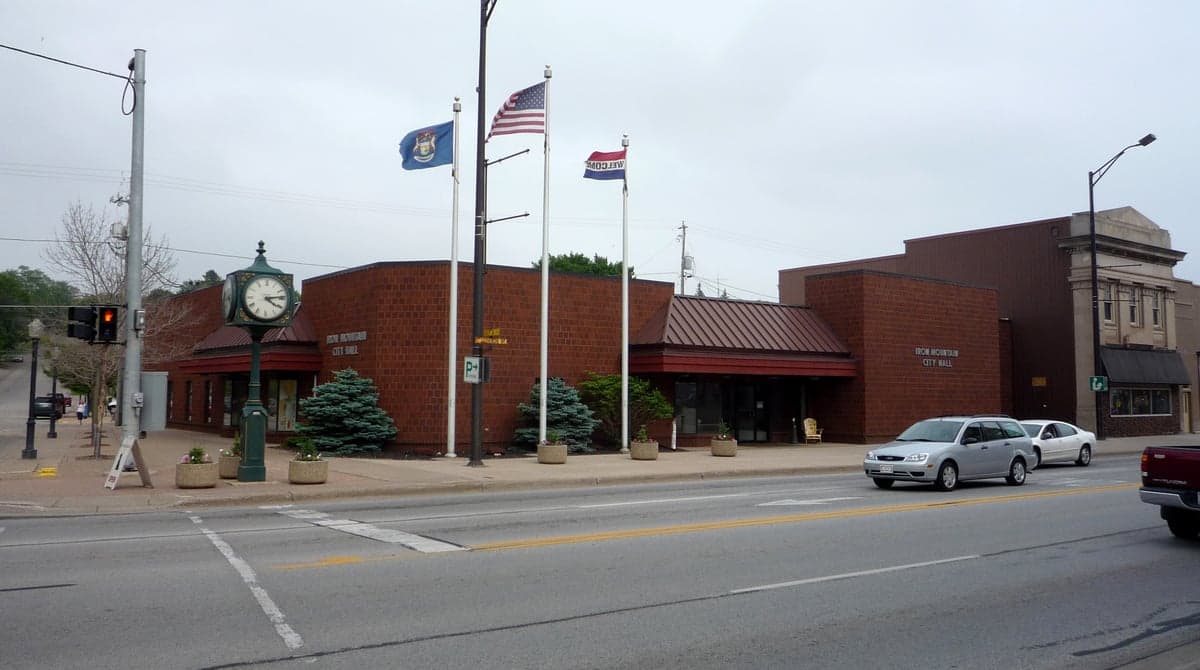
Photo: Wikipedia
Demographics of Iron Mountain, MI
Affluence Level in Iron Mountain, MI
A middle-class area roughly in line with national averages across income, home values, education, and employment.
People of Iron Mountain, MI
Iron Mountain, Michigan, is a city of 7,508 residents that remains overwhelmingly white (90.9%) and native-born (98.6% U.S.-born), with a small but growing Hispanic population (2.7%) and modest Black (1.7%) and Indian-subcontinent (0.8%) communities. Its people are defined by a strong Finnish and Italian immigrant heritage, a blue-collar work ethic rooted in iron mining and forestry, and a conservative-leaning cultural identity that prizes self-reliance and community ties. The city feels older than its population suggests—median age hovers around 45—and its character is one of quiet stability rather than rapid change.
How the city was settled and grew
Iron Mountain’s human history begins with the Menominee people, who used the region for seasonal hunting and fishing before European-American settlers arrived in the 1850s following the discovery of rich iron ore deposits. The city’s name comes directly from the ore body itself—a massive iron formation that drew the first permanent wave of settlers: Cornish and Irish miners who arrived in the 1860s and 1870s. These early miners built their homes in the Downtown Iron Mountain area, near the original mine shafts and the Chicago & North Western Railway depot, establishing the city’s first commercial district along Stephenson Avenue. A second, larger wave came between 1880 and 1910, when Finnish immigrants—fleeing Russian conscription and land shortages—arrived in force to work the mines and clear the forests. They settled in what became known as Finn Town, a neighborhood roughly bounded by A Street, B Street, and the railroad tracks, where Finnish-language newspapers, saunas, and cooperative stores thrived well into the 1930s. Italian immigrants followed in the 1900s-1910s, working as miners and railroad laborers, and concentrated in East Iron Mountain (also called the East Side), a working-class district east of the Menominee River that still retains a distinct Italian-American identity through its Catholic church, Immaculate Conception, and annual spaghetti dinners. By 1920, the city’s population peaked at nearly 12,000, driven by World War I-era demand for steel. The Finnish and Italian communities remained largely separate through the mid-20th century, each with its own social halls, churches, and mutual-aid societies.
Modern era (post-1965)
After the 1965 Hart-Cellar Act, Iron Mountain saw virtually no new immigration—its foreign-born population today is just 1.4%, far below the national average. Instead, the post-1965 story is one of domestic out-migration and suburbanization. The mining industry mechanized and consolidated, shedding jobs; the city’s population fell from 11,000 in 1960 to 7,500 by 2020. The children and grandchildren of the Finnish and Italian families moved to newer subdivisions like Pine Grove (a 1970s-era development west of US-2) and Lake Antoine Shores (a lakeside area on the city’s northern edge), leaving the older ethnic neighborhoods to age in place. The small Hispanic population (2.7%) is largely a post-2000 phenomenon, drawn by seasonal work in forestry, construction, and the region’s tourism industry; they are dispersed across the city rather than concentrated in any single neighborhood. The Black community (1.7%) is mostly composed of military families stationed at nearby KI Sawyer Air Force Base (closed in 1995) who chose to stay, and they live primarily in the West Side near the former base. The Indian-subcontinent population (0.8%) is a very recent arrival—mostly professionals working at the Dickinson County Healthcare System or Michigan Technological University in nearby Houghton—and they are scattered, with no ethnic enclave. The East/Southeast Asian community (0.4%) is similarly small and dispersed, largely tied to the university and hospital.
The future
Iron Mountain’s population is projected to continue a slow decline—the state demographer estimates a 3-5% drop by 2035—driven by an aging population (median age 45) and limited job growth outside healthcare and tourism. The city is becoming slightly more diverse, but from a very low base: the Hispanic share is expected to rise to 4-5% by 2040, and the Indian-subcontinent share may grow to 1.5-2% as the hospital expands. No new ethnic neighborhoods are forming; new residents of any background tend to settle in the Pine Grove and Lake Antoine Shores subdivisions, which are the only areas with new housing construction. The cultural identity is slowly shifting from a purely Finnish-Italian mining town to a broader Upper Peninsula identity that incorporates outdoor recreation (skiing, hunting, ATV trails) as a unifying force. The city’s conservative lean is likely to persist, as the small influx of new residents tends to be families and retirees seeking lower taxes and a slower pace of life.
For someone moving in now, Iron Mountain offers a stable, safe, and culturally cohesive community with a strong sense of place—but one that is aging and slowly shrinking. New arrivals will find a welcoming but insular population, where fitting in means embracing the region’s outdoor lifestyle and respecting its working-class roots. The city is not becoming a diverse melting pot; it is becoming a quieter, more homogeneous version of its former self, with a modest Hispanic infusion adding a small measure of change.

* Values derived from national, state, county, city and local statistics and may differ in a specific area. Last updated: 2026-11-22T18:55:42.000Z
Narrative content on this page is AI-generated and may contain mistakes. Verify any details that matter before acting on them.
ReloMaps may earn a commission from affiliate links at no extra cost to you.

