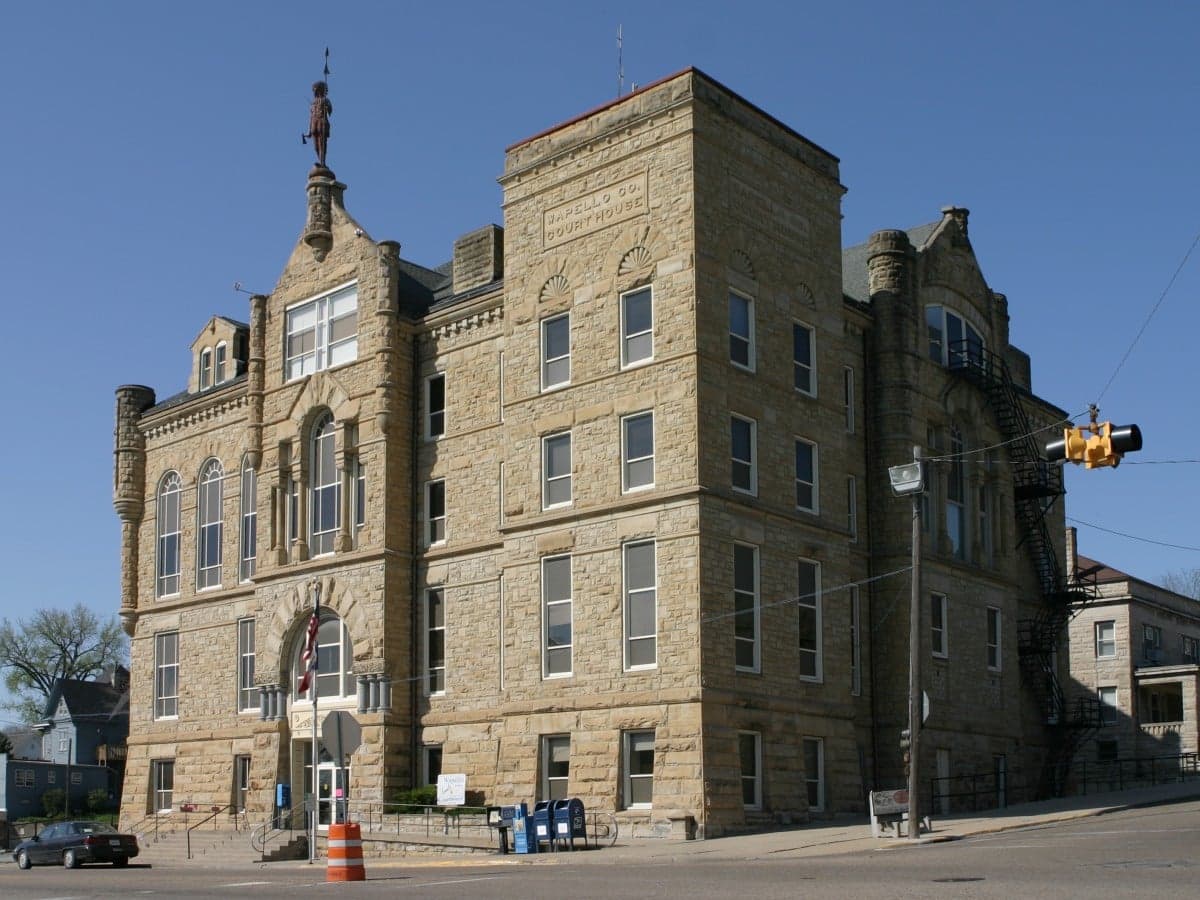
Photo: Wikipedia
Political ClimatePolitical Climate in Wapello County
Showing district-level results — no local-only data available.
Local Political AnalysisPolitical Analysis of Wapello County
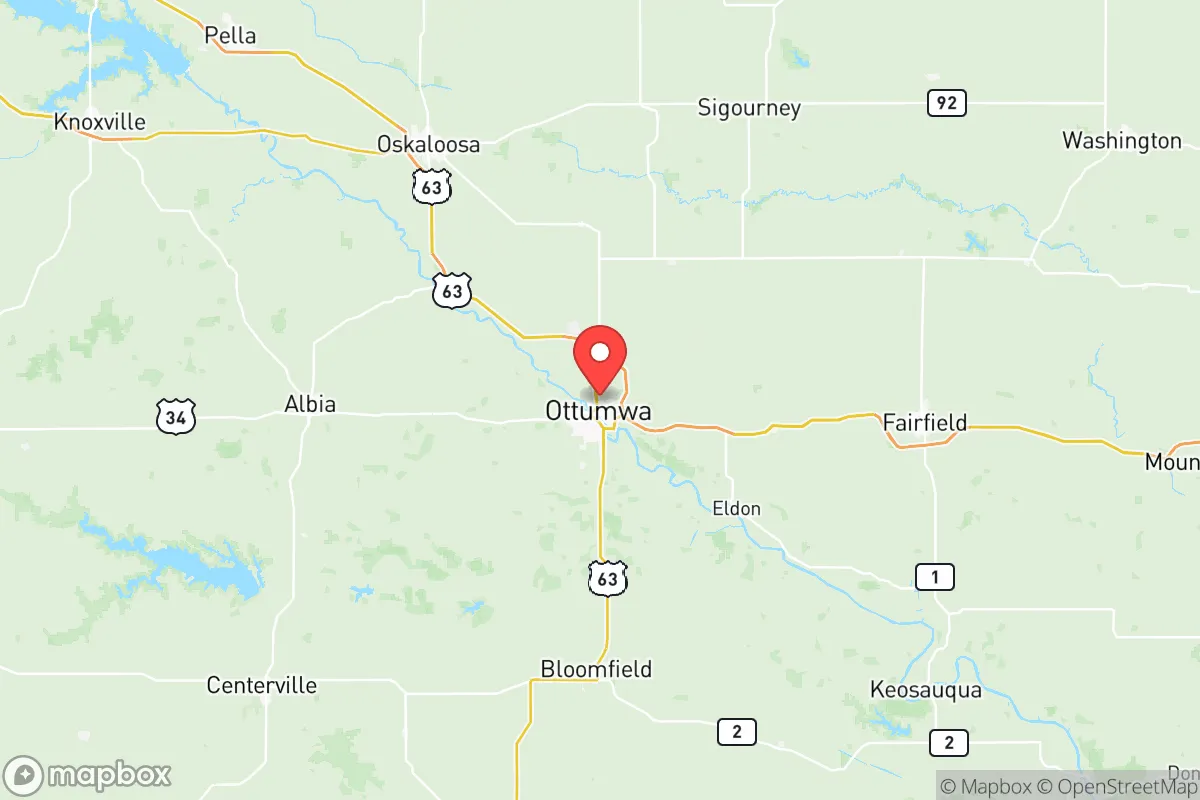
Wapello County, anchored by the city of Ottumwa, is a classic swing county in a state that has shifted decisively to the right. While Iowa as a whole carries a Cook PVI of R+6, Wapello County sits at a much tighter R+2, making it one of the few remaining competitive areas in southeastern Iowa. The county has a long history of backing the winner in presidential elections, but that bellwether status is fraying as the rural-urban divide deepens. In 2020, Donald Trump carried the county by just under 4 points, a far cry from the double-digit margins he posted in most of the rest of the state, and a sign that the old Democratic coalition of union labor and rural voters still has a pulse here, even if it's weakening.
How it compares
The political geography of Wapello County tells the real story. Ottumwa itself is the main blue-leaning population center, where precincts around the John Deere Ottumwa Works plant and the older working-class neighborhoods near the Des Moines River still vote reliably Democratic in local races. In contrast, the smaller towns and rural townships—places like Eldon (of "American Gothic" fame), Blakesburg, and Chillicothe—have swung hard to the right over the past decade. The swing precincts are in the suburban-style developments just outside Ottumwa city limits, like the area around Bridge View Center and the newer subdivisions along Highway 63. These precincts voted for Obama in 2012, then flipped to Trump in 2016 and 2020, mirroring the statewide trend but at a slower pace. Compared to Iowa's R+6 rating, Wapello County's R+2 means it is roughly 8 points more Democratic-leaning than the state average, a gap that has actually widened slightly since 2016 as the rest of Iowa moved right faster than this county did.
What this means for residents
For conservative residents, the county's lean means they can expect to win most countywide races—sheriff, supervisors, auditor—but they can't take it for granted. The Ottumwa City Council often has a Democratic majority, and local school board races are genuinely competitive. For liberal residents, the picture is more mixed: they can reliably win city-level races in Ottumwa, but countywide and state legislative seats are an uphill climb. The practical effect is that both sides have to actually campaign here. You don't see the kind of automatic, unopposed elections that happen in deep-red counties like neighboring Davis or Van Buren. The county's status as a swing area also means that both parties invest in get-out-the-vote operations here, so residents get more mailers, more door-knockers, and more candidate events than they would in a safe seat.
Culturally, Wapello County is a place where the old and new politics rub against each other. The John Deere plant remains the economic and political anchor, and its union hall is still a force in local Democratic politics, but the union's influence has waned as the workforce has shrunk. The county is also home to the Indian Hills Community College, which brings in a younger, more transient population that tends to lean left, but that effect is muted by the steady growth of retirees moving into the area from more expensive parts of the state. On policy, the county has been a battleground over renewable energy—wind farms have been proposed in the rural townships, sparking fierce debates between landowners who want the lease payments and neighbors who oppose the visual impact. It's a microcosm of the larger state dynamic: a place where the old manufacturing economy still shapes the political DNA, but where the forces reshaping Iowa—agricultural consolidation, rural depopulation, and the rise of the Des Moines suburbs—are slowly but surely pulling the county rightward, just at a slower pace than the rest of the state.

State Political ClimatePolitical Climate in Iowa
State Political AnalysisPolitical Environment in the State
Iowa has been a reliably Republican state for the past decade, carrying a Cook PVI of R+6, but its politics are more nuanced than a simple red label suggests. The state was a genuine battleground as recently as 2012, when Barack Obama won it twice, but a sharp rightward shift over the last three cycles has cemented GOP dominance at the state level. Today, the Republican trifecta in Des Moines drives policy, but the state’s political soul remains split between a handful of growing blue metros and a vast, deeply conservative rural expanse.
Urban vs. rural divide
The political map of Iowa is a textbook study in urban-rural polarization. The state’s two largest metros, Des Moines and Iowa City, are the Democratic strongholds. Polk County (Des Moines) voted for Joe Biden in 2020 by about 12 points, and Johnson County (Iowa City) went for Biden by a staggering 40 points. These are the islands of blue in a red sea. Meanwhile, the rest of the state leans heavily Republican. Counties like Sioux County in the northwest, home to a large conservative Dutch Reformed population, routinely vote 80%+ Republican. The shift is most visible in smaller industrial cities: Dubuque and Council Bluffs were once competitive blue-collar Democratic areas but have moved decisively right over the past two cycles. The suburbs around Des Moines, like Ankeny and Waukee, are the true battlegrounds—fast-growing, affluent, and trending slightly more competitive, though they still lean Republican overall. If you’re moving to Iowa, your immediate political environment will depend almost entirely on whether you land in the Des Moines metro, a college town like Ames or Iowa City, or a small farming community.
Policy environment
Iowa’s policy environment is defined by a low-tax, limited-government philosophy that has been aggressively pursued since the GOP took full control in 2017. The state has a flat income tax rate of 3.8% (phasing down to 3.5% by 2027), no inheritance tax, and property taxes that are among the lowest in the Midwest. On education, Iowa passed a universal school voucher program in 2023—called the Students First Act—allowing any family to use public funds for private or homeschool expenses. This was a major win for school-choice advocates and a flashpoint for rural districts worried about funding. Healthcare policy has been more mixed: Iowa expanded Medicaid under the Affordable Care Act in 2014, but the state has also pursued work requirements for able-bodied adults on the program, a move that was blocked by courts. Election laws tightened in 2021 with a law reducing early voting days, closing polls at 8 p.m. instead of 9 p.m., and requiring stricter voter ID. For a relocator, the practical takeaway is that Iowa is a state where conservative policy priorities are enacted quickly and with little resistance from the legislature.
Recent policy direction
The last three years have seen Iowa move decisively on a broad front of cultural and liberty-related issues. On gun rights, Iowa became a permitless carry state in 2021, meaning any law-abiding adult can carry a concealed firearm without a permit or training. On parental rights and education, the 2023 law banning instruction on sexual orientation and gender identity through sixth grade (SF 496) was one of the strictest in the nation. On medical and bodily autonomy, Iowa passed a six-week abortion ban in 2023, which was briefly blocked by courts but reinstated by the Iowa Supreme Court in 2024; abortion is now effectively banned after cardiac activity is detected, around six weeks. On property rights, the state has been friendly to landowners, with strong eminent domain protections and no statewide rent control. On privacy and surveillance, Iowa passed a consumer data privacy law in 2023 giving residents the right to access, delete, and opt out of the sale of their personal data. On voting and ballot access, the 2021 law (SF 413) shortened the early voting window and imposed stricter ID requirements, which critics say reduces turnout but supporters argue ensures integrity. The overall direction is unmistakable: Iowa is moving toward a model of maximum individual liberty on guns, education, and property, while restricting abortion and tightening election procedures.
Civil unrest & political movements
Iowa is not a state known for frequent civil unrest, but it has seen organized political movements on both sides. The most visible flashpoint in recent years was the 2023-2024 debate over the six-week abortion ban, which drew large, peaceful protests to the Iowa State Capitol in Des Moines, with both pro-choice and pro-life groups holding regular rallies. On the right, the state has a strong network of conservative activist groups, including The Family Leader and Iowans for Tax Relief, which have been instrumental in pushing the school voucher and tax cut agendas. On immigration, Iowa has no sanctuary cities, and the state passed a law in 2024 requiring local law enforcement to cooperate with federal immigration authorities. There has been no serious secession or nullification rhetoric in Iowa. Election integrity was a hot topic after 2020, but the 2021 voting law largely satisfied Republican concerns, and there have been no major controversies in subsequent elections. A new resident would notice that political engagement is high—Iowa’s first-in-the-nation caucuses mean that presidential candidates visit regularly, and local politics are taken seriously, but the state is generally orderly and civil compared to coastal flashpoints.
Projection
Over the next 5-10 years, Iowa’s political trajectory is likely to remain solidly Republican, but with some interesting demographic wrinkles. The Des Moines metro is growing steadily, attracting younger, more diverse residents who lean slightly more Democratic, but the rural areas are shrinking and aging, which amplifies the GOP vote share. The net effect is that Iowa will probably stay R+6 or even move slightly redder, as the rural exodus continues. In-migration is modest—Iowa isn’t a boom state like Texas or Florida—but the people who do move in tend to be retirees or remote workers seeking lower costs, which often aligns with conservative preferences. The wild card is the suburbs: if Ankeny and Waukee continue to grow and diversify, they could become competitive in a decade, but for now, the GOP’s grip on the legislature and governor’s office looks secure. Someone moving in now should expect a state where conservative policy will continue to be enacted, but where the Des Moines and Iowa City areas will remain progressive enclaves with their own local dynamics.
For a new resident, the bottom line is that Iowa offers a clear political choice. If you’re a conservative, you’ll find a state government that is actively enacting your priorities on taxes, education, guns, and abortion. If you’re a liberal, you’ll find strong communities in Des Moines, Iowa City, and Ames where your values are shared, but you’ll be living under state laws you likely oppose. The practical reality is that Iowa is a low-drama, high-predictability state politically—what you see is what you get, and the direction isn’t likely to change soon. Your day-to-day life will be shaped more by your local community than by state politics, but the state-level framework is firmly conservative and likely to remain so.
* Values derived from national, state, county, city and local statistics and may differ in a specific area. Last updated: 2026-07-16T18:25:32.000Z
Narrative content on this page is AI-generated and may contain mistakes. Verify any details that matter before acting on them.
ReloMaps may earn a commission from affiliate links at no extra cost to you.

