Photo: Wikipedia
Demographics of Van Buren County
Affluence Level in Van Buren County
A middle-class area roughly in line with national averages across income, home values, education, and employment.
People of Van Buren County
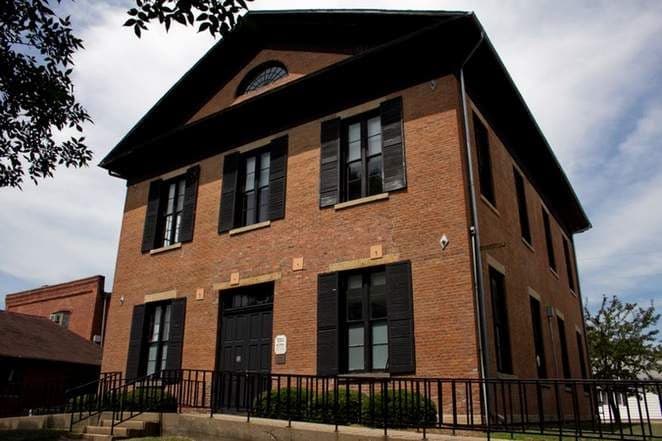
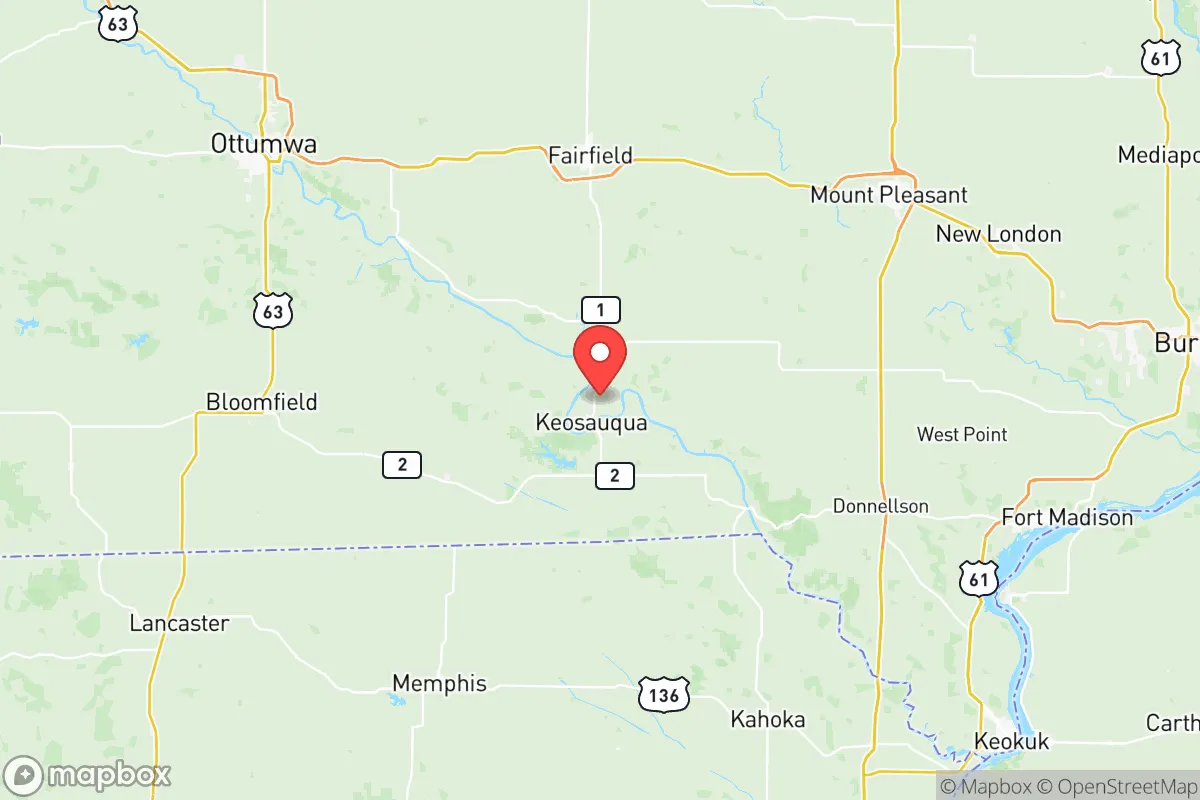
Van Buren County, Iowa, is home to 7,236 residents, making it one of the state's least densely populated counties. The population is overwhelmingly white (94.6%) and native-born, with only 0.5% foreign-born, reflecting a deep-rooted, generational community. Its distinctive identity is shaped by a blend of Yankee and German heritage, a strong agricultural economy, and a network of small towns like Keosauqua, Farmington, and Birmingham that have retained their 19th-century character.
Settlement & growth (pre-1960)
Before American settlement, the land that is now Van Buren County was part of the traditional territory of the Sauk and Meskwaki (Fox) nations. These groups used the Des Moines River valley for seasonal hunting and fishing, but no permanent large villages existed within the county's boundaries. The area was ceded to the United States in the 1832 Black Hawk Purchase, opening it to Euro-American settlement.
The first wave of settlers arrived in the mid-1830s, primarily Yankees from New England and upstate New York. These families were drawn by the promise of cheap, fertile land along the Des Moines River. They founded the county seat of Keosauqua in 1836, naming it after a Sauk chief, and established Farmington (1837) and Birmingham (1837) as river and stagecoach towns. The Yankees brought a tradition of small-scale mixed farming, Protestant congregationalism, and a commitment to public education that shaped the county's early institutions.
A second, larger wave of German immigrants began arriving in the 1850s and continued through the 1880s. These settlers, many from the Rhineland and Bavaria, were attracted by the availability of farmland and the construction of the Keokuk & Des Moines Railroad through the county. They established the towns of Stockport (1853) and Douds (1854), as well as the unincorporated community of Mount Zion. The Germans brought a strong Catholic and Lutheran presence, and their farming practices—emphasizing livestock and diversified crops—complemented the Yankee grain economy. By 1880, German-Americans made up roughly a third of the county's population.
A smaller but notable group of Irish immigrants arrived in the 1850s and 1860s, many working as laborers on the railroad and in the coal mines that briefly operated near Cantril and Milton. The Irish population never exceeded 5% of the total, but they established St. Mary's Catholic Church in Keosauqua and left a lasting imprint on the county's religious landscape.
The county's population peaked at 17,140 in 1900, then began a long decline as agricultural consolidation reduced the need for farm labor and younger generations moved to cities. The Dust Bowl and Great Depression of the 1930s accelerated this outmigration, but the county's remaining population remained remarkably stable in its ethnic composition: overwhelmingly white, native-born, and of Yankee or German descent.
Modern era (post-1965)
The 1965 Hart-Cellar Act, which reshaped American immigration, had virtually no effect on Van Buren County. The foreign-born population has remained below 1% for the entire post-1965 period, and the county saw no significant influx of immigrants from Asia, Latin America, or Africa. The 0.5% foreign-born share today is among the lowest in Iowa, and the county's East/Southeast Asian (0.2%), Indian subcontinent (0.0%), and Black (0.2%) populations are negligible.
The most significant demographic shift since 1965 has been domestic outmigration. The county's population fell from 9,778 in 1970 to 7,236 in 2020, a decline of 26%. Young adults have left for college and jobs in larger Iowa cities like Des Moines, Iowa City, and Burlington, while the remaining population has aged. The median age is now 46.3, well above the state average of 38.1. The Hispanic population, at 1.7%, has grown slightly since 2000, driven by a small number of migrant farmworkers and their families settling in Keosauqua and Farmington, but this remains a minor trend.
Suburbanization has not occurred in Van Buren County. There are no suburbs of a major city within its borders; the county remains rural and agricultural. The largest town, Keosauqua, has just 1,006 residents. The county's housing stock is older, and new construction is minimal. The college-educated share of the population is 19.4%, significantly below the state average of 29.3%, reflecting the outmigration of younger, more educated residents.
The future
Van Buren County's population is projected to continue declining slowly, with the state forecasting a drop to roughly 6,800 by 2040. The county is becoming slightly more diverse at the margins—the Hispanic share may reach 3-4% over the next decade—but it will remain overwhelmingly white and native-born. The aging of the population means that natural decrease (more deaths than births) will likely be the primary driver of population loss, rather than outmigration.
New residents are most likely to be retirees or remote workers seeking low-cost, rural living, drawn by the county's natural amenities along the Des Moines River and the Villages of Van Buren tourism corridor. These newcomers are dispersing across the county rather than concentrating in any one town, as high-speed internet becomes more available. The county's cultural identity—rooted in Yankee and German traditions, conservative politics, and a strong sense of local community—is likely to persist, as the small number of newcomers are demographically similar to the existing population.
For someone moving in now, Van Buren County offers a stable, predictable community where the population is small, aging, and deeply rooted. The county is not becoming more diverse or urban; it is becoming quieter and more rural. The trade-off is a low cost of living, low crime, and a strong sense of place, but with limited economic opportunity and a shrinking tax base that challenges local schools and services.

* Values derived from national, state, county, city and local statistics and may differ in a specific area. Last updated: 2026-10-17T20:20:16.000Z
Narrative content on this page is AI-generated and may contain mistakes. Verify any details that matter before acting on them.
ReloMaps may earn a commission from affiliate links at no extra cost to you.

