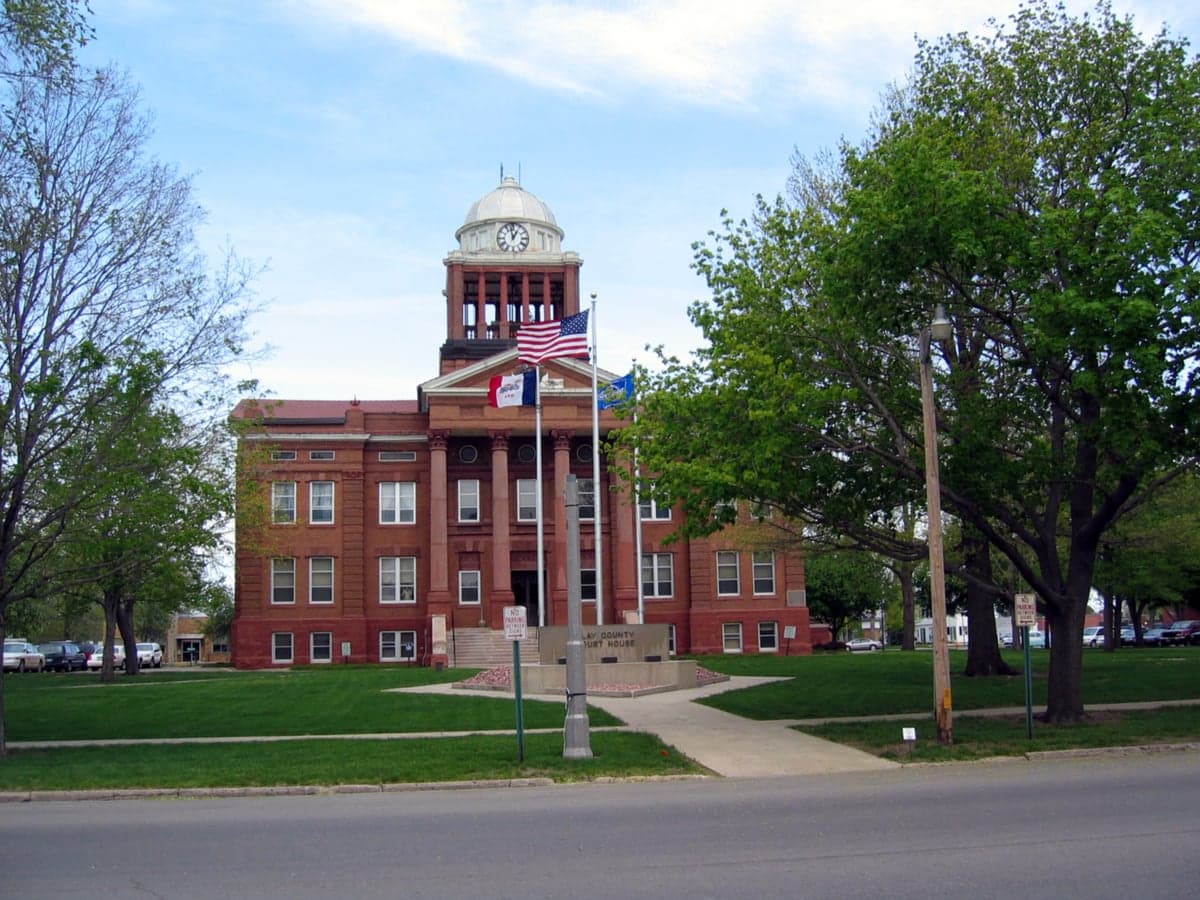
Photo: Wikipedia
Political ClimatePolitical Climate in Clay County
Showing district-level results — no local-only data available.
Local Political AnalysisPolitical Analysis of Clay County
Clay County, Iowa, is a reliably Republican stronghold with a Cook PVI of R+15, making it significantly more conservative than the state of Iowa as a whole, which sits at R+6. This isn't a recent shift; the county has voted for the GOP presidential candidate in every election since 2000, often by margins exceeding 20 points. The political center of gravity is firmly anchored in the rural, agricultural areas, while the county seat, Spencer, introduces a slightly more moderate, though still conservative, dynamic. The trajectory here is one of steady, deepening red, mirroring the broader rural-urban political divide seen across the Midwest, with little indication of a near-term shift toward the center.
How it compares
The R+15 rating places Clay County in the top tier of Iowa's most Republican counties, a full nine points to the right of the state's overall lean. To put that in perspective, while Iowa as a state is competitive enough to be considered a swing state in national elections, Clay County is not. In the 2020 presidential election, Donald Trump carried the county with roughly 68% of the vote, compared to his 53% statewide. This gap is consistent down the ballot; Republican candidates for state legislature and county offices routinely win by similar margins. The political culture here is more akin to neighboring counties like Dickinson or Osceola than to the more competitive precincts in Polk or Linn Counties. The real political action in Clay County isn't between Democrats and Republicans, but within the Republican primaries, where the more conservative candidate often prevails.
What this means for residents
For conservative residents, the political climate is one of comfort and alignment. Local governance, from the county board of supervisors to the school board, generally reflects their values. Issues like lower taxes, gun rights, and agricultural policy are front and center, and there's a strong sense that local representatives are in lockstep with the community's priorities. For liberal or moderate residents, the reality is different. While they are not a persecuted minority, they often find themselves politically isolated. In a town like Spencer, with its larger population and presence of Iowa Lakes Community College, there is a slightly more diverse range of viewpoints, but it's still a place where political conversations are often navigated carefully. The practical impact is that progressive policy initiatives, whether at the county or city level, face an uphill battle. A Democrat running for office in Clay County knows they are a longshot, and the focus is usually on building relationships and chipping away at the margins rather than winning outright.
One notable cultural distinction is the county's relationship with the Iowa Great Lakes region, which includes the popular tourist destinations of Okoboji and Arnolds Park just to the north in Dickinson County. This influx of seasonal visitors and second-home owners brings a slightly more cosmopolitan and, at times, politically moderate influence to the area, though it hasn't fundamentally altered Clay County's deep-red character. The local economy, heavily tied to agriculture and manufacturing, reinforces a pragmatic, business-friendly political outlook. There is a strong sense of self-reliance and a wariness of government overreach that cuts across party lines, even if the parties disagree on what constitutes overreach. This shared cultural bedrock means that while political disagreements are real, they often take a backseat to community events, high school sports, and the practical challenges of living in a rural area. The near-term future looks like more of the same: a reliably Republican county in a state that will remain a key political battleground, where local elections are decided in the primary and the general election is a formality.

State Political ClimatePolitical Climate in Iowa
State Political AnalysisPolitical Environment in the State
Iowa has shifted from a classic purple swing state to a solidly Republican-leaning one, carrying a Cook PVI of R+6. The state voted for Donald Trump by 8.5 points in 2020 and 13 points in 2024, a dramatic departure from 2000 and 2004 when it was decided by less than 1 point each time. The dominant coalition today is a mix of rural and small-town conservatives, evangelical voters, and a shrinking but still influential bloc of blue-collar Democrats in the eastern part of the state, while the Des Moines metro has become the state’s primary political battleground.
Urban vs. rural divide
The political map of Iowa is a textbook case of the urban-rural split. The Des Moines metro (Polk, Dallas, and Warren counties) is the state’s Democratic stronghold, with Polk County delivering 60% for Biden in 2020. But the real story is the suburbs: Dallas County, home to the booming western suburbs of Waukee and West Des Moines, flipped from blue to red in 2024, voting for Trump by 3 points after backing Biden by 5 points in 2020. This reflects a broader trend of suburban voters moving right on education and parental rights. Meanwhile, Johnson County (Iowa City) remains the deepest blue in the state, with Biden winning 70% there, driven by the University of Iowa. The rural counties tell the opposite story: Lyon County in the northwest gave Trump 84%, and counties like Sioux, Osceola, and Plymouth routinely hit 75-80% Republican. The Mississippi River counties—Dubuque, Clinton, Scott (Quad Cities)—were once union-anchored Democratic territory but have trended hard red, with Scott County flipping to Trump in 2024 after backing Biden in 2020. The only real blue outlier left east of Des Moines is Linn County (Cedar Rapids), which Biden carried by 12 points.
Policy environment
Iowa’s policy environment is unmistakably conservative, shaped by a Republican trifecta that has held the governorship and both legislative chambers since 2017. The state has a flat income tax of 3.8% (phasing down to 3.5% by 2026), with a goal of reaching 3.25%—one of the lowest rates in the Midwest. Property taxes are relatively low, with a median effective rate of 1.4%, though local levies vary. The state is a right-to-work state, and public-sector unions were significantly weakened by 2017’s Chapter 20 reforms, which ended most collective bargaining over non-wage issues. Education policy is a flashpoint: Iowa enacted a universal Education Savings Account (ESA) program in 2023, allowing any family to use public funds for private school tuition, with a per-student value of roughly $7,600. The state also passed a law requiring schools to notify parents if a student requests a name or pronoun change, and banned books with explicit sexual content from school libraries. On healthcare, Iowa expanded Medicaid under the ACA but has since imposed work requirements for able-bodied adults, and the state has some of the strictest abortion laws in the nation—a 2023 law bans abortion after a fetal heartbeat is detected (around 6 weeks), with no exceptions for rape or incest, only for medical emergencies. Election laws have tightened: voter ID is required, absentee ballot drop boxes are limited to one per county, and early voting windows were shortened from 29 to 20 days.
Recent policy direction
The last three years have seen a cascade of legislation that signals a clear direction. On guns, Iowa became a permitless carry state in 2021, allowing any legal adult to carry a concealed firearm without a permit or training. On parental rights, the 2023 law requiring school notification of pronoun changes was paired with a ban on instruction about sexual orientation and gender identity in grades K-6. On speech and privacy, the state passed a law in 2024 prohibiting government entities from requiring employees or contractors to undergo diversity, equity, and inclusion (DEI) training that promotes “divisive concepts.” On medical autonomy, the 6-week abortion ban is among the most restrictive in the country, and the state has also banned gender-affirming care for minors. Property rights remain strong, with no state-level rent control and a relatively straightforward eminent domain process. On taxation, the 2022 tax reform package accelerated income tax cuts and eliminated the inheritance tax entirely. Voting access has been restricted, but the state also expanded early in-person voting hours in 2024 to address long lines. The overall trajectory is toward a smaller government footprint, lower taxes, and a strong emphasis on parental authority and local control, though critics argue this has come at the cost of reduced public school funding and diminished protections for LGBTQ+ residents.
Civil unrest & political movements
Iowa has seen its share of political flashpoints, but they tend to be more organized and less chaotic than in coastal states. The most visible movement in recent years has been the Parents’ Rights movement, centered in suburban districts like Ankeny and Waukee, where school board meetings became heated battlegrounds over mask mandates, critical race theory, and library books. This grassroots energy directly fueled the 2023 ESA law and the parental notification legislation. On the left, the Iowa City and Des Moines areas have seen regular protests for abortion rights and racial justice, including a 2020 George Floyd protest in Des Moines that drew 2,000 people and led to some property damage. Immigration politics are relatively quiet compared to border states, but Governor Kim Reynolds signed a 2024 law making it a state crime to enter Iowa after being deported, a direct challenge to federal authority that has drawn lawsuits. There is no serious secession or nullification movement, though some rural counties have passed symbolic “Second Amendment sanctuary” resolutions. Election integrity controversies flared after 2020, with the state GOP conducting a forensic audit of six counties that found no widespread fraud but did recommend tighter chain-of-custody rules. The most visible flashpoint for a new resident would likely be the school board dynamics: in fast-growing suburbs like Johnston and Norwalk, these races are now hotly contested and often determine the local political temperature.
Projection
Over the next 5-10 years, Iowa is likely to become more Republican, not less. The key demographic driver is the continued growth of the Des Moines metro, which is attracting younger, more diverse residents—but these newcomers are often families moving from other Midwest states for jobs at companies like Principal Financial, Corteva, and Microsoft’s data centers. Early data suggests these transplants are more conservative than the native Iowans they’re replacing in the suburbs, as evidenced by Dallas County’s flip. Meanwhile, the rural counties are depopulating but voting even more heavily Republican, amplifying their electoral weight. The University of Iowa and Iowa State University will continue to anchor blue pockets in Iowa City and Ames, but these are unlikely to expand beyond their college-town borders. The state’s political trajectory is toward a durable Republican majority, with the main internal debate shifting from “R vs. D” to “establishment vs. populist” within the GOP. A new resident moving in now should expect to find a state where conservative policy is the baseline, not the exception, and where the most contentious fights will be over how far to push that agenda—particularly on education funding and local control.
For a new resident, the bottom line is straightforward: Iowa offers a stable, low-tax, and increasingly conservative environment where your vote will matter most in Republican primaries and local school board races. If you lean right, you’ll find a state that has already enacted many of the policies you’d want—permitless carry, school choice, abortion restrictions, and voter ID. If you lean left, you’ll find a state where your vote is concentrated in a few urban counties, and where statewide policy will likely continue moving in a direction you oppose. Either way, the political climate is less volatile than in many states, with a strong tradition of civic engagement and a government that, for better or worse, moves deliberately on its agenda. The practical takeaway: know your local school board candidates, expect property taxes to stay manageable, and don’t be surprised if your new neighbors are more politically engaged than you’re used to.
* Values derived from national, state, county, city and local statistics and may differ in a specific area. Last updated: 2026-07-09T20:45:34.000Z
Narrative content on this page is AI-generated and may contain mistakes. Verify any details that matter before acting on them.
ReloMaps may earn a commission from affiliate links at no extra cost to you.

