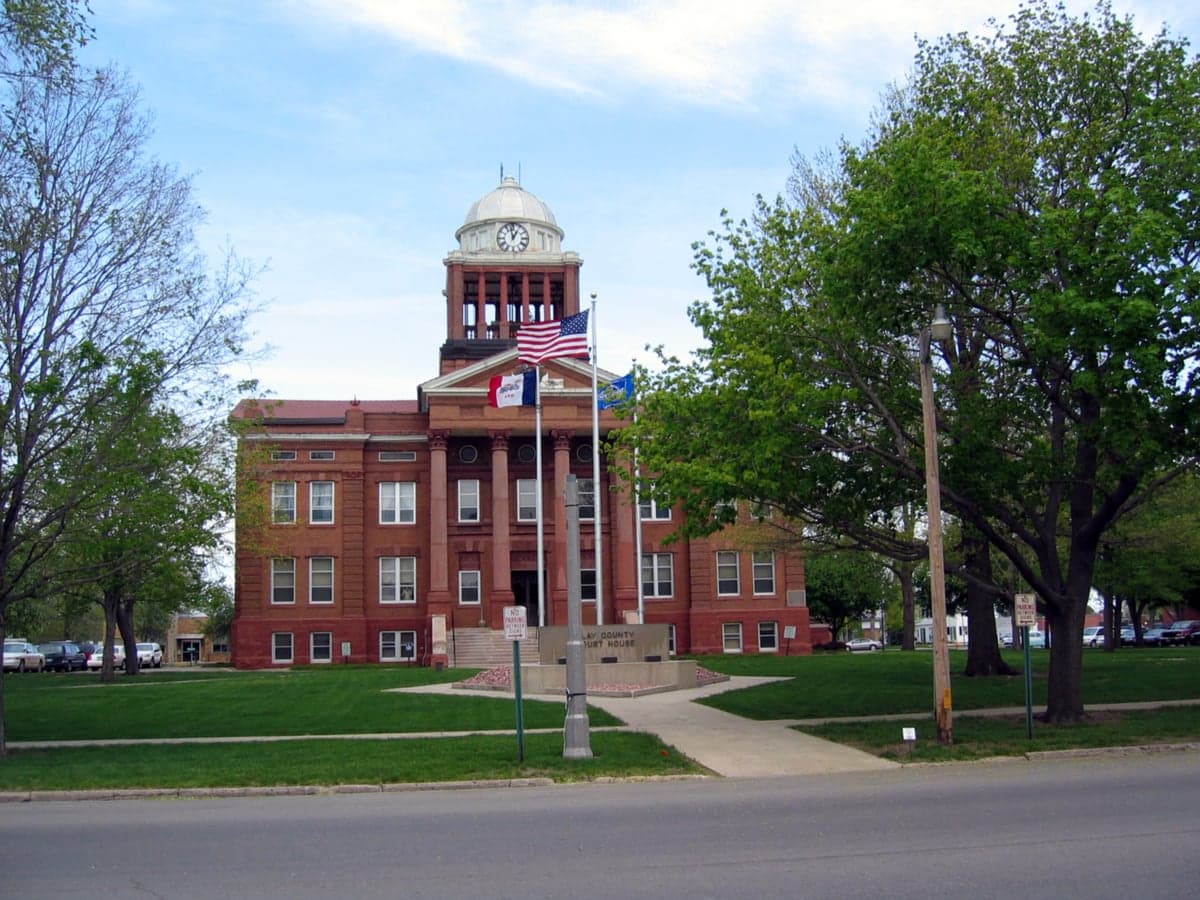
Photo: Wikipedia
Personal Sovereignty in Clay County
Viable for self-reliance. Generally workable, though some barriers may limit total independence.
What does Personal Sovereignty tell us?
Personal Sovereignty measures your capacity for self-reliance and independence with minimal government friction. Higher scores mean fewer barriers between you and the way you want to live... but it assumes you have the space you need and good neighbors.
What does this tell us?
Personal Sovereignty measures your capacity for self-reliance and independence with minimal government friction. Higher scores mean fewer barriers between you and the way you want to live... but it assumes you have the space you need and good neighbors.
State Policy
Energy independence: Importer (50% of energy produced in-state)
Personal Liberty
Homesteading

Personal Liberty Analysis
Clay County, Iowa, offers a notably high degree of personal sovereignty, rooted in a state-level commitment to limited government and local control that translates into a light regulatory touch for residents. For individuals and families prioritizing autonomy, the county provides an environment where self-reliance is not just possible but actively supported by low taxes, permissive gun laws, and minimal zoning interference. This stands in contrast to more heavily regulated urban centers, making communities like Spencer, the county seat, and smaller towns such as Peterson and Royal attractive for those seeking to maximize personal freedom.
Tax burden and regulatory posture: How light is the government footprint?
Clay County operates under Iowa’s generally low-tax framework, which is a cornerstone of its appeal for sovereignty-minded residents. The state’s income tax is structured with a flat rate of 3.8% as of 2026, and property taxes in Clay County are below the state average, with the effective rate hovering around 1.2% of assessed home value. This creates a tangible financial buffer for homeowners and small business owners. The regulatory posture at the county level is decidedly hands-off; there is no county-wide zoning ordinance in unincorporated areas, meaning that outside of city limits—in places like Dickens or Gillett Grove—residents face few bureaucratic hurdles for building, operating a home business, or keeping livestock. The city of Spencer does enforce standard municipal codes, but even there, the permitting process is streamlined compared to larger metropolitan areas, reflecting a cultural preference for minimal government interference in daily life.
Self-defense and gun law specifics: What are the legal boundaries for carrying and owning firearms?
Iowa is a "shall-issue" state for concealed carry permits, and as of 2021, it became a permitless carry state, meaning law-abiding adults 21 and older can carry a concealed firearm without a permit. This legal framework is fully embraced in Clay County, where gun ownership is a common and culturally accepted practice. The sheriff's office in Spencer processes permits efficiently, and there are no additional county-level restrictions beyond state law. Open carry is legal without a permit, and there are no magazine capacity limits or specific firearm registration requirements. For residents in towns like Everly or Hartley, this means the legal environment supports a robust right to self-defense both inside the home and in public spaces, with the only significant restrictions being federal prohibitions on felons and the standard prohibition on carrying in certain government buildings and schools.
Self-reliance and homesteading viability: Lot sizes, zoning, and off-grid feasibility
The viability of a self-reliant lifestyle in Clay County is high, particularly in its rural townships. Unincorporated areas have no minimum lot size requirements for agricultural use, allowing for acreage purchases that support gardening, small-scale farming, or livestock. In towns like Webb and Fostoria, it is common to see properties with a few acres where residents keep chickens, goats, or a small herd of cattle. Off-grid living is legally feasible; Iowa has no state-level prohibition on rainwater collection, and while the county requires a septic system permit, there are no mandates to connect to municipal water or sewer outside of city limits. Solar panel installation is unrestricted by county code, and the net metering policy from the local utility, Spencer Municipal Utilities, allows residents to offset their electricity costs. This regulatory permissiveness makes Clay County a practical choice for those seeking to reduce dependence on public utilities and commercial food systems.
Personal liberties: Parental rights, medical autonomy, speech, and property rights
Personal liberties in Clay County are reinforced by state-level protections that resonate with a conservative-leaning audience. Iowa law grants strong parental rights, including the ability to opt children out of specific curriculum or health mandates without legal pushback. Medical autonomy is respected, with no state or county mandates for COVID-19 vaccinations or masking in effect as of 2026, and no restrictions on accessing alternative or complementary medical treatments. Free speech is robustly protected, with no local ordinances limiting public expression beyond standard time, place, and manner restrictions. Property rights are a particular strength; the county’s lack of comprehensive zoning in rural areas means landowners have broad discretion over how to use their land, whether for a home-based business, a workshop, or recreational shooting. This combination of legal protections creates an environment where residents in Spencer or the surrounding countryside can live with minimal interference from government at any level.
Overall, Clay County ranks among the more sovereignty-friendly areas in the Midwest, offering a blend of low taxes, permissive gun laws, and minimal land-use regulation that is increasingly rare. While it does not have the extreme libertarian posture of some rural Western counties, its practical, no-nonsense approach to governance provides a solid foundation for personal independence. For families and individuals moving from states with heavier regulatory burdens, the transition to Clay County’s lighter touch is both tangible and immediate, particularly in its smaller communities where neighborly self-reliance remains the cultural norm.

* Values derived from national, state, county, city and local statistics and may differ in a specific area. Last updated: 2026-07-09T20:45:34.000Z
Narrative content on this page is AI-generated and may contain mistakes. Verify any details that matter before acting on them.
ReloMaps may earn a commission from affiliate links at no extra cost to you.

