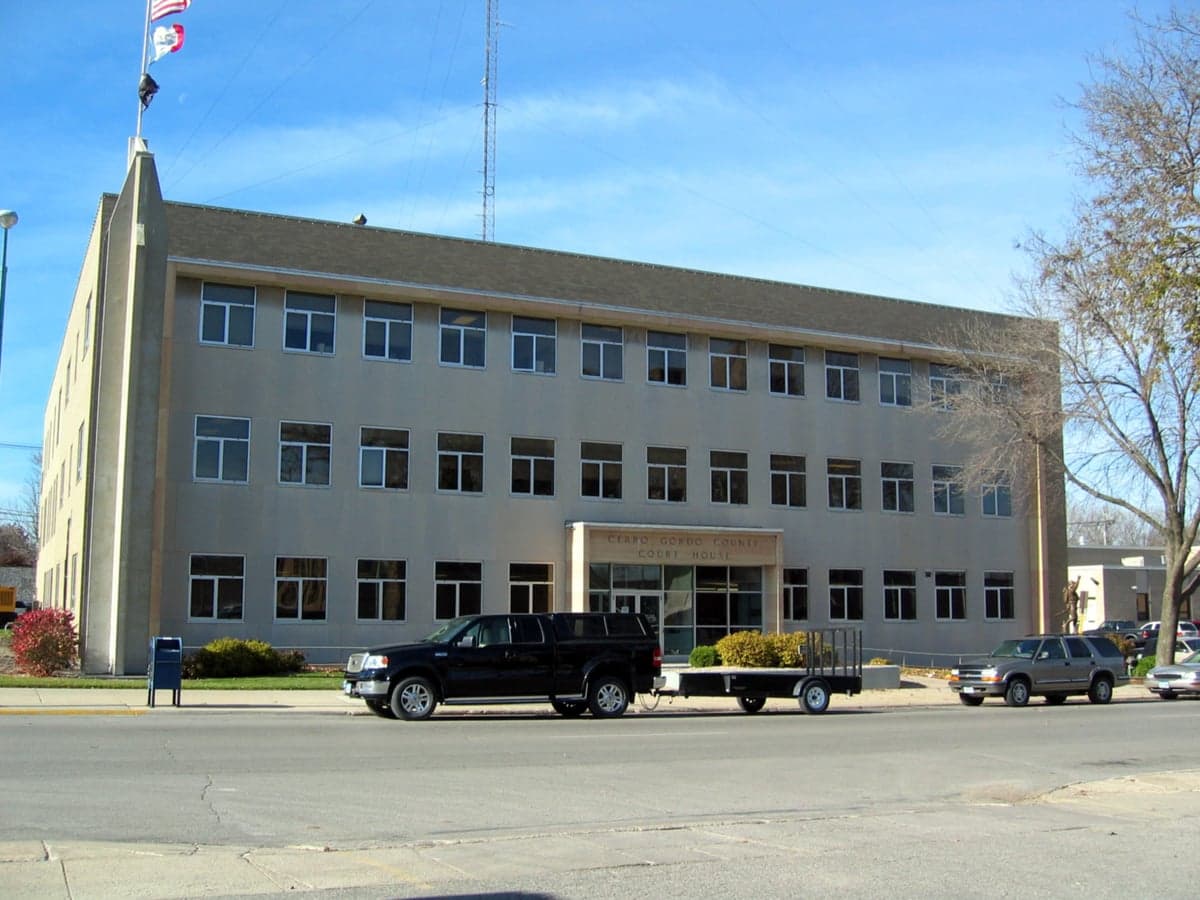
Photo: Wikipedia
Political ClimatePolitical Climate in Cerro Gordo County
Showing district-level results — no local-only data available.
Local Political AnalysisPolitical Analysis of Cerro Gordo County
Cerro Gordo County, anchored by the city of Mason City, has a Cook Partisan Voting Index of R+4, making it a reliably Republican area but notably less conservative than the state of Iowa as a whole, which sits at R+6. This isn't a deep-red stronghold; it's a place where Democrats can and do win local offices, especially in the county seat. The county has been trending rightward over the past decade, mirroring the broader rural shift in the Midwest, but the presence of a sizable urban core in Mason City and the college town of Clear Lake keeps it from being a lock for either party. If you look at the 2020 presidential results, Donald Trump carried the county with about 52% of the vote, but that was a tighter margin than in most of the surrounding rural counties, which often went 65% or higher for him.
How it compares to the rest of Iowa
The two-point gap between Cerro Gordo's R+4 and Iowa's R+6 is significant in a state where the rural-urban divide is stark. While the state tilts red thanks to massive margins in places like Sioux and Plymouth counties, Cerro Gordo's politics are more of a tug-of-war. Mason City's 1st and 2nd wards, which include the downtown and the historic neighborhoods near the river, consistently vote Democratic, often by 10-15 points. Meanwhile, the rural townships outside the city limits—like Portland Township and Rock Falls—are deeply Republican, frequently delivering 70%+ for GOP candidates. Clear Lake is the county's true swing area; its precincts can flip between parties depending on the candidate and the year, making it the bellwether for countywide races. In contrast, a county like Story County (home to Ames) is D+5, showing that Cerro Gordo is more moderate than the state's true blue islands but less conservative than the vast rural expanse.
What this means for residents
For conservative residents, the R+4 lean means their values are broadly reflected in county-level decisions, from the board of supervisors to the sheriff's office. You won't see the kind of progressive policy pushes you'd find in Johnson County. But it's not a rubber stamp; the Democratic minority is large enough to force compromise on issues like county budgeting and land use. For liberal residents, the reality is that you can win local races if you run a good campaign, especially in Mason City and Clear Lake, but you're unlikely to flip the county in a presidential or statewide election. The practical effect is a government that tends toward fiscal conservatism but isn't hostile to public services—the county's hospital and community college are well-funded, and there's broad support for maintaining the parks and the lake. The cultural vibe is more "live and let live" than in the deeply red counties to the west; you'll see a few pride flags in Mason City storefronts, but don't expect a lot of overt political activism.
One notable distinction is the county's relationship with the Iowa caucuses. Cerro Gordo is a frequent stop for presidential candidates, especially those trying to prove they can appeal to moderate Midwesterners. The county has a history of picking the eventual Republican nominee, and its swing nature means candidates spend real time here, unlike in the deep-red counties where the primary is a foregone conclusion. For residents, that means a front-row seat to national politics every four years, but it also means the local political conversation is often nationalized, which can feel exhausting. The long-term trajectory is likely a slow drift rightward as the rural population grows slightly faster than the urban core, but the presence of a stable Democratic base in Mason City and Clear Lake means Cerro Gordo will remain one of Iowa's more competitive counties for the foreseeable future.

State Political ClimatePolitical Climate in Iowa
State Political AnalysisPolitical Environment in the State
Iowa has been a reliably Republican state for the past decade, carrying a Cook PVI of R+6, but it wasn't always this way. The state was a classic presidential battleground from the 1980s through 2012, flipping between parties and hosting the first-in-the-nation caucuses that gave it outsized influence. Over the last 10-15 years, the shift has been decisive: the rural and small-town base that once split tickets has consolidated behind the GOP, while the state's few growing urban centers have become Democratic strongholds. The result is a state that now votes about 6 points more Republican than the nation as a whole, with a political culture that increasingly reflects that lean.
Urban vs. rural divide
The political map of Iowa is a textbook case of the urban-rural split. The Democratic vote is concentrated in three main areas: Des Moines and its inner suburbs (Polk County), Iowa City (Johnson County, home to the University of Iowa), and the Quad Cities area along the Mississippi. Johnson County voted +32 for Biden in 2020, while Polk County was +16. Meanwhile, the rest of the state is deeply red. The northwest corner, including counties like Sioux and Lyon, regularly votes 75-80% Republican. The shift is most visible in places like Cedar Rapids (Linn County), which was a Democratic stronghold as recently as 2012 but has moved right, and Dubuque, where blue-collar Catholic voters have trended Republican. The fast-growing suburbs of Ankeny and Waukee outside Des Moines are now reliably red, while the exurbs of North Liberty near Iowa City are more purple.
Policy environment
Iowa's policy environment is shaped by a Republican trifecta that has held the governorship and both legislative chambers since 2017. The state has a flat income tax of 3.8%, set to drop to 3.65% in 2026, with a path to a flat 3.5% by 2027. Property taxes are relatively low compared to neighboring states, and there is no inheritance tax. The regulatory climate is business-friendly, with a right-to-work law on the books and a tort reform system that caps noneconomic damages in medical malpractice cases. Education policy has been a flashpoint: the state passed a universal school voucher program in 2023, allowing any family to use public funds for private school tuition. On healthcare, Iowa expanded Medicaid under the Affordable Care Act but has since pursued a waiver-based managed care model. Election laws tightened in 2021, with reduced early voting windows and stricter ID requirements.
Recent policy direction
The last five years have seen Iowa move decisively in a conservative direction across multiple fronts. On gun rights, the state passed permitless carry in 2021, allowing any law-abiding adult to carry a concealed firearm without a permit. On education and parental rights, the 2023 law banning instruction on sexual orientation and gender identity through sixth grade (SF 496) was followed by a 2024 law requiring school libraries to remove books deemed "age-inappropriate." On abortion and bodily autonomy, the Iowa Supreme Court reversed its 2018 ruling protecting abortion rights, and a 2023 law now bans abortion after six weeks of pregnancy, with limited exceptions. On property rights, the state has strengthened eminent domain protections for landowners. On voting and ballot access, the 2021 law (SF 413) shortened the early voting period from 29 to 20 days, closed polls at 8 p.m. instead of 9 p.m., and required absentee ballot applications to be returned by mail rather than dropped off. On privacy and surveillance, Iowa has not passed broad data privacy legislation, though a 2023 law restricts the use of facial recognition technology by law enforcement without a warrant.
Civil unrest & political movements
Iowa has not seen the kind of large-scale civil unrest common in coastal states, but there have been notable flashpoints. The Black Lives Matter protests in Des Moines and Iowa City in 2020 were significant, with several nights of demonstrations and some property damage, but they were smaller and shorter-lived than in many states. The farm protest movement of the 1980s left a lasting cultural memory, but today's agricultural activism is more focused on CAFO regulations and carbon pipeline projects. The proposed Summit Carbon Solutions pipeline has become a major political issue, with landowners and some county boards fighting eminent domain for CO2 sequestration infrastructure. On immigration politics, Iowa has seen a small but vocal movement in towns like Storm Lake and Postville, where meatpacking plants have drawn immigrant populations. The state passed a law in 2024 requiring local law enforcement to cooperate with federal immigration authorities. Election integrity remains a live issue: the 2020 audit of the presidential results in Iowa's 2nd congressional district, which was initially too close to call, became a national story when the state canvass board certified the Democrat over Republican objections. There has been no serious secession or nullification rhetoric in Iowa.
Projection
Over the next 5-10 years, Iowa's political trajectory is likely to stay on its current course, with some moderation around the edges. The demographic trends favor the GOP: the state's population is aging and rural areas are shrinking, while the urban centers of Des Moines and Iowa City grow slowly. In-migration is modest and mostly from other Midwestern states, not from high-cost coastal areas, so there is little pressure for political change from newcomers. The suburban shift seen in places like Ankeny and Waukee shows no sign of reversing, and the GOP's grip on the legislature is likely to persist. However, the Iowa caucuses, which have been a source of political energy and national attention, are under threat after the Democratic Party restructured its primary calendar; if the caucuses lose relevance, Iowa's political influence will wane, but its internal dynamics will remain unchanged. A new resident moving in now should expect a state that is solidly Republican, with conservative policy momentum, but with enough Democratic presence in the cities to keep politics interesting.
For someone relocating to Iowa, the bottom line is this: if you lean conservative, you'll find a state where your values are reflected in state law and local governance, from low taxes to school choice to gun rights. If you lean liberal, you'll find a state where your vote matters most in Des Moines, Iowa City, or the Quad Cities, and where you'll need to be comfortable being in the minority at the state level. Either way, Iowa's politics are stable, predictable, and grounded in a Midwestern pragmatism that values results over rhetoric. The state is not a political battleground anymore, but it is a place where the political culture is clear and consistent.
* Values derived from national, state, county, city and local statistics and may differ in a specific area. Last updated: 2026-07-12T08:40:55.000Z
Narrative content on this page is AI-generated and may contain mistakes. Verify any details that matter before acting on them.
ReloMaps may earn a commission from affiliate links at no extra cost to you.

