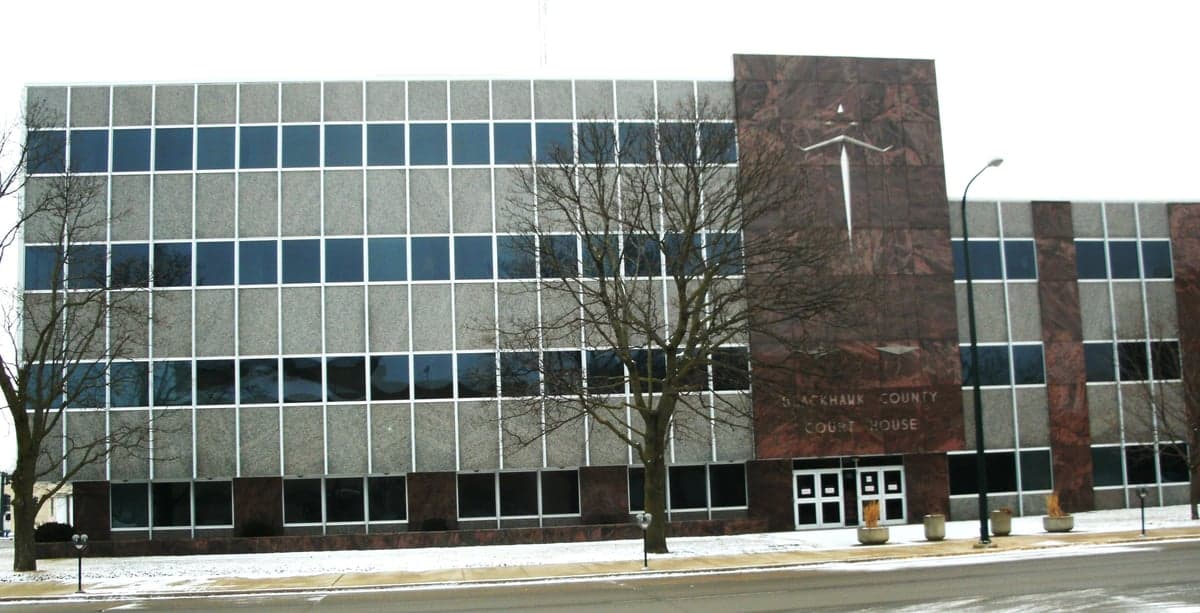
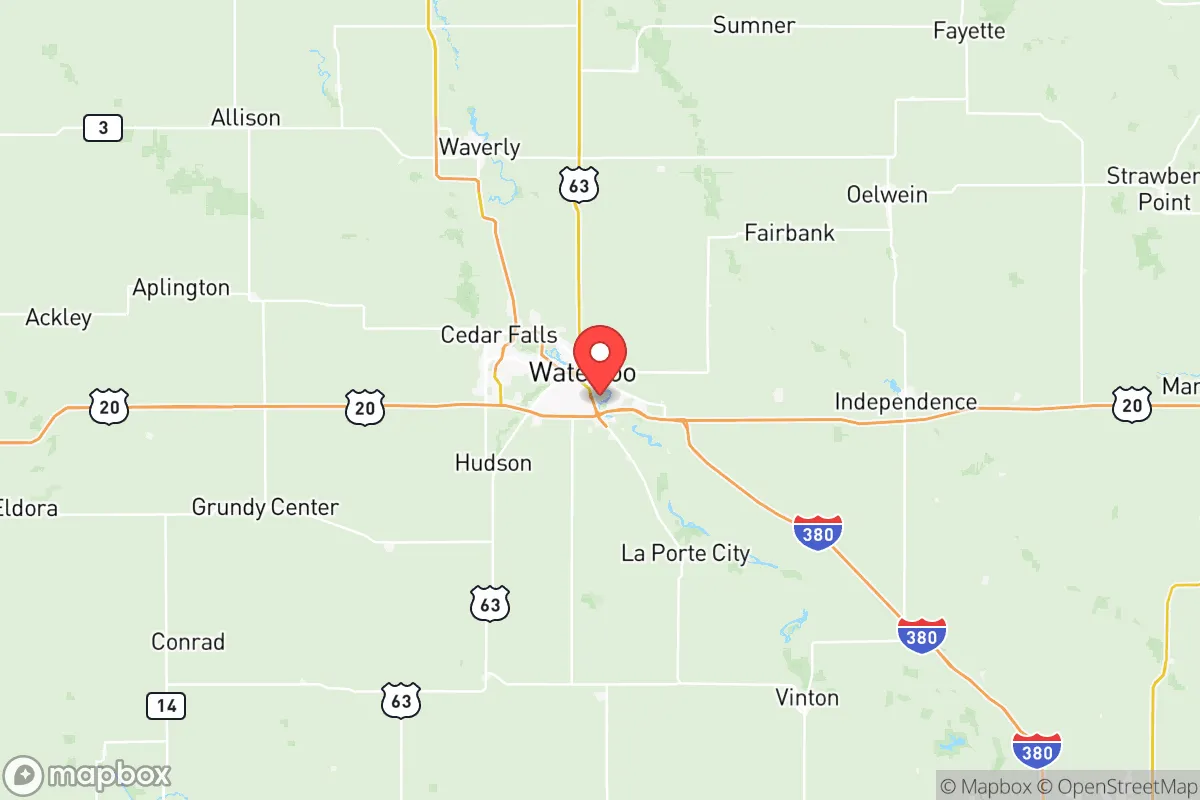
Photo: Wikipedia
Demographics of Black Hawk County
Affluence Level in Black Hawk County
A middle-class area roughly in line with national averages across income, home values, education, and employment.
People of Black Hawk County
Black Hawk County, Iowa, is home to roughly 130,700 residents, anchored by the industrial and cultural hub of Waterloo and its twin city, Cedar Falls. The population is predominantly white (78.8%) with a significant Black minority (9.5%) and a growing Hispanic community (5.0%), reflecting a history shaped by industrial booms, agricultural roots, and a relatively low foreign-born share of just 3.3%. Distinctive markers include a strong union and manufacturing heritage, a notable Bosnian refugee community, and a political landscape that leans conservative in the rural townships while the urban core of Waterloo provides a Democratic counterweight. This is a region where the legacy of the meatpacking and farm implement industries still defines the character of its people.
Settlement & growth (pre-1960)
Before European settlement, the area that is now Black Hawk County was home to the Sauk and Meskwaki (Fox) nations, who used the Cedar River valley for seasonal hunting and farming. The county is named after the Sauk leader Black Hawk, though the tribe was forcibly removed west of the Mississippi after the Black Hawk War of 1832. The first Euro-American settlers arrived in the 1840s, primarily Yankees from New York and New England, who established the county seat of Waterloo in 1845 and the agricultural community of Cedar Falls in 1847. These early settlers were drawn by the fertile prairie soil and the water power of the Cedar River, which fueled gristmills and sawmills.
The major demographic transformation began in the 1860s and 1870s with the arrival of German and Irish immigrants, who came to work on the railroads and in the new agricultural processing plants. German settlers concentrated in the towns of Hudson and La Porte City, where they established Lutheran churches and farming cooperatives. The Irish settled primarily in Waterloo's "Dry Run" neighborhood near the river. A smaller wave of Danish immigrants arrived in the 1880s, founding the town of Dunkerton and leaving a lasting imprint on local dairy farming.
The single most transformative event for the county's population was the establishment of the Rath Packing Company in Waterloo in 1891, followed by the John Deere tractor works in 1918. These industrial giants pulled in a new wave of workers: first, Southern and Eastern European immigrants—Poles, Italians, and Czechs—who settled in Waterloo's East Side and the industrial corridor along the Cedar River. Then, during the Great Migration (roughly 1915-1970), thousands of Black families from the Deep South—particularly Mississippi and Arkansas—moved to Waterloo for jobs in the packinghouses and foundries. By 1950, Black Hawk County had one of the largest Black populations in Iowa, concentrated in Waterloo's "Smokey Row" and "East Fourth Street" neighborhoods. This industrial base also attracted a smaller number of Mexican laborers in the 1940s and 1950s through the Bracero program, who settled in Waterloo's West Side.
Modern era (post-1965)
The 1965 Hart-Cellar Act had a modest direct impact on Black Hawk County compared to coastal regions, but it did open the door for two significant new groups. The first was a wave of Southeast Asian refugees—primarily Vietnamese and Lao—who arrived after the fall of Saigon in 1975, resettled by Catholic Charities and local churches. They concentrated in Waterloo's central neighborhoods and in Cedar Falls near the university, establishing small grocery stores and restaurants. Today, East and Southeast Asian communities make up about 1.8% of the county's population, with a visible presence in the Cedar Falls school district.
The second, and more dramatic, post-1965 arrival was the Bosnian refugee community. Beginning in the mid-1990s after the Bosnian War, several thousand Bosniaks (Muslim Bosnians) were resettled in Waterloo, drawn by the availability of jobs in the remaining meatpacking plants and the presence of a growing Islamic center. This community, now numbering perhaps 2,000-3,000 people, is concentrated in Waterloo's central and northern neighborhoods and has established several mosques and halal markets. It is one of the largest Bosnian enclaves in the Midwest outside of St. Louis and Chicago.
Domestically, the post-1965 period saw the decline of the industrial base that had defined the county. Rath Packing closed in 1984, and John Deere underwent massive layoffs in the 1980s and 1990s. This triggered a population decline from a peak of 137,000 in 1980 to 128,000 by 2000. The white population, in particular, began a slow out-migration to the suburbs of Des Moines and to Sun Belt states. Meanwhile, the Black population stabilized at around 9-10% as families remained rooted in Waterloo's established neighborhoods. The Hispanic population grew steadily from less than 1% in 1990 to 5.0% today, driven by new immigration from Mexico and Central America for work in construction, food processing, and the service industry. These newer Hispanic arrivals have settled in Waterloo's West Side and in the rural areas around Evansdale and Raymond.
Suburbanization has been modest compared to larger metros. Cedar Falls, home to the University of Northern Iowa, has grown as a white-collar, college-educated enclave, while Waterloo has retained a more blue-collar, racially diverse character. The county's college-educated share is 30.1%, heavily concentrated in Cedar Falls and the western townships.
The future
The population of Black Hawk County is projected to remain relatively flat or decline slightly over the next decade, as the aging white population is not fully replaced by younger, more diverse cohorts. The county is not homogenizing; rather, it is tribalizing into distinct enclaves. Waterloo's core is becoming more diverse—Black, Hispanic, Bosnian, and Southeast Asian—while the outlying towns of Cedar Falls, Hudson, and La Porte City remain overwhelmingly white and more conservative. The Bosnian community is showing signs of second-generation assimilation, with younger adults moving to larger cities for professional opportunities, while the Hispanic community is growing steadily through both immigration and higher birth rates.
In-migration from other parts of Iowa or the Midwest is minimal, as the county lacks the job growth of Des Moines or the amenities of Iowa City. The University of Northern Iowa provides a steady but small stream of new residents, many of whom leave after graduation. The cultural identity of the county is thus becoming more polarized: the urban core of Waterloo is increasingly multiethnic and working-class, while the surrounding towns and rural areas are aging, white, and culturally conservative.
For someone moving in now, Black Hawk County offers a relatively affordable cost of living and a strong sense of local identity, but it is not a region of rapid growth or demographic transformation. The character of the place is being shaped by the tension between Waterloo's industrial, multiethnic past and the suburban, white, university-oriented future of Cedar Falls. The next 10-20 years will likely see a slow continuation of these trends: a slightly more diverse Waterloo, a stable and prosperous Cedar Falls, and a gradual hollowing out of the rural townships as young people leave for larger metros.

* Values derived from national, state, county, city and local statistics and may differ in a specific area. Last updated: 2026-05-15T21:48:51.000Z
Narrative content on this page is AI-generated and may contain mistakes. Verify any details that matter before acting on them.
ReloMaps may earn a commission from affiliate links at no extra cost to you.

