
Photo: Wikipedia
Personal Sovereignty in Whitley County
Viable for self-reliance. Generally workable, though some barriers may limit total independence.
What does Personal Sovereignty tell us?
Personal Sovereignty measures your capacity for self-reliance and independence with minimal government friction. Higher scores mean fewer barriers between you and the way you want to live... but it assumes you have the space you need and good neighbors.
What does this tell us?
Personal Sovereignty measures your capacity for self-reliance and independence with minimal government friction. Higher scores mean fewer barriers between you and the way you want to live... but it assumes you have the space you need and good neighbors.
State Policy
Energy independence: Importer (35% of energy produced in-state)
Personal Liberty
Homesteading

Personal Liberty Analysis
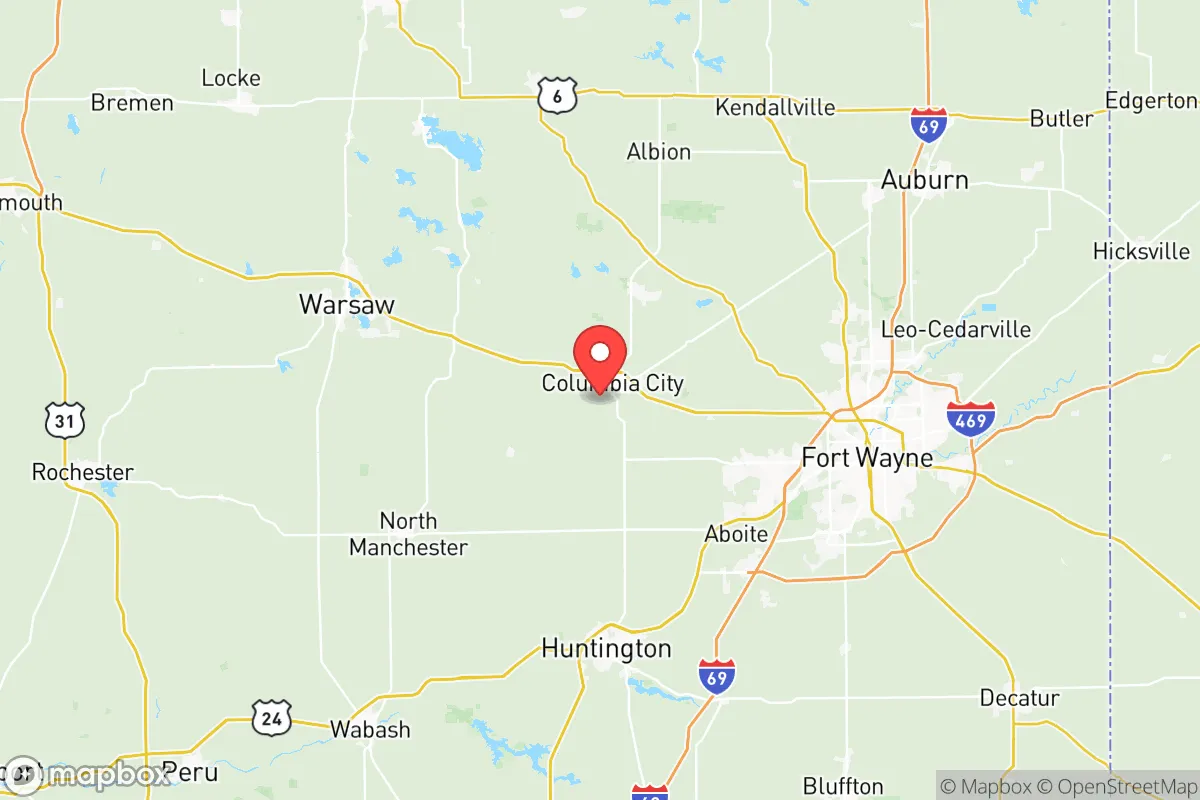
Whitley County, Indiana, offers a notably high degree of personal sovereignty compared to most of the Midwest, with a regulatory environment that leans heavily toward individual discretion rather than collective mandates. The county’s rural character, anchored by the county seat of Columbia City and the smaller towns of Churubusco, Larwill, and South Whitley, creates a setting where self-reliance is not just tolerated but practically expected. For single individuals and families weighing relocation, the autonomy environment here is defined by low taxes, permissive gun laws, and a hands-off approach to land use that rewards initiative over paperwork.
Tax burden and regulatory posture in Whitley County
Indiana’s state-level tax structure is among the most favorable in the nation for those seeking to keep more of their earnings, and Whitley County operates well within that framework. The state’s flat income tax rate of 3.05% is paired with a statewide property tax cap that limits homeowners to 1% of gross assessed value, a constitutional safeguard that prevents the kind of runaway levies seen in neighboring Illinois or Michigan. Whitley County’s combined local income tax rate sits at roughly 1.55%, which funds essential services like the sheriff’s department and road maintenance without ballooning into the 2%+ rates found in some urban Indiana counties like Marion or Lake. The regulatory posture at the county level is best described as light-touch: there is no county-wide zoning ordinance governing unincorporated areas, meaning that outside the town limits of Columbia City, Churubusco, Larwill, and South Whitley, a landowner’s use of their property is largely their own business. Permits are required for new residential construction through the county building department, but the process is streamlined compared to metro areas, with typical approval times measured in days rather than months. Business formation is equally frictionless, with Indiana’s Secretary of State online portal allowing LLC registration in under an hour for roughly $100, and no county-level occupational licensing beyond state-regulated professions.
Self-defense and gun law specifics in Whitley County
Indiana is a constitutional carry state, and Whitley County’s culture and enforcement posture fully embrace that framework. Since July 2022, any law-abiding adult 18 or older may carry a handgun openly or concealed without a permit, a right that local sheriff’s deputies and the Columbia City Police Department actively respect in practice. For those who still want a license for reciprocity when traveling to states like Michigan or Florida, the Indiana License to Carry a Handgun is issued by the county sheriff’s office with a statutory 60-day processing window, though Whitley County typically issues within 2-3 weeks. The county’s gun culture is visible in everyday life: the Whitley County Gun Show at the county fairgrounds in Columbia City draws vendors and buyers from across northeast Indiana, and the Whitley County Conservation Club in rural Jefferson Township maintains a 200-yard rifle range and a separate pistol range open to members. Use-of-force law in Indiana is among the most protective in the nation, with a Castle Doctrine statute that presumes a reasonable fear of death or serious bodily injury when an intruder unlawfully enters your home, vehicle, or place of business. There is no duty to retreat in any place where you are lawfully present, and civil immunity is granted to those who use force in justified self-defense. The county prosecutor’s office has a track record of declining charges in self-defense shootings that meet the statutory standard, a factor that matters for anyone prioritizing legal certainty in defensive scenarios.
Self-reliance and homesteading viability across the county
Whitley County’s unincorporated areas are a homesteader’s dream, with land prices that remain accessible compared to the rest of the state. As of 2026, raw agricultural land in the southern townships near Churubusco and the Eel River bottoms runs $6,000-$9,000 per acre, while improved parcels with a house and outbuildings in the northern part of the county near Larwill and South Whitley typically list between $250,000 and $400,000. Because there is no county-wide zoning, a landowner in the unincorporated areas of Union Township or Smith Township can keep chickens, goats, pigs, and cattle without special permits, and can build a pole barn or workshop without a building permit as long as it is not a dwelling. Off-grid feasibility is strong: the county’s rural electric cooperatives, including Northeastern REMC serving the eastern half of the county, allow net metering for solar arrays up to 1 MW, and the state’s Right to Farm Act protects agricultural operations from nuisance lawsuits filed by later-arriving neighbors. Water access is a differentiator — most rural parcels have a private well and septic system, and the county’s groundwater quality in the glacial till aquifers is generally good, though well testing is recommended in the western townships near the Allen County line where agricultural runoff has been documented. For those seeking true self-sufficiency, the town of Churubusco has a thriving small-scale farming community, with the annual Turtle Days festival celebrating the area’s agricultural heritage, while the more suburbanized areas just south of Columbia City along US-30 see tighter restrictions due to proximity to the city’s planning jurisdiction.
Personal liberties: parental rights, medical autonomy, speech, and property
Indiana’s legal framework in 2026 strongly favors parental authority and individual medical decision-making, and Whitley County’s conservative social fabric reinforces those norms. Parental rights are codified in state law through the Parental Bill of Rights, which requires schools to obtain written consent before administering any health survey or non-emergency medical service, and gives parents the right to review all instructional materials. The county’s three school districts — Whitley County Consolidated Schools, Smith-Green Community Schools, and the Columbia City school system — have all adopted policies that align with these statutes, and school board meetings in Columbia City regularly draw standing-room crowds on curriculum matters, reflecting active community oversight. Medical autonomy is protected by Indiana’s conscience clause laws, which allow individuals and healthcare providers to decline participation in procedures they object to on religious or moral grounds, and the state does not mandate COVID-19 or other vaccinations for adults. Speech is protected under both the state constitution’s broad free expression clause and the common law tradition, with no county-level ordinances restricting signage, political expression, or public assembly beyond standard noise and traffic safety rules. Property rights are the strongest pillar of personal sovereignty here: Indiana’s eminent domain law prohibits taking private property for private economic development, a direct response to the 2005 Kelo decision, and Whitley County has never used eminent domain for a private project in its history. The county’s assessor’s office operates under a market-value system with a robust appeals process, and property owners who disagree with their assessment can appeal to the Indiana Board of Tax Review with a high success rate for well-documented cases.
Relative to other areas of Indiana and the broader Midwest, Whitley County stands out as a jurisdiction where personal sovereignty is the default rather than the exception. The combination of constitutional carry, no county-wide zoning, a 1% property tax cap, and statutory protections for parental rights and property owners creates an environment where individuals and families can live largely on their own terms. Compared to the more heavily regulated urban counties like Marion (Indianapolis) or the high-tax environments of Cook County, Illinois, Whitley County offers a markedly lighter regulatory footprint. For the relocation-minded reader who values independence, the county’s rural townships and small towns provide the space — both physical and legal — to build a self-directed life without constant government interference.

* Values derived from national, state, county, city and local statistics and may differ in a specific area. Last updated: 2026-10-23T01:06:39.000Z
Narrative content on this page is AI-generated and may contain mistakes. Verify any details that matter before acting on them.
ReloMaps may earn a commission from affiliate links at no extra cost to you.

