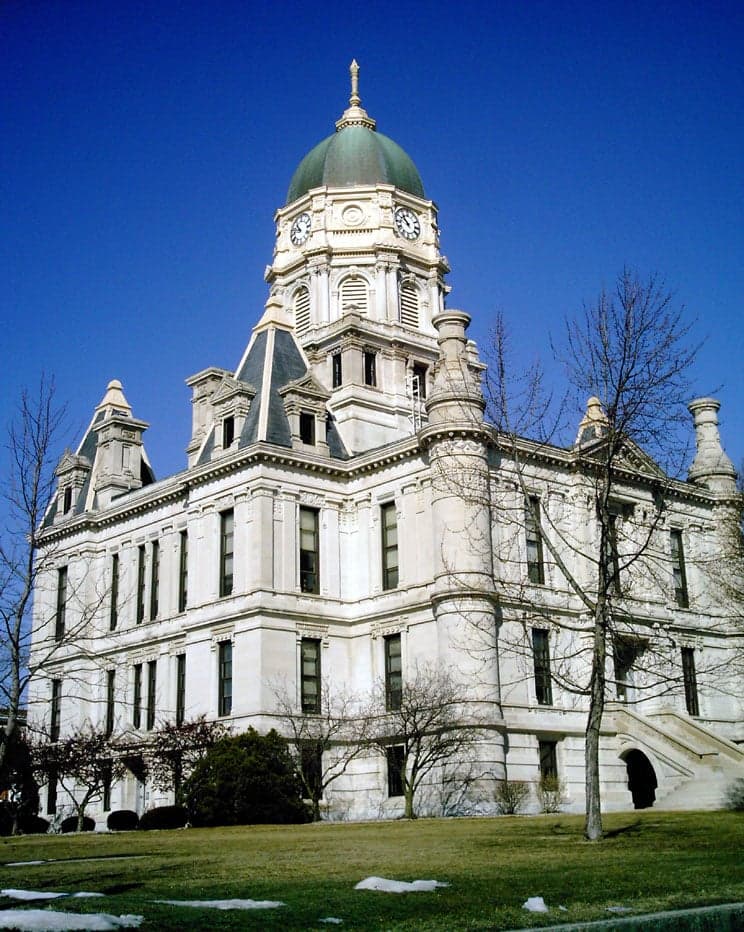
Photo: Wikipedia
Demographics of Whitley County
Historical data isn't available for Whitley County. Trends shown are for Indiana.
Affluence Level in Whitley County
A middle-class area roughly in line with national averages across income, home values, education, and employment.
People of Whitley County
Whitley County, Indiana, is home to roughly 34,400 residents, a population that remains overwhelmingly white (92.7%) and overwhelmingly native-born, with a foreign-born share of just 0.2% — one of the lowest in the nation. This is a rural-to-suburban county in the Fort Wayne metro orbit, where the dominant cultural identity is still shaped by its 19th-century Yankee and German Protestant roots, layered with a steady trickle of Midwestern domestic migration. The county seat, Columbia City, anchors a community that is politically and socially conservative, church-oriented, and defined more by its farming heritage and small-town manufacturing base than by any recent wave of immigration.
Settlement & growth (pre-1960)
Before American settlement, the area that became Whitley County was the domain of the Miami and Potawatomi nations, who used the Eel River and its tributaries for fishing and travel. The 1838 Potawatomi Trail of Death forcibly removed most of these communities, and the county was formally organized in 1835, named for a U.S. Army officer killed at the Battle of the Thames. The first permanent American settlers were Yankees from New England and upstate New York, who arrived in the 1830s and 1840s, drawn by cheap federal land offered at $1.25 per acre. These early arrivals founded Columbia City (the county seat, platted in 1835), Churubusco, and the smaller hamlets of Larwill and South Whitley, and they brought with them a distinctly New England flavor of Congregational and Presbyterian church life, town-meeting governance, and an emphasis on public schooling.
The next major wave came in the 1840s through the 1860s, when German immigrants — many of them Protestant farmers from Hanover, Hesse, and Westphalia — pushed into the county's rich, glaciated loam. They established a dense cluster of German Lutheran and Reformed congregations in the townships around Columbia City and in the village of Collins, and their descendants remain a visible plurality in the county's rural precincts today. A smaller but significant group of Irish immigrants arrived in the 1850s, largely as laborers on the Pittsburgh, Fort Wayne and Chicago Railroad, which laid track through the county in 1854 and put Columbia City on the map as a shipping point for grain and livestock. The railroad also brought a wave of English and Scots-Irish migrants from Ohio and Pennsylvania, who settled in the county's southern townships and in the town of South Whitley.
By 1900, the county's population had peaked at roughly 17,000, and it would remain essentially flat for the next six decades. The economy shifted from subsistence farming to commercial agriculture — corn, soybeans, and dairy — supplemented by small factories producing wagon parts, furniture, and later automotive components. The 1920s and 1930s saw a modest influx of Appalachian migrants from Kentucky and Tennessee, drawn by factory work in Columbia City and by the oil and gas boom that briefly touched the county's northern edge. But unlike industrial counties further north, Whitley never attracted Southern European or Eastern European immigrants in significant numbers; its foreign-born share was already below 2% by 1930, and it has stayed there ever since.
Modern era (post-1965)
The 1965 Hart-Cellar Act, which transformed U.S. immigration policy, had almost no measurable effect on Whitley County. The county's foreign-born population today is 0.2% — roughly 70 people out of 34,000 — and there are no immigrant enclaves, no ethnic grocery stores, and no non-English-language churches anywhere in the county. The Hispanic share, at 2.6%, is the only minority population of any size, and it is composed almost entirely of U.S.-born citizens of Mexican descent, many of them families who arrived in the 1990s and 2000s to work in the county's poultry processing plants and in the RV manufacturing industry that has become a regional staple. These families are dispersed rather than concentrated, though a small cluster has formed in and around Columbia City, where a Spanish-language Catholic Mass is offered monthly.
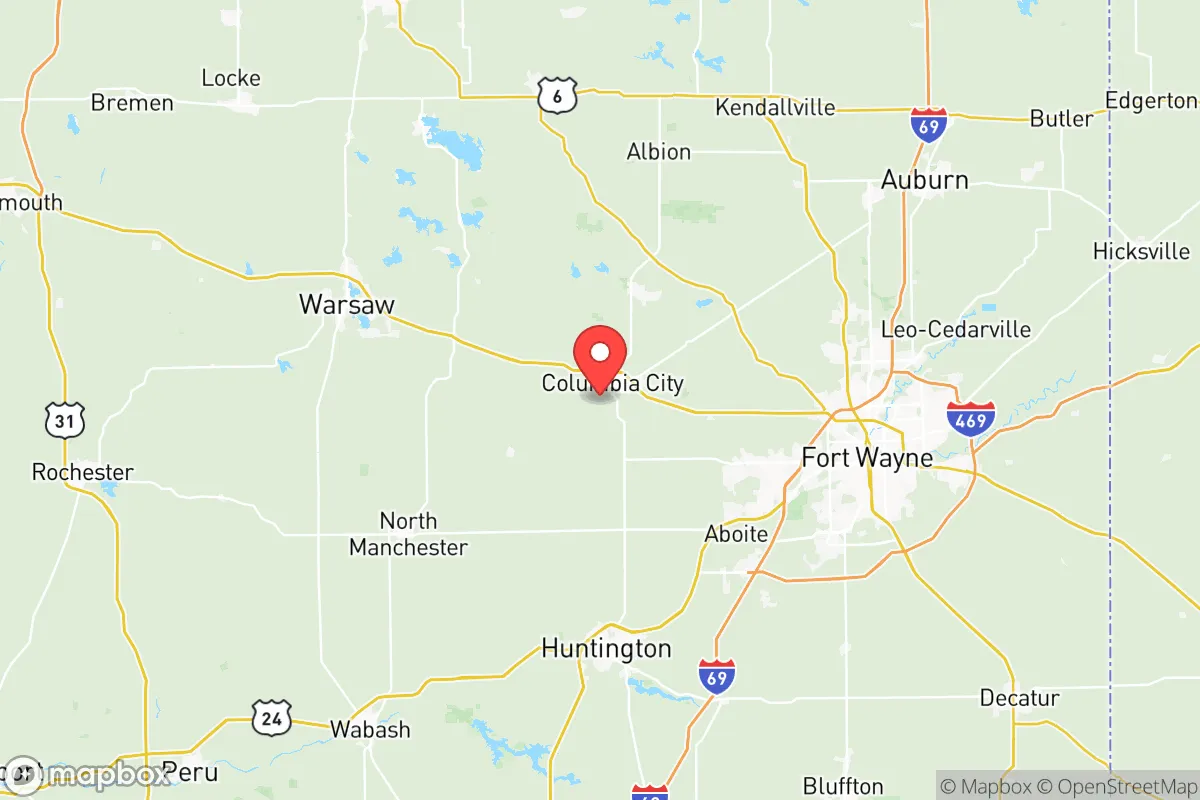
The county's real demographic story since 1965 is domestic, not international. The construction of Interstate 69 in the 1970s, running north-south through the county's western edge, turned Whitley into a bedroom community for Fort Wayne, 20 miles to the south. Suburban development has concentrated in the townships closest to the interstate — particularly around the town of Churubusco and the unincorporated area near the I-69 interchange at U.S. 30 — while the county's eastern and northern townships remain firmly agricultural. The population has grown by roughly 25% since 1990, almost entirely through white domestic in-migration from Allen County (Fort Wayne) and from other Rust Belt counties in Indiana and Ohio. These newcomers are typically young families seeking lower taxes, larger lots, and better schools than they can find inside the city limits.
The county's racial demographics have barely budged: Black residents make up 0.2% of the population, East and Southeast Asian residents 0.3%, and Indian-subcontinent residents 0.0%. The college-educated share, at 22.8%, is below the national average, reflecting an economy that still leans on manufacturing, agriculture, and logistics rather than professional services. The largest employers are Dana Incorporated (axle manufacturing), the county's three school corporations, and a network of RV and boat manufacturers that have made the broader region a national hub for recreational vehicle production.
The future
Whitley County is projected to continue its slow, steady growth — reaching roughly 37,000 to 38,000 residents by 2040 — but it is not projected to become meaningfully more diverse. The Hispanic share may edge up to 4-5% as younger families age into childbearing years, but the county's low housing stock, lack of rental options, and absence of any immigrant-serving infrastructure make it an unlikely destination for new international arrivals. The more significant demographic shift is age: the county's median age is already 41, and the 65-and-older cohort is growing faster than the under-18 cohort, as retirees from Fort Wayne move out to the county's lakes — particularly around the chain of glacial lakes near Churubusco and the town of Tri-Lakes.
The cultural identity of the county is likely to remain stable: white, Protestant, conservative, and rooted in a small-town Midwestern ethos that prizes self-reliance, church membership, and high school sports. The most visible change over the next decade will be the continued suburbanization of the county's southwestern corner, as Fort Wayne's exurban sprawl pushes further north along the I-69 corridor. That growth will bring more commuters, more chain retail, and more pressure on the county's rural character, but it is unlikely to bring significant racial or ethnic change.
For someone moving to Whitley County today, the bottom line is this: you are choosing a place that is demographically homogeneous, culturally traditional, and economically stable, but not dynamic. The county offers affordable housing, safe streets, and a strong sense of community in Columbia City, Churubusco, and South Whitley, but it offers little in the way of ethnic diversity, cosmopolitan amenities, or demographic momentum. It is a place where the population is slowly aging, slowly growing, and slowly becoming more suburban — but where the fundamental character of the people, descendants of Yankee farmers and German Lutherans, remains remarkably unchanged from a century ago.

* Values derived from national, state, county, city and local statistics and may differ in a specific area. Last updated: 2026-10-23T01:06:39.000Z
Narrative content on this page is AI-generated and may contain mistakes. Verify any details that matter before acting on them.
ReloMaps may earn a commission from affiliate links at no extra cost to you.

