Photo: Wikipedia
Political ClimatePolitical Climate in Vigo County
Showing district-level results — no local-only data available.
Local Political AnalysisPolitical Analysis of Vigo County
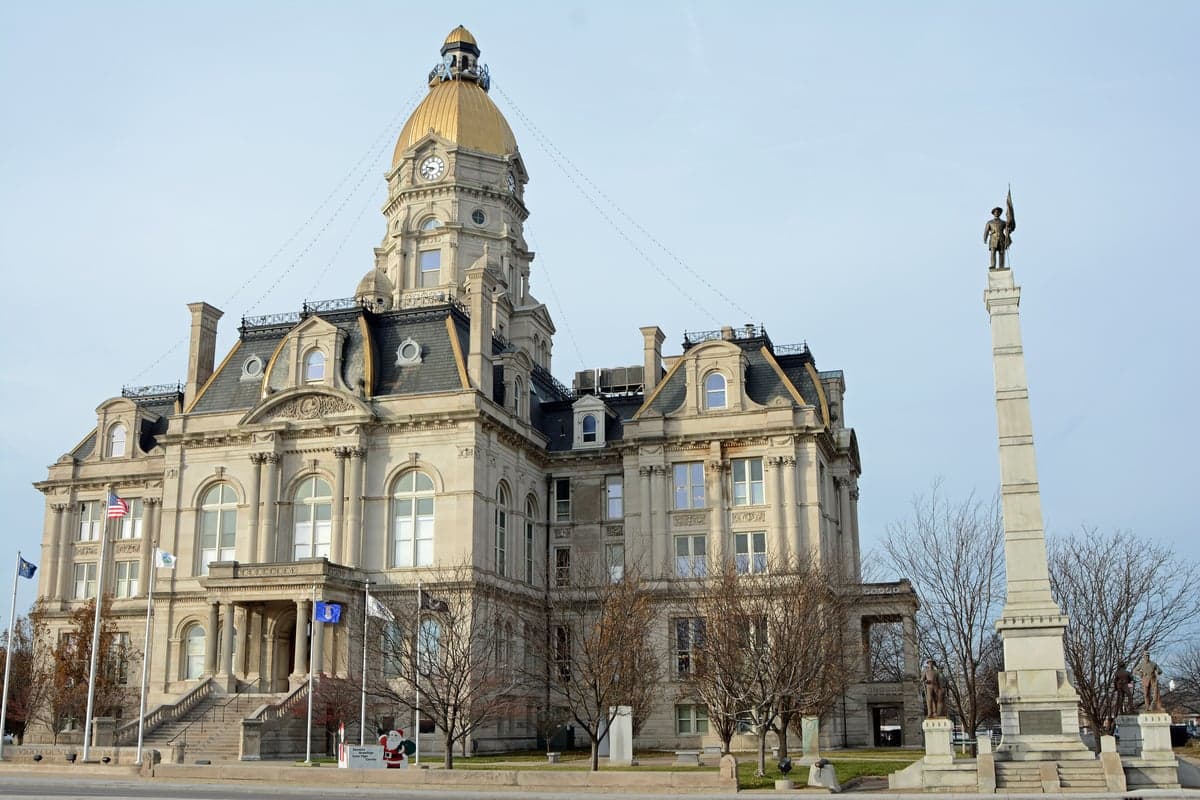
Vigo County, Indiana, is a reliably Republican stronghold with a Cook Partisan Voting Index of R+18, making it significantly more conservative than the state of Indiana as a whole, which sits at R+9. This isn't a new development; the county has been trending red for decades, though the margins have widened in recent presidential cycles. While the county seat, Terre Haute, provides a slight blue tint due to its union history and university influence, the surrounding towns and rural areas—like West Terre Haute, Seelyville, and Riley—overwhelmingly vote Republican, creating a political landscape that feels distinctly more conservative than the state average.
How it compares
The R+18 rating means Vigo County is roughly nine points more Republican than Indiana as a whole. To put that in perspective, while Indiana itself is a solidly red state, Vigo County votes more like a deep-red rural county in the southern part of the state. In the 2024 presidential election, Donald Trump carried Vigo County by a margin of roughly 62% to 36%, a 26-point spread that far exceeded his statewide margin of about 18 points. The difference is most stark when you look at precinct-level data: Terre Haute's central and near-campus precincts, particularly around Indiana State University, often vote Democratic by 10-15 points, but those votes are easily swamped by the rural and suburban precincts in the county's eastern and southern townships. Towns like Prairie Creek and Lewis regularly deliver 70%+ Republican margins, while the small village of Saint Mary-of-the-Woods leans slightly more moderate due to the presence of the Catholic college there. The swing precincts are actually in the suburban fringe of Terre Haute—places like Honey Creek and Riley—where independent voters can shift the countywide totals by a few points in a close race.
What this means for residents
For conservative residents, the political climate is comfortable and affirming. Local offices—county commissioners, sheriff, and most school board seats—are reliably held by Republicans, and policy debates tend to center on fiscal conservatism, property tax relief, and rural infrastructure. For liberal residents, the reality is more about finding community in specific pockets. Terre Haute's downtown and near-campus areas are where you'll find Democratic-leaning social circles, and the local Democratic Party remains active, but statewide and national candidates rarely invest heavily in the county because the outcome is largely predetermined. This dynamic means that while national politics can feel one-sided, local governance is often pragmatic and less ideologically charged than in more competitive counties. The county's conservative lean also influences cultural institutions: churches are prominent, gun ownership is common, and public discourse tends to emphasize self-reliance and traditional values.
One notable cultural distinction is the county's relationship with organized labor. Despite its red lean, Vigo County has a strong union heritage, particularly in the construction trades and at the now-diminished manufacturing plants like the former Pfizer facility and the CSX rail yard. This creates an interesting tension: many union members vote Republican for president but support Democratic candidates for local labor-friendly policies. This blue-collar conservatism is a defining feature of the area, setting it apart from more affluent, suburban Republican counties in Indiana. Looking ahead, the county's political trajectory seems stable—demographic trends show an aging, predominantly white population with slow growth, which typically reinforces existing partisan patterns. The wildcard is Indiana State University: if enrollment grows and brings in more out-of-state or diverse students, Terre Haute's blue precincts could expand, but for the foreseeable future, Vigo County will remain a reliably red anchor in a red state.

State Political ClimatePolitical Climate in Indiana
State Political AnalysisPolitical Environment in the State
Indiana is a reliably Republican state with a Cook PVI of R+9, meaning it votes about nine points more Republican than the national average in presidential elections. Over the past 20 years, the state has shifted rightward, driven by the consolidation of rural and exurban voters around the GOP and the steady erosion of Democratic strength in its industrial and union-heavy regions. While no one would mistake Indiana for a swing state, the political reality is more layered than the top-line numbers suggest — especially for someone considering a move here.
Urban vs. rural divide
The political map of Indiana is a classic study in contrast. The state’s largest city, Indianapolis (Marion County), is a Democratic stronghold, delivering about 60-65% of its vote to Democratic presidential candidates in recent cycles. But the city is surrounded by a ring of deeply Republican suburbs and exurbs — places like Carmel, Fishers, and Noblesville in Hamilton County, which routinely vote 60-70% Republican. These suburbs have grown explosively over the past two decades, and their political weight has helped push the state’s overall lean rightward. Fort Wayne (Allen County) is more competitive but leans Republican, while Evansville (Vanderburgh County) has trended redder as its industrial base has shrunk. Bloomington (Monroe County), home to Indiana University, is a liberal island in a sea of red, voting about 60% Democratic. The rest of the state — vast stretches of farmland, small towns, and medium-sized cities like Terre Haute, Kokomo, and Muncie — votes overwhelmingly Republican. The rural-urban split is stark: in 2020, Donald Trump won 80 of Indiana’s 92 counties, often by margins of 70% or more in the most rural ones.
Policy environment
Indiana’s policy environment reflects its Republican lean. The state has a flat income tax rate of 3.15% (as of 2025, with further cuts scheduled), and property taxes are capped at 1% of assessed value for owner-occupied homes, 2% for rental properties, and 3% for commercial property — a constitutional amendment passed in 2010. There is no inheritance tax, and the state sales tax is 7%. The regulatory posture is generally business-friendly, with a right-to-work law (passed in 2012) and a low corporate income tax rate of 4.9%. On education, Indiana has a robust school choice program, including vouchers that can be used at private and religious schools, and a growing network of charter schools. The state’s education policy has been a national model for school choice advocates. Healthcare policy is more limited: Indiana expanded Medicaid under the Affordable Care Act in 2015, but through a conservative, market-based waiver program called the Healthy Indiana Plan (HIP). The state has not expanded abortion access post-Dobbs; instead, a near-total abortion ban was enacted in 2023, with limited exceptions for rape, incest, and fatal fetal anomalies, and only up to 10 weeks for rape and incest. Election laws are moderately restrictive: voter ID is required, early voting is available for 28 days, and absentee voting requires an excuse (though the excuse requirement was temporarily waived during COVID and has since been reinstated).
Recent policy direction
Indiana’s recent legislative sessions have moved the state decisively in a conservative direction across multiple fronts. On gun rights, Indiana became a permitless carry state in 2022, allowing any law-abiding adult to carry a handgun without a license. On education and parental rights, the state passed a law in 2023 requiring schools to notify parents if a child requests a name or pronoun change, and banning instruction on human sexuality in grades K-3. On speech and privacy, Indiana passed a law in 2024 restricting the use of TikTok on state-owned devices and limiting certain data collection practices. On medical and bodily autonomy, the near-total abortion ban took effect in 2023, and the state has also restricted gender-affirming care for minors, banning it in 2023. On property rights, Indiana has a relatively strong eminent domain framework, but property taxes remain capped and predictable. On voting and ballot access, the state has tightened absentee voting rules and purged inactive voters from rolls, but has also expanded early voting hours in some counties. On taxation, the state is on a path to eliminate the individual income tax entirely, with a plan passed in 2024 to phase it down to 2.9% by 2029 and eventually zero, contingent on revenue growth. The overall direction is toward lower taxes, fewer regulations, and a more culturally conservative social policy.
Civil unrest & political movements
Indiana has seen its share of political activism, though it rarely makes national headlines. The most visible flashpoints in recent years have been around abortion and education. In 2022 and 2023, large protests erupted at the Statehouse in Indianapolis over the abortion ban, with thousands of demonstrators on both sides. The state has also seen organized school board activism, particularly in suburban districts like Hamilton County and Johnson County, where debates over curriculum, library books, and parental rights have been heated. Immigration politics are less visible in Indiana than in border states, but there have been localized controversies, such as in Logansport, where a growing immigrant population has sparked tension. There is no sanctuary city policy anywhere in Indiana; in fact, state law prohibits sanctuary policies. Election integrity controversies have been relatively muted compared to other states, though there were some disputes over the 2020 election results in a few counties. The state has not seen significant secession or nullification rhetoric. Overall, political activism in Indiana is real but localized — a new resident is unlikely to encounter daily political friction unless they seek it out.
Projection
Over the next 5-10 years, Indiana is likely to become more Republican, not less. The demographic trends driving this are clear: the fastest-growing parts of the state are the conservative suburbs around Indianapolis, while the Democratic-leaning urban core and the shrinking industrial towns are losing population. In-migration to Indiana is coming disproportionately from other Midwestern states and from the coasts, but the new arrivals tend to be drawn by lower taxes and housing costs, which correlates with a more conservative political orientation. The state’s Republican supermajority in the legislature is unlikely to be seriously challenged, and the policy direction — lower taxes, school choice expansion, cultural conservatism — will continue. For a liberal resident, this means living in a state where their political views are increasingly marginal, especially outside of Bloomington or central Indianapolis. For a conservative resident, it means living in a state where their priorities are likely to be enacted into law with little opposition. The one wild card is the possibility of a Democratic resurgence in the suburbs if national politics shift, but that would require a major realignment that is not currently visible in the data.
For a new resident, the bottom line is this: Indiana is a state where conservative policies are the norm and are likely to remain so for the foreseeable future. If you are a conservative, you will find a government that broadly shares your values on taxes, education, gun rights, and social issues. If you are a liberal, you will find a state where your vote carries less weight, but where the cost of living is low and the political climate is stable rather than volatile. Either way, the political reality is straightforward — Indiana is a red state, and it is getting redder.
* Values derived from national, state, county, city and local statistics and may differ in a specific area. Last updated: 2026-07-09T14:48:37.000Z
Narrative content on this page is AI-generated and may contain mistakes. Verify any details that matter before acting on them.
ReloMaps may earn a commission from affiliate links at no extra cost to you.

