Photo: Wikipedia
Demographics of Vigo County
Affluence Level in Vigo County
A low-income area with significant economic hardship. Household wealth and educational attainment are well below national averages.
People of Vigo County
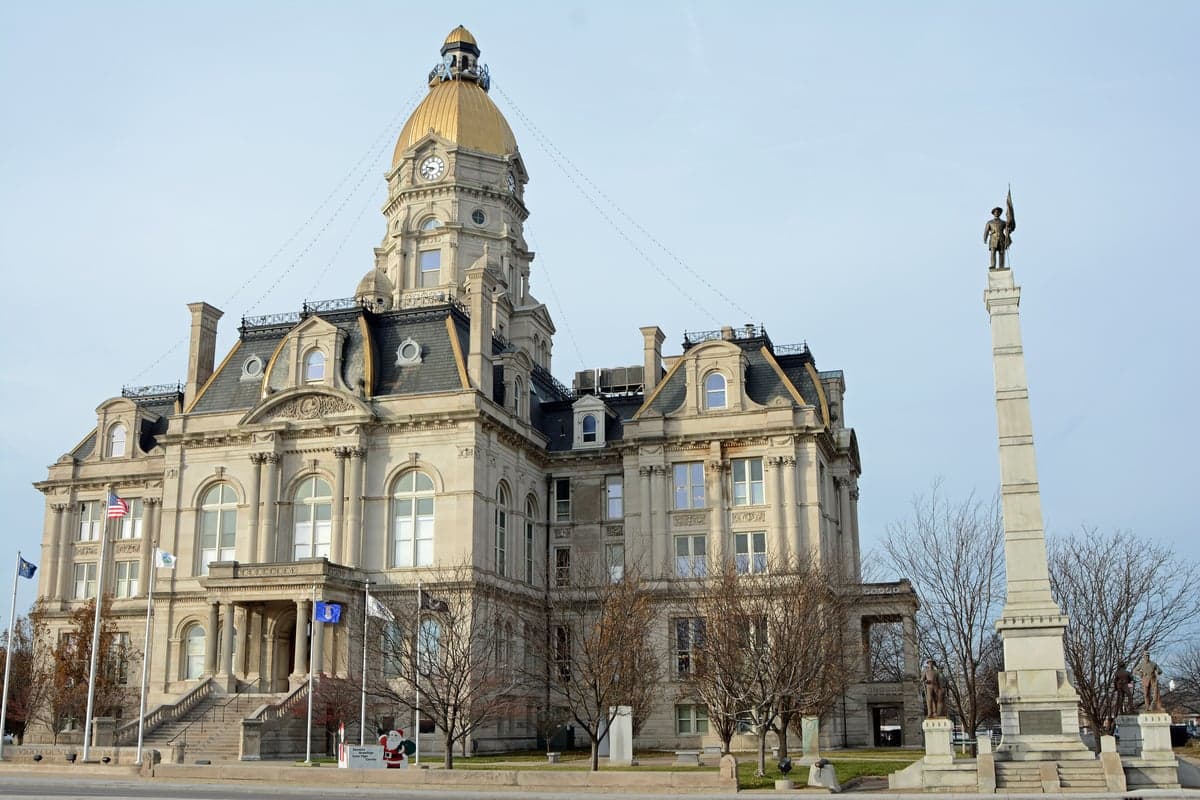
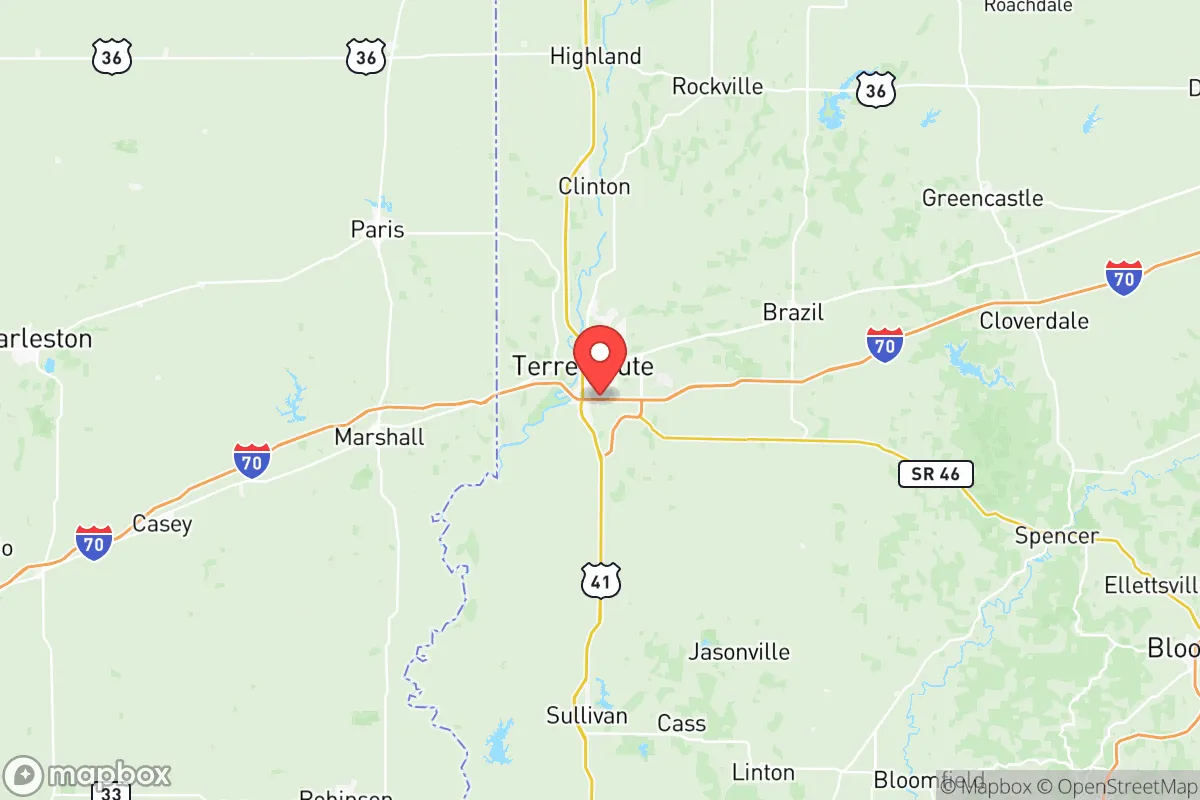
Today, Vigo County is home to 106,201 residents, a population that is 84.3% white and notably less diverse than the national average, with a foreign-born share of just 1.7%. The county's character is defined by its anchor city, Terre Haute, a historic industrial and railroad hub on the Wabash River that has seen its manufacturing base shrink and its population stagnate. This is a community with deep roots in the 19th-century waves of European immigration and a modest but growing Hispanic and Black presence, giving it a stable, working-to-middle-class identity that leans conservative in its cultural and political outlook.
Settlement & growth (pre-1960)
Long before European settlement, the area that is now Vigo County was home to the Miami and Wea nations, who controlled the fertile Wabash River valley. The first permanent American settlers arrived after the War of 1812, drawn by the promise of rich bottomland for farming. The county was formally organized in 1818 and named for Francis Vigo, an Italian-born fur trader who aided the American cause during the Revolutionary War. The earliest settlers were overwhelmingly of Scots-Irish and English stock, moving west from Kentucky, Ohio, and the upland South.
The real transformation began with the arrival of the railroad in the 1850s. Terre Haute became a major junction for the Terre Haute & Indianapolis and the Wabash & Erie railroads, turning the town into a manufacturing and coal-mining center. This industrial boom pulled in a wave of German and Irish immigrants in the 1850s and 1860s, who settled in working-class neighborhoods near the rail yards and the Wabash River, particularly in the city's south and west sides. By the 1870s, the coal mines and glass factories of the region attracted Italian and Polish immigrants, who formed small but distinct ethnic enclaves in Terre Haute's central and north-side neighborhoods. The town of West Terre Haute, across the river, became a particularly stronghold for Italian families working the mines.
The post-Civil War period also saw a small but steady migration of freed African Americans from the South, who settled primarily in Terre Haute's near-east side and around the 13th and 14th Street corridor. By 1900, Terre Haute was a bustling industrial city of over 36,000, with a diverse European-born population and a Black community that made up roughly 5% of the total. The early 20th century brought a smaller wave of Eastern European Jews and Greeks, who established businesses along Wabash Avenue and in the downtown commercial district. The Great Migration of Black Americans from the South accelerated during World War I and again during World War II, as Terre Haute's factories—including the massive Columbia Enameling & Stamping Company and the American Can Company—needed labor. The county's population peaked at roughly 108,000 in the 1960s, just as the industrial economy began its long decline.
Modern era (post-1965)
The post-1965 period in Vigo County has been defined more by domestic out-migration than by new international arrivals. The foreign-born population today is just 1.7%, far below the national average of roughly 14%, and the county has not seen the large-scale immigration from Latin America or Asia that has reshaped much of the Midwest. The Hispanic population, at 3.1%, is the fastest-growing minority group, driven by Mexican and Central American families who have moved into the area for work in warehousing, logistics, and agriculture. These newer residents are concentrated in Terre Haute's south side and in the smaller towns of Riley and Seelyville, where affordable housing and proximity to Interstate 70 make settlement practical.
The Black population, now 6.1%, has remained relatively stable in share since the 1970s, though its geographic concentration has shifted. Many Black families moved out of the old near-east-side corridor into newer subdivisions on the city's north and east sides, particularly around the Honey Creek area and near Indiana State University. The East/Southeast Asian population, at 1.5%, is largely tied to the university and the medical community, with many families of Chinese, Korean, and Filipino descent living in the neighborhoods around the Indiana State University campus and near the Terre Haute Regional Hospital. The Indian-subcontinent population, at 0.6%, is similarly concentrated near the university and in professional-class subdivisions on the city's east side.
Domestically, Vigo County has experienced a net loss of population since the 1960s, as manufacturing jobs disappeared and younger residents moved to Indianapolis, Chicago, or the Sun Belt. The county's population has declined by roughly 2% since 2010, and the median age has risen to 39.5. Suburbanization has been modest, with some growth in the unincorporated areas around Prairie Creek and North Terre Haute, but the county lacks the explosive exurban development seen in counties closer to Indianapolis. The town of Brazil, in neighboring Clay County, has seen some spillover from Vigo County residents seeking lower property taxes, but within Vigo County itself, the population remains heavily centered on Terre Haute and its immediate surroundings.
The future
Vigo County is likely to become slightly more diverse over the next 10 to 20 years, but the pace of change will be slow. The Hispanic population is projected to grow to roughly 5-6% of the total by 2040, driven by continued migration for logistics and warehouse jobs along the I-70 corridor. The Black and Asian populations are expected to remain stable or grow modestly, largely through births rather than new immigration. The county's overall population is projected to decline slightly or hold steady, as out-migration of young adults continues to offset any gains from immigration or natural increase.
The cultural identity of Vigo County is likely to remain rooted in its European-American, working-class heritage, with a growing but still small Hispanic influence. The county's political leanings have shifted rightward in recent cycles, reflecting the national trend of rural and post-industrial counties moving toward the Republican Party. For a new resident moving in now, Vigo County offers a low-cost, low-hassle lifestyle with a strong sense of local history, but it is not a place of rapid demographic change or cosmopolitan diversity. It is a county that is slowly aging, slowly diversifying, and slowly adjusting to a post-industrial economy—a stable, if not dynamic, place to put down roots.
For someone moving in today, Vigo County is a place where the past is still very present. The descendants of the German, Irish, Italian, and Polish immigrants who built the factories and mines still form the backbone of the community, and the newer Hispanic and Asian families are integrating into a social fabric that values stability, church, and family. The county is not becoming a melting pot in the way that larger Midwestern cities are, but it is becoming a slightly more varied version of itself—a quiet, affordable, and historically grounded corner of Indiana where the population is holding steady rather than surging or collapsing.

* Values derived from national, state, county, city and local statistics and may differ in a specific area. Last updated: 2026-07-09T14:48:37.000Z
Narrative content on this page is AI-generated and may contain mistakes. Verify any details that matter before acting on them.
ReloMaps may earn a commission from affiliate links at no extra cost to you.

