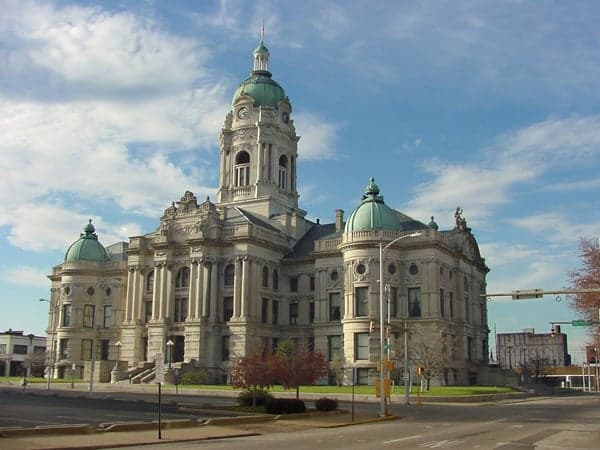
Photo: Wikipedia
Demographics of Vanderburgh County
Affluence Level in Vanderburgh County
A middle-class area roughly in line with national averages across income, home values, education, and employment.
People of Vanderburgh County
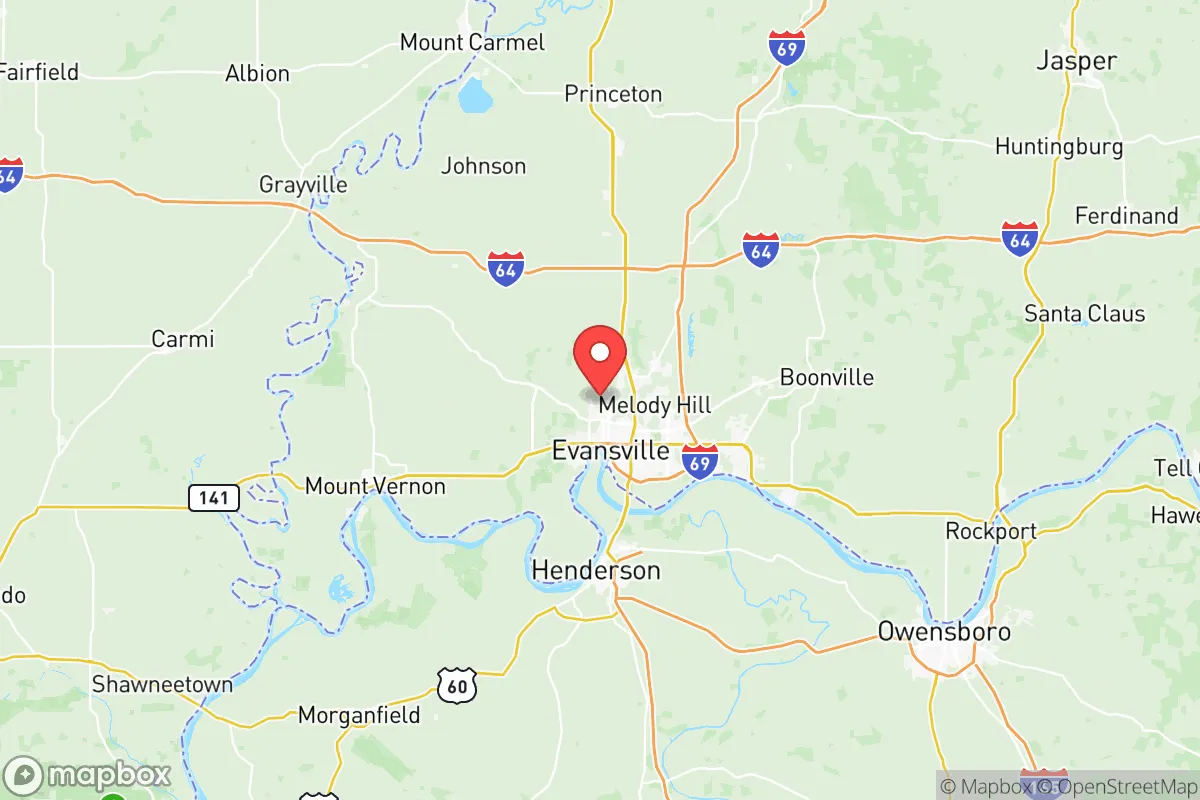
Vanderburgh County, anchored by Evansville, is home to 179,908 residents who form a predominantly white (80.8%) and historically rooted population with a modest 2.0% foreign-born share, giving the area a distinctly Midwestern, multi-generational character. The county’s identity is shaped by its Ohio River location, a legacy of German Catholic and Protestant settlement, and a slow but measurable diversification driven by Black (9.7%) and Hispanic (3.6%) growth since the 1990s. With a college-educated rate of 27.1%, below the national average, the workforce remains heavily tied to manufacturing, healthcare, and logistics. For a conservative-leaning audience, Vanderburgh County offers a stable, family-oriented environment where community ties run deep and change arrives gradually.
Settlement & growth (pre-1960)
Before European settlement, the area was part of the hunting and trading grounds of the Miami, Shawnee, and Delaware nations, who used the Ohio River corridor for travel and commerce. French fur traders and missionaries passed through as early as the 1700s, but no permanent European settlement took hold until after the American Revolution. The 1803 Louisiana Purchase and subsequent treaties with Native nations opened the region to Anglo-American settlers, and the county was formally organized in 1818.
The first major wave of settlers were Upland Southerners — primarily of Scots-Irish and English descent — who crossed the Ohio River from Kentucky and Tennessee between 1810 and 1840. They established small farms and river landings, with the earliest concentrations at Evansville (founded 1812), Lamasco (an early river town later absorbed into Evansville), and Howell, a farming hamlet that grew around a mill. These early arrivals were largely Protestant, Democratic-leaning, and subsistence-oriented, laying the county's foundational rural character.
The defining demographic event was the German immigration wave of 1840–1880. German Catholics and Lutherans, fleeing economic hardship and political unrest in the German states, were drawn to Vanderburgh County by the availability of farmland, the growing river trade, and the promise of religious freedom. They settled heavily in Evansville's West Side, around St. Boniface and St. Joseph parishes, and in the rural townships of German (named for the settlers themselves), Knight, and Perry. By 1870, German-born residents made up roughly a third of the county's population. They brought with them a strong work ethic, a tradition of brewing and winemaking, and a Catholic institutional framework that still shapes the county's social fabric. The German influence remains visible today in Evansville's annual Germania Männerchor events and the persistence of German surnames across the county.
A smaller but significant Irish immigration occurred in the 1850s–1870s, with Irish laborers arriving to work on the Evansville & Terre Haute Railroad and the Ohio River levees. They concentrated in Evansville's Lower East Side and the riverfront neighborhoods near the old rail yards, forming a distinct Catholic enclave that gradually merged with the German community. Unlike the Germans, the Irish were more transient, and their numbers declined as rail work moved westward.
The Great Migration of African Americans from the rural South reached Vanderburgh County in two pulses: a smaller wave during World War I (1915–1920) for factory jobs, and a much larger wave during and after World War II (1940–1960). Black migrants, primarily from western Kentucky and Tennessee, settled in Evansville's near South Side and the Baptisttown neighborhood, a historic Black business and residential district. By 1960, Black residents made up roughly 8% of the county's population, a share that would grow modestly in the decades to follow. The county's industrial base — including Whirlpool (opened 1947), Bristol-Myers Squibb, and various automotive parts plants — provided steady employment that anchored these families.
Suburbanization began in earnest after World War II, with white families moving from Evansville's urban core to new developments in Darmstadt, Highland, and Melody Hill. These unincorporated communities grew rapidly in the 1950s and 1960s, offering larger lots, new schools, and a more homogeneous social environment. The construction of the Lloyd Expressway (completed in stages from the 1960s through the 1990s) accelerated this outward movement, connecting the suburbs to downtown Evansville's employment base.
Modern era (post-1965)
The 1965 Hart-Cellar Act had a muted effect on Vanderburgh County compared to coastal or Sun Belt regions. The foreign-born population remains low at 2.0%, and the county did not experience the large-scale immigration from Asia or Latin America seen in many Midwestern cities. However, the Hispanic population has grown steadily since the 1990s, rising from under 1% in 1990 to 3.6% today. This growth is driven primarily by Mexican and Central American immigrants recruited for work in manufacturing, construction, and agriculture. They have concentrated in Evansville's West Side and in the unincorporated area around St. Joseph, where a small but visible cluster of Hispanic-owned businesses and a Spanish-language Catholic Mass have emerged.
The East/Southeast Asian community (1.2% of the population) is a more recent addition, arriving primarily since 2000. A small number of Vietnamese and Filipino families came as professionals in healthcare and engineering, settling in Evansville's North Side and the Highland area. There is no formal Asian enclave, but a scattering of Asian grocery stores and restaurants in central Evansville serves this community. The Indian subcontinent population (0.1%) is negligible, consisting mostly of medical professionals at Deaconess and St. Vincent hospitals.
Domestic migration has been the larger force shaping modern Vanderburgh County. The county has experienced a slow but steady population decline since its 1970 peak of 198,000, driven by the loss of manufacturing jobs and the outmigration of young adults to larger metros like Indianapolis, Nashville, and Atlanta. However, the county has also attracted a modest inflow of retirees and remote workers from Illinois and the Rust Belt, drawn by lower housing costs and a lower cost of living. These newcomers tend to settle in Newburgh, a fast-growing Ohio River town in the county's southeast corner, and in the suburban fringe around McCullough and Inglefield.
Suburbanization has continued, with Newburgh emerging as the county's most affluent and fastest-growing community. Its population has more than doubled since 1990, driven by families seeking top-rated schools (Warrick County School Corporation) and newer housing stock. This has created a demographic divide: Newburgh and the southeastern townships are whiter, wealthier, and more Republican-leaning, while Evansville's urban core is more diverse, older, and economically mixed.
The future
Vanderburgh County is projected to continue its slow population decline, with the Indiana Business Research Center forecasting a drop to roughly 175,000 by 2040. The county is becoming slightly more diverse, with the Hispanic and Black shares expected to rise to 5–6% and 11–12% respectively by 2040, while the white share falls to around 75%. The foreign-born population will likely remain below 3%, as the county lacks the job diversity and immigrant networks of larger metros.
The most significant demographic trend is the aging of the population. The median age has risen from 35 in 2000 to 40 today, and the share of residents over 65 is expected to reach 22% by 2040. This will increase demand for healthcare, senior housing, and age-restricted communities, particularly in Newburgh and Evansville's East Side. At the same time, the county is struggling to retain young adults, who continue to leave for college and career opportunities elsewhere.
Culturally, Vanderburgh County is likely to remain a conservative, family-oriented community with a strong sense of place. The German Catholic and Protestant heritage will persist as a cultural touchstone, even as the population becomes more diverse. New residents — whether retirees from Illinois or young families seeking affordable housing — will find a community that values stability, church involvement, and local sports, but may feel insular to outsiders.
For someone moving in now, Vanderburgh County offers a low-cost, low-stress environment with a deep sense of history and community. The population is stable, not growing, and the pace of change is slow. The county is becoming slightly more diverse and slightly older, but its essential character — rooted in German-American traditions, manufacturing heritage, and Ohio River commerce — will remain intact for the foreseeable future.

* Values derived from national, state, county, city and local statistics and may differ in a specific area. Last updated: 2026-07-22T17:06:36.000Z
Narrative content on this page is AI-generated and may contain mistakes. Verify any details that matter before acting on them.
ReloMaps may earn a commission from affiliate links at no extra cost to you.

