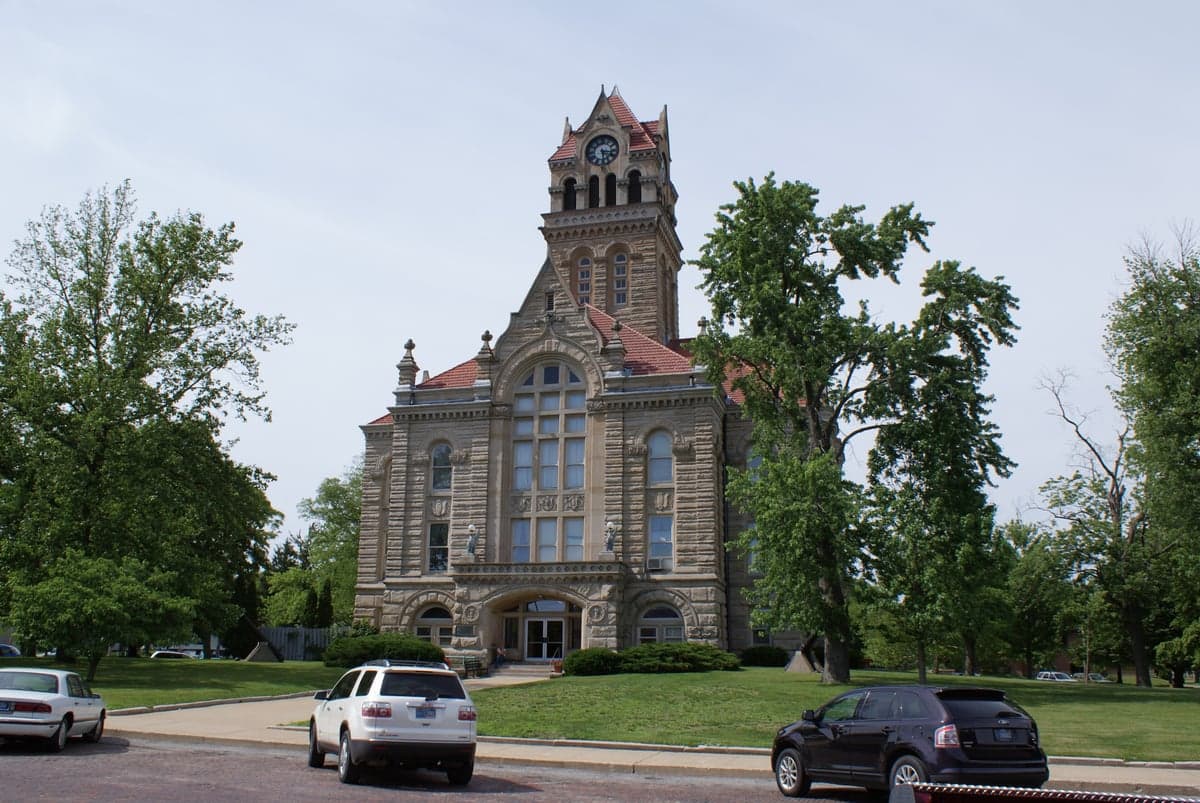
Photo: Wikipedia
Political ClimatePolitical Climate in Starke County
Showing county-level results — no local-only data available.
Lean and PVI are calculated from this county’s 2020 and 2024 presidential results, Cook-style.
Political rankings in Indiana
- Most Conservative Cities in Indiana
- Most Liberal Cities in Indiana
- Best Liberal-Leaning Towns in the Midwest
- Safest Liberal-Leaning Towns in the Midwest
- Safest Conservative-Leaning Towns in the Midwest
- Affordable Small Towns for Conservatives
- Most Affordable Liberal-Leaning Small Towns in the U.S.
- Safest Conservative-Leaning Cities in the U.S.
- Most Conservative Counties in Indiana
- Most Liberal Counties in Indiana
Local Political AnalysisPolitical Analysis of Starke County
Starke County, Indiana, is a reliably Republican area with a Cook PVI of R+13, making it notably more conservative than the state of Indiana as a whole, which sits at R+9. This isn't a new development; the county has voted for the GOP presidential candidate in every election since 2000, though the margins have tightened slightly in recent cycles as national trends shift. The political center of gravity is firmly in the rural, agricultural stretches, but there are real pockets of variation—especially in the county's smaller towns and along the rail corridor—that keep things from being a complete monolith.
How it compares
Starke County's R+13 rating is a full four points redder than Indiana's statewide R+9, which places it among the more conservative counties in the northern part of the state. To put that in perspective, while Indiana as a whole leans Republican in presidential races by about 9 points, Starke County typically delivers margins closer to 13-15 points for the GOP. The biggest contrast within the county is between the town of Knox, the county seat, and the more rural townships. Knox, with its larger population and a mix of manufacturing and service workers, tends to be more competitive—precincts there can swing within 5-8 points of the county average, and occasionally a Democrat running for local office can pull off a win. Meanwhile, towns like North Judson and Hamlet are reliably deep red, often voting 20+ points more Republican than the state average. The swing precincts are typically in the unincorporated areas around Bass Lake and Koontz Lake, where seasonal residents and retirees from more liberal areas (like Porter County) sometimes tip a precinct toward the center. In 2024, for example, the Bass Lake precinct voted about 5 points more Democratic than the county overall, a notable outlier.
What this means for residents
For conservative residents, the political climate means their values are broadly reflected in local governance—county commissioners, school boards, and the sheriff's office are almost uniformly Republican, and policy debates tend to center on tax rates, agricultural regulations, and Second Amendment rights. For liberal residents, the reality is more about finding community in smaller circles. There's no formal Democratic Party infrastructure to speak of in Starke County, but informal groups meet in Knox and around the lakes. The practical effect is that local elections are often decided in the Republican primary, not the general election, so the real political action happens in May, not November. This can be frustrating for progressives, but it also means that moderate Republicans—especially those focused on economic development or infrastructure—can sometimes win primaries if they run on local issues rather than national culture-war platforms.
Culturally, Starke County is distinct from the rest of Indiana in a few ways. It's one of the few counties in the state with a significant railroad heritage (the Chesapeake & Ohio line runs through North Judson), and that blue-collar, union-influenced history still lingers in some precincts, creating a strain of "Reagan Democrat" voters who split tickets. The county also has a higher-than-average number of Amish and Mennonite families, particularly around the Hamlet area, who tend to vote Republican but often prioritize local control and religious liberty over national party platforms. Policy-wise, the county has been slower than the state to embrace broadband expansion and renewable energy projects, reflecting a cautious, small-government ethos. But there's also a pragmatic streak: when a major employer like NIPSCO or a local hospital system needs zoning changes or tax abatements, the county commission has historically been willing to work across the aisle to get deals done. It's a place where the national political labels matter less than whether you show up to the town hall meeting and know the county council members by name.

State Political ClimatePolitical Climate in Indiana
State Political AnalysisPolitical Environment in the State
Indiana has been a reliably Republican state for decades, with a Cook Partisan Voting Index of R+9, meaning it votes about nine points more Republican than the nation as a whole. The dominant coalition is a mix of socially conservative rural voters, fiscally conservative suburbanites, and a growing number of working-class voters who have shifted rightward. Over the past 10-20 years, the state has moved from a competitive purple state—it voted for Barack Obama in 2008—to a solid red one, driven by the realignment of rural areas and the exodus of union-aligned Democrats from the industrial north.
Urban vs. rural divide
The political map of Indiana is a classic story of urban islands in a red sea. Indianapolis (Marion County) is the Democratic stronghold, delivering about 60% of its vote to Democratic candidates, but its influence is diluted by the deep-red suburbs like Hamilton County (Carmel, Fishers, Noblesville), which routinely vote 65-70% Republican. Lake County (Gary, Hammond) in the northwest corner is another Democratic bastion, powered by legacy union households and a significant Black population, but it’s shrinking. The rest of the state—places like Fort Wayne (Allen County), Evansville (Vanderburgh County), and Terre Haute (Vigo County)—have shifted rightward, with once-competitive counties now routinely going +20 to +30 points Republican. The rural south and central regions, including Bloomington (Monroe County), are a notable exception: Bloomington’s university population keeps it reliably blue, but it’s an outlier surrounded by deep-red countryside.
Policy environment
Indiana’s policy environment is shaped by a Republican supermajority that has controlled both chambers of the legislature since 2010. The state has a flat income tax rate of 3.05% (scheduled to drop to 2.9% by 2027), a low corporate tax rate of 4.9%, and no inheritance or estate tax. Property taxes are capped at 1% of assessed value for owner-occupied homes, a constitutional amendment that keeps them among the lowest in the Midwest. Education policy is dominated by school choice: Indiana has one of the nation’s largest voucher programs, with over 60,000 students using state-funded scholarships to attend private or religious schools. The state is a “right-to-work” state (passed in 2012), meaning workers cannot be required to join a union as a condition of employment. Election laws are moderately restrictive: voter ID is required, early voting runs 28 days, and no-excuse absentee voting is available. There is no state-level hate crime law, though a bias-motivated crime enhancement was passed in 2019 after years of controversy.
Recent policy direction
Over the last five years, Indiana has moved decisively to the right on a broad set of issues. In 2022, the legislature passed a near-total abortion ban (Senate Enrolled Act 1) with exceptions only for rape, incest, and lethal fetal anomalies, and a strict 20-week limit for those exceptions. The law was temporarily blocked by the courts but reinstated in 2023; a ballot measure to enshrine abortion restrictions in the state constitution is expected in the next few years. On gun rights, Indiana became a permitless carry state in 2022 (House Enrolled Act 1296), allowing any adult who can legally possess a firearm to carry it concealed or openly without a license. The state also passed a “stand your ground” law in 2019, removing the duty to retreat before using deadly force. On education, the state has banned instruction on “human sexuality” through grade 3 (House Enrolled Act 1608, 2023) and created a parental bill of rights that requires schools to notify parents of any changes to a student’s health or well-being. On privacy and surveillance, Indiana has no comprehensive data privacy law, but it did pass a ban on TikTok on state devices in 2023. Property rights are strong: the state has no statewide rent control, and eminent domain for private economic development is restricted. Voting access has tightened slightly: a 2021 law (Senate Enrolled Act 391) limited the use of drop boxes for absentee ballots and required that all absentee ballots be returned by mail or in person to the county election board.
Civil unrest & political movements
Indiana has seen its share of political flashpoints, though large-scale civil unrest is rare. The 2020 George Floyd protests in Indianapolis were significant, with several nights of property damage and a police shooting that killed a protester. The state’s immigration politics are relatively quiet: Indiana has no sanctuary cities, and a 2011 law (Senate Enrolled Act 590) requires local law enforcement to cooperate with federal immigration authorities, though enforcement varies. The “election integrity” movement has been active, with Republican county officials in places like Hamilton County pushing for hand-count audits and tighter ballot security, though no major fraud has been found. The most visible political movement in recent years has been the anti-abortion activism, which has been energized by the 2022 ban. On the left, the Indiana Democratic Party has struggled to maintain a foothold, with its strongest base in Indianapolis and Lake County. There is no serious secession or nullification rhetoric in Indiana; the state is firmly within the national political mainstream.
Projection
Over the next 5-10 years, Indiana is likely to remain solidly Republican, but the margins may narrow slightly as the Indianapolis suburbs diversify. Hamilton County is growing fast and becoming more moderate, while Lake County continues to lose population. The state’s in-migration is largely from other Midwestern states, not from coastal blue states, so the political culture is unlikely to shift dramatically. The biggest wildcard is the state’s abortion ban: if it becomes a major issue in local elections, it could mobilize suburban women and moderate Republicans, potentially flipping a few statehouse seats. But the supermajority is safe for the foreseeable future. A new resident moving in now should expect a state where conservative policies on taxes, guns, and education are the norm, and where the political debate is about how far right to go, not whether to go right at all.
For a new resident, the bottom line is that Indiana offers a low-tax, low-regulation environment with strong protections for gun rights and school choice, but with limited abortion access and a political culture that is deeply conservative outside of a few urban pockets. If you lean right, you’ll find a state that largely aligns with your values. If you lean left, you’ll find a small but active community in Indianapolis and Bloomington, but you’ll be voting in a state where your vote has limited impact on statewide outcomes. Either way, the state is stable, affordable, and politically predictable—which is exactly what many relocators are looking for.
* Values derived from national, state, county, city and local statistics and may differ in a specific area. Last updated: 2026-11-08T12:44:11.000Z
Narrative content on this page is AI-generated and may contain mistakes. Verify any details that matter before acting on them.
ReloMaps may earn a commission from affiliate links at no extra cost to you.

