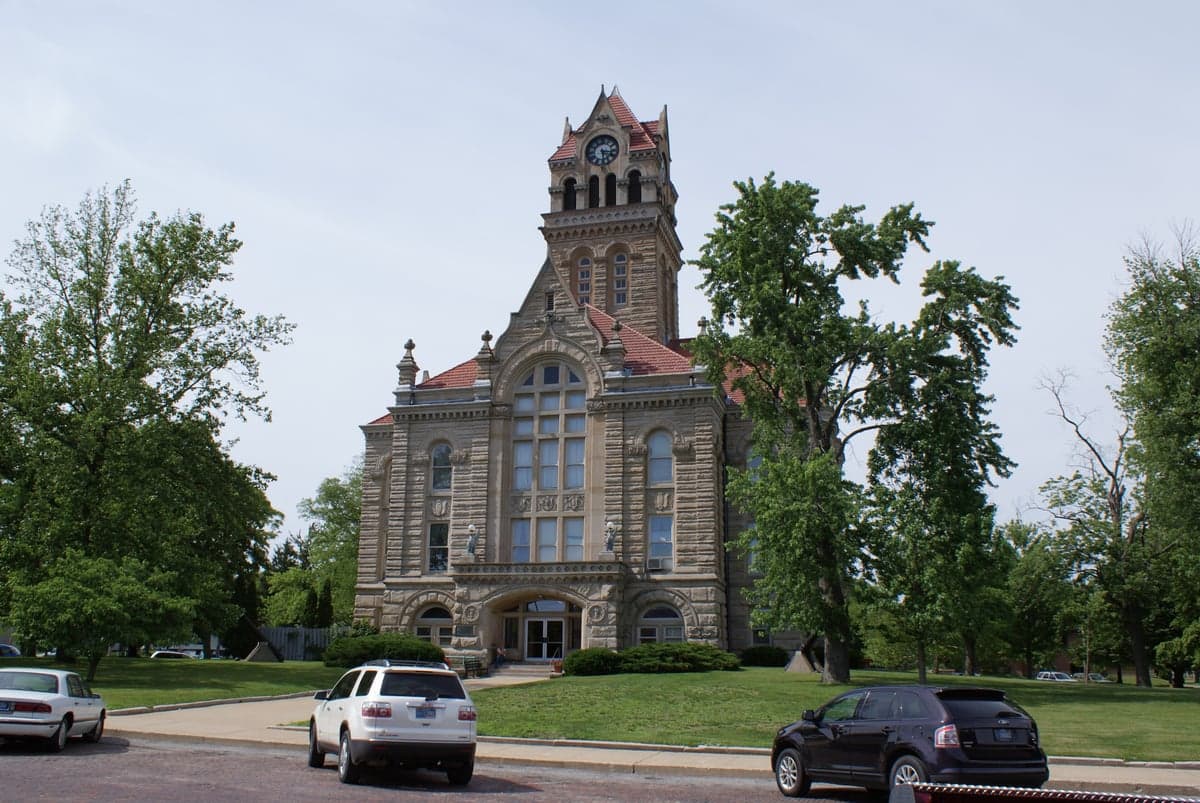
Photo: Wikipedia
Demographics of Starke County
Affluence Level in Starke County
A middle-class area roughly in line with national averages across income, home values, education, and employment.
People of Starke County
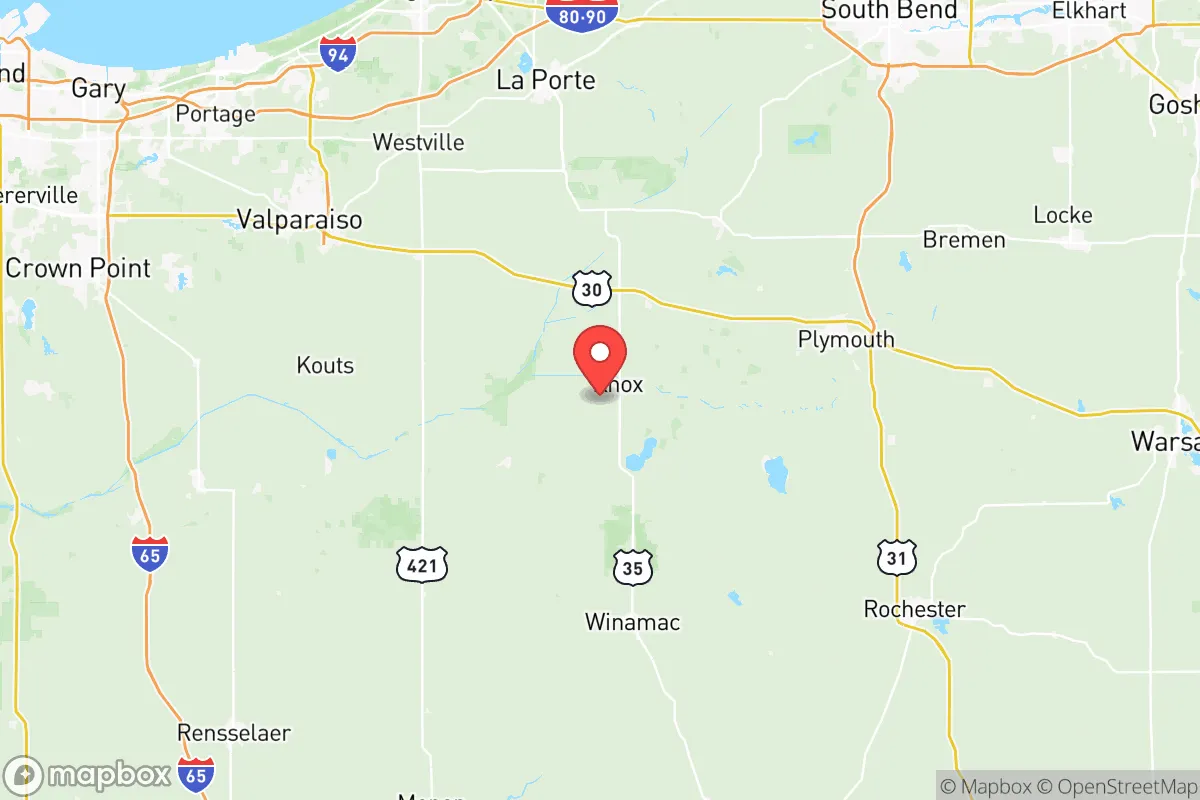
Starke County, Indiana, is home to roughly 23,300 residents, making it one of the state’s more sparsely populated counties. The population is overwhelmingly White (92.1%) and native-born (only 1.0% foreign-born), with a small but growing Hispanic community (4.1%) and minimal Black (0.4%) or East/Southeast Asian (0.3%) representation. With just 12.6% of adults holding a college degree, the county’s identity is rooted in rural, working-class traditions, centered on the towns of Knox (the county seat), North Judson, Hamlet, and Bass Lake.
Settlement & growth (pre-1960)
Before European settlement, the area that became Starke County was part of the hunting and trading grounds of the Miami and Potawatomi nations. The Potawatomi were forcibly removed in the 1830s via the Trail of Death, which passed through the region, clearing the land for American expansion. Starke County was formally organized in 1850, carved out of parts of neighboring counties, and its early settlers were overwhelmingly native-born Americans of English, Scots-Irish, and German descent moving west from Ohio, Pennsylvania, and New York.
The first major wave of settlement followed the construction of the Lake Erie and Western Railroad (later part of the Nickel Plate Road) in the 1850s, which connected the county to larger markets. The railroad spurred the founding of Knox (the county seat, platted in 1851) and North Judson (platted in 1855), both of which became agricultural service centers. A second wave arrived in the 1870s and 1880s, when the Baltimore and Ohio Railroad built a line through the southern part of the county, leading to the establishment of Hamlet (1870) and Grovertown (1872). These towns attracted a mix of German and Irish immigrants who worked as railroad laborers and farmers, though the foreign-born share never exceeded 10% even at its peak.
The late 19th and early 20th centuries saw the rise of the county’s other distinctive settlement: Bass Lake, a natural lake that became a summer resort destination for Chicagoans and South Benders after the interurban electric railway arrived in 1908. This seasonal tourism economy brought a different demographic—middle-class vacationers—but few permanent residents. The county’s population peaked at around 19,000 in 1910 and then stagnated for decades, as the agricultural economy offered few opportunities for newcomers. The Great Depression and World War II saw little net change, and by 1960 Starke County’s population was still under 18,000, with a nearly all-White, native-born character.
Modern era (post-1965)
The post-1965 period brought only modest demographic change to Starke County, in stark contrast to the urban and suburban growth seen elsewhere in Indiana. The 1965 Hart-Cellar Act, which opened immigration from Asia and Latin America, had almost no effect here: the foreign-born share remains at just 1.0%, and the East/Southeast Asian population is a negligible 0.3%. The county’s Hispanic population, however, has grown from near zero in 1970 to 4.1% today, driven by Mexican-origin families who moved into the area for agricultural work—particularly in the onion and mint farms around San Pierre and Denham—and for lower-cost housing relative to Lake County to the west.
Domestic migration has been the larger story. The decline of heavy manufacturing in nearby Gary and South Bend after 1980 pushed some working-class White families into Starke County, seeking cheaper land and a quieter lifestyle. This “Rust Belt exodus” within Indiana concentrated in the unincorporated areas around Koontz Lake and English Lake, where lakefront properties attracted retirees and commuters willing to drive 45 minutes to jobs in Valparaiso or Michigan City. At the same time, the county’s own manufacturing base—anchored by the Norfolk Southern rail yard in North Judson and a few light industrial plants in Knox—has shrunk, leaving retail, healthcare, and education as the largest employment sectors.
Suburbanization has been limited. Starke County lacks a major interstate highway (U.S. 35 and State Road 10 are the main arteries), and its towns remain small and walkable. The most notable modern development is the growth of Bass Lake as a year-round bedroom community for commuters to South Bend and Valparaiso, with new subdivisions built around the lake since the 1990s. This has brought a slightly more affluent, college-educated cohort (though the county’s college attainment rate remains low at 12.6%), but the overall racial and ethnic composition has barely shifted: the White share in 2020 was 92.1%, down only slightly from 97.5% in 1980.
The future
Starke County’s population is projected to remain stable or decline slightly over the next 10–20 years, as the county’s older demographic (median age 43) and limited job growth fail to attract young families. The Hispanic share is likely to continue its gradual increase, potentially reaching 6–8% by 2040, as agricultural and service-sector employers draw more Latino workers to the area around San Pierre and Hamlet. However, the county will remain overwhelmingly White and native-born, with little change in the Black or Asian populations.
The cultural identity of the county is evolving slowly. The old resort economy of Bass Lake is giving way to permanent residential use, and the railroad towns of Knox and North Judson are seeing a modest revival of downtown retail and events (such as the North Judson Railroad Days festival). But the county’s political and social conservatism—it voted +40 points for Donald Trump in 2020—is likely to persist, as the small number of new arrivals tend to be White families seeking a rural, low-tax lifestyle rather than diversity. The county’s population is aging, and without a significant influx of younger residents or immigrants, the school-age population will continue to shrink, potentially leading to school consolidations in the next decade.
For someone moving in now, Starke County offers a quiet, affordable, and culturally homogeneous rural environment with strong community ties in its small towns. The trade-offs are clear: limited economic opportunity, low educational attainment, and minimal racial or ethnic diversity. The county is not becoming more cosmopolitan or diverse; it is slowly aging and slowly becoming slightly more Hispanic, but its essential character as a White, working-class, agricultural and railroad community will remain intact for the foreseeable future.

* Values derived from national, state, county, city and local statistics and may differ in a specific area. Last updated: 2026-11-08T12:44:11.000Z
Narrative content on this page is AI-generated and may contain mistakes. Verify any details that matter before acting on them.
ReloMaps may earn a commission from affiliate links at no extra cost to you.

