Photo: Wikipedia
Political ClimatePolitical Climate in St Joseph County
Showing district-level results — no local-only data available.
Local Political AnalysisPolitical Analysis of St Joseph County
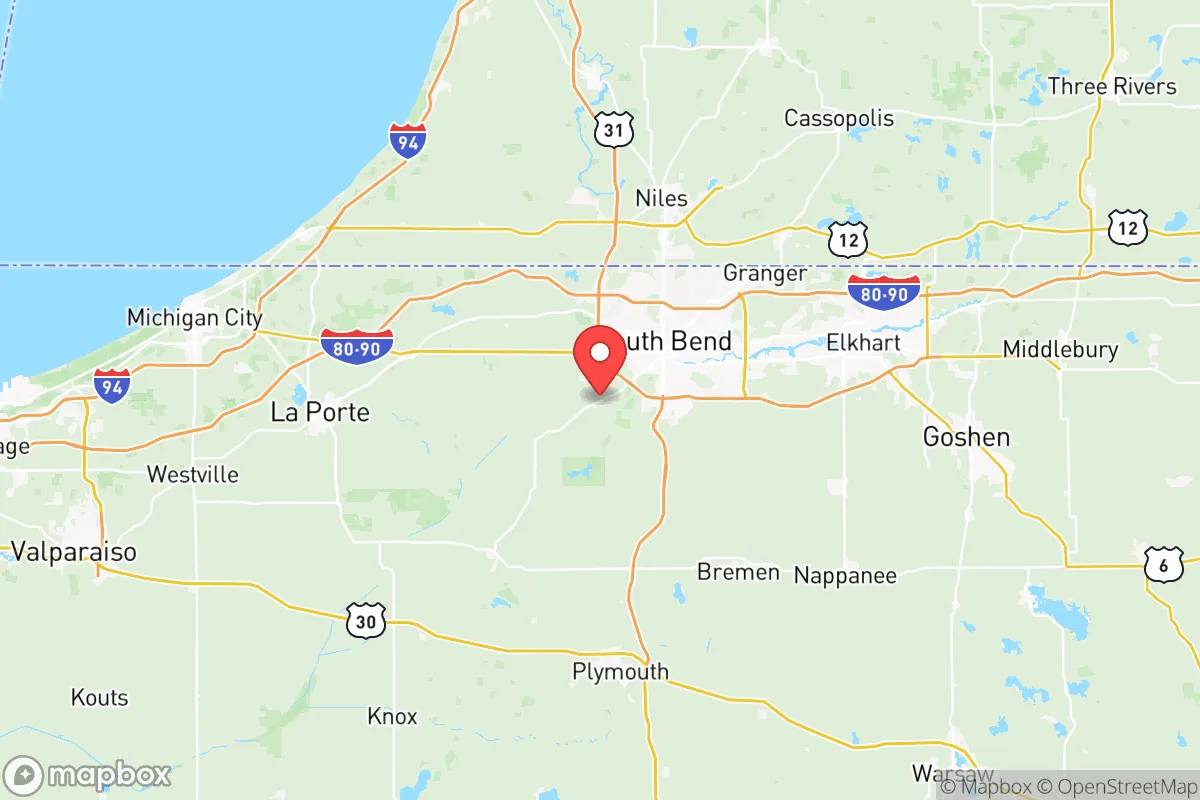
St Joseph County, Indiana, leans solidly Republican with a Cook PVI of R+13, making it roughly 4 points more conservative than the state of Indiana as a whole, which sits at R+9. In practice, this means the county has been a reliable red anchor in recent presidential cycles, though its internal politics are far from monolithic. The county’s trajectory has been steadily redder over the past decade, driven by suburban and rural shifts, but blue-leaning pockets in South Bend and Mishawaka ensure local elections and policy debates reflect a genuine split rather than a one-party lock.
How it compares
Compared to Indiana’s broader R+9 lean, St Joseph County’s R+13 rating signals it is more conservative than the state average, which is already a reliably Republican vote. However, this masks sharp internal variation. The city of South Bend—home to the University of Notre Dame—is the county’s dominant blue stronghold, consistently voting Democratic by 15-20 points in recent presidential races. In contrast, suburbs like Granger and Mishawaka lean right, often by margins of 10-15 points. The true swing precincts are in the county’s more exurban and rural towns—think Walkerton or North Liberty—where races can be decided by a few hundred votes. This geographic polarization means the county’s overall red tint is a sum of a very blue urban core and a very red periphery, with the suburbs acting as the tipping point.
What this means for residents
For conservative residents, the county’s lean means their vote is generally reflected at the national level. Republican candidates win St Joseph County handily, and local offices—like the county commission and sheriff—are reliably held by Republicans. Policy-making tends to favor limited government and lower taxes, and you’ll see that in the county’s lean budgets for social services compared to neighboring Lake County. For liberal residents, the reality is more mixed. While South Bend provides a Democratic safe haven—with progressive city council members and a mayor’s office that often flips between parties—state-level power is firmly out of reach. Liberal voters in the county know their influence peaks in city-level decisions on housing, policing, and zoning, but they rarely get traction on state funding or redistricting. The upshot is a county where both sides can feel their voting power matters locally, but the national trend leans red, so don’t expect a blue wave here anytime soon.
Cultural and policy distinctions
Culturally, St Joseph County is a microcosm of Midwest political identity: grounded, blue-collar, and economically pragmatic. The county has a strong union history—especially in South Bend’s manufacturing sector—but those ties have frayed as jobs moved overseas, pushing many working-class voters toward the GOP. This creates a noticeable cultural split between the Notre Dame-influenced liberal enclave of South Bend and the more traditional, church-going communities in Granger and the rural towns. On policy, the county’s Republican leadership has pushed for lower property taxes, which has kept mill rates among the lowest in Indiana, but also led to underfunded roads in unincorporated areas. Gun rights are widely supported, with open carry common, though South Bend has tried to impose local restrictions that are often preempted by state law. For a resident, the day-to-day reality is polite neighborly tension: your neighbor might sigh at a Biden lawn sign or a Gadsden flag, but you’ll both show up for the county fair.

State Political ClimatePolitical Climate in Indiana
State Political AnalysisPolitical Environment in the State
Indiana has been a reliable Republican stronghold for decades, carrying the GOP in every presidential election since 2008 except for Barack Obama’s narrow 2008 win by about 1 point. The state’s Cook Partisan Voting Index of R+9 understates the practical reality: Republicans hold supermajorities in both chambers of the General Assembly, control the governor’s office, and dominate county-level offices in all but a handful of areas. Over the past 20 years, the suburban counties around Indianapolis—Hamilton, Hendricks, and Johnson—have shifted rightward even as Marion County (Indianapolis) has become more Democratic. The GOP’s grip has tightened since the early 2000s, driven by rural consolidation and an exodus of moderate Democrats from the legislature.
Urban vs. rural divide
Indiana’s political map is textbook Midwest split. Marion County (Indianapolis) votes about 60-40 Democratic, while Lake County (northwest, near Chicago) and Monroe County (Bloomington, home to Indiana University) are the only other reliably blue strongholds. Meanwhile, the rural 80 counties—stretching from the Ohio River towns like Evansville and New Albany up through the corn and soybean belt to Fort Wayne and South Bend’s outer edges—vote Republican by 20-40 points. The real story is in the doughnut counties around Indianapolis: Hamilton County (Carmel, Fishers, Noblesville) votes around 60% Republican, and that share has grown as the population boomed. Kokomo and Muncie, once union-heavy industrial towns, have trended red as manufacturing declined; both now reliably back GOP statewide candidates. Bloomington remains the only college town where Democrats consistently win local offices.
Policy environment
Indiana’s state-level policies reflect a conservative majority. The income tax rate is a flat 3.15% as of 2025, down from 3.23% in 2024, with a planned phase-down to 2.9% by 2029. Property taxes are capped at 1% of assessed value for owner-occupied homes, 2% for rentals, and 3% for commercial—among the lowest burdens in the Rust Belt. There is no sales tax on groceries or prescription drugs. Right-to-work remains law (passed in 2012), though it’s been a political football; union density in construction has dropped. Education policy is dominated by the largest school voucher program in the country—the Choice Scholarship program covers nearly 70,000 students—and a 2023 law banned instruction on human sexuality before grade 3. In 2022, the General Assembly passed a near-total abortion ban with exceptions only for rape, incest (up to 10 weeks), and lethal fetal anomalies. Election laws include strict voter ID, a 28-day early voting window, and no-excuse absentee voting only through 2020 (now restricted to those 65+, with a disability, or who will be out of county on Election Day). The state does not have a state-level minimum wage; federal $7.25 applies, but many employers pay above it.
Recent policy direction
In the last four years, Indiana has passed several major laws that signal its trajectory. On guns: in 2022, the state enacted permitless carry (no license needed to carry a handgun in public). On parental rights: a 2023 law requires schools to notify parents of any material changes to a student’s mental or physical health—effectively requiring parental consent for a child to use a different name or pronoun at school. On privacy: a 2024 law restricts law enforcement from accessing cell phone location data without a warrant, but does not address data broker sales. On medical autonomy: the 2022 abortion ban is currently being challenged in court (the state supreme court upheld it, but a clinic lawsuit over the “lethal fetal anomaly” exception is ongoing). On property rights: a 2025 law prohibits local governments from banning gas stoves or natural gas hookups in new construction. On taxes: the 2023-2025 phase-down of the income tax is locked in, with no new major tax credits expected. Voting access: a 2024 law requires absentee ballots to be returned by noon on Election Day (previously midnight), and drop boxes were banned for all but the most populous counties in 2023. For a relocator, the practical takeaway: Indiana is moving steadily right on guns and education, staying moderate on taxes, and hitting friction points on abortion and ballot access.
Civil unrest & political movements
Political protests in Indiana are generally localized. The largest recent flashpoint was the 2022-2023 abortion protests outside the Statehouse in Indianapolis, which drew thousands but dissipated after the ban passed. Black Lives Matter demonstrations in 2020 in downtown Indianapolis were among the largest in the state’s history, but no sustained leftist activist presence remains outside of college towns. On the right, the “Constitutional sheriffs” movement has adherent in rural counties like Montgomery (Crawfordsville) and Whitley (Columbia City), where sheriffs have publicly stated they won’t enforce certain gun or COVID-related restrictions. There is no sanctuary city or county in Indiana; in fact, a 2011 state law prohibits any local “sanctuary” policies for undocumented immigrants. Immigration enforcement is left to federal authorities, but local jail cooperation with ICE is standard across all 92 counties. Election integrity controversies were limited: the 2020 audit found no widespread fraud, but several GOP county parties passed resolutions calling for hand-counting ballots—none adopted. A new resident would notice minimal visible activism: yard signs in suburban neighborhoods are the main political expression outside election cycles.
Projection
Over the next 5-10 years, Indiana will likely solidify as an R+ medium-red state. Population growth is concentrated in the Indianapolis suburbs (Hamilton County is expected to add 100,000 residents by 2035) and the Republican-leaning areas of the I-69 corridor from Bloomington to Fort Wayne. The Democratic strongholds in Lake County are losing population as manufacturing shrinks, though Indianapolis’s core is growing. In-migration is predominantly domestic; Indiana doesn’t attract many out-of-state movers, but those who come tend to be from Illinois (retirees and families escaping Chicago-area taxes) and Michigan, both of which lean redder than the existing population. The state GOP is currently factionalized between the “moderate” business wing and the “hard-line” caucus aligned with Allen County (Fort Wayne) and Madison County (Anderson); the hard-liners are winning most primary battles, which means policy will likely continue shifting right on education (more vouchers, more parental control) and guns (potential campus carry or expanded preemption). The abortion ban is unlikely to be repealed or significantly softened even with a Democratic governor (who would need veto-proof majorities to overcome GOP legislature). A relocator moving in now should expect the political climate to be dominantly conservative, with a growing evangelical and exurban influence, and limited legislative space for Democratic priorities.
Bottom line for someone choosing Indiana: if you prioritize low taxes, gun rights, school choice, and a limited welfare state, you’ll find the legislature actively crafting policy in your favor. If you lean left, you’ll find strong Democratic representation only in Indianapolis, Bloomington, and Gary—and a state government that will routinely preempt local progressive ordinances. The state is stable, not volatile; the policy direction is clear and has been for a decade. You won’t wake up to a new political reality every election cycle. But your vote in state and local elections will matter in a way it might not in a deep-blue or deep-red state.
* Values derived from national, state, county, city and local statistics and may differ in a specific area. Last updated: 2026-06-29T01:30:02.000Z
Narrative content on this page is AI-generated and may contain mistakes. Verify any details that matter before acting on them.
ReloMaps may earn a commission from affiliate links at no extra cost to you.

