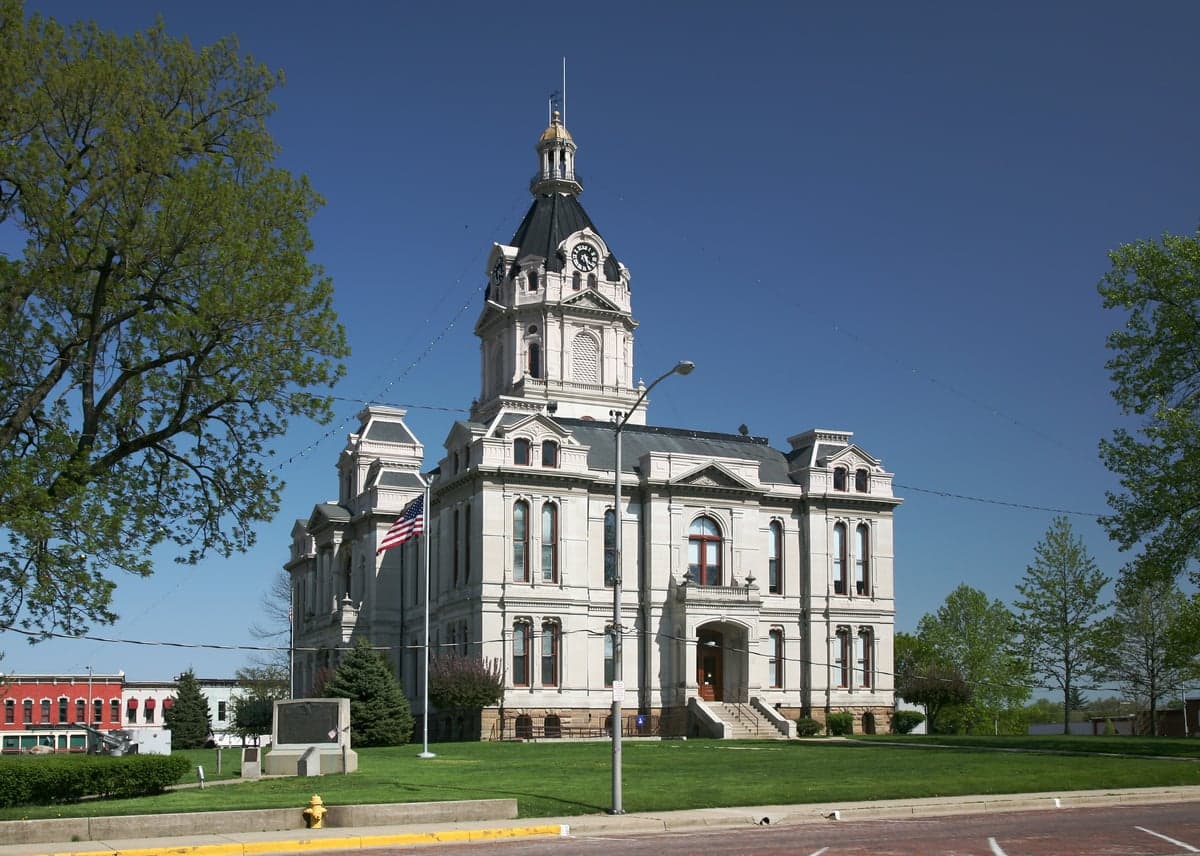
Photo: Wikipedia
Personal Sovereignty in Parke County
Viable for self-reliance. Generally workable, though some barriers may limit total independence.
What does Personal Sovereignty tell us?
Personal Sovereignty measures your capacity for self-reliance and independence with minimal government friction. Higher scores mean fewer barriers between you and the way you want to live... but it assumes you have the space you need and good neighbors.
What does this tell us?
Personal Sovereignty measures your capacity for self-reliance and independence with minimal government friction. Higher scores mean fewer barriers between you and the way you want to live... but it assumes you have the space you need and good neighbors.
State Policy
Energy independence: Importer (35% of energy produced in-state)
Personal Liberty
Homesteading

Personal Liberty Analysis
Parke County, Indiana, offers one of the more permissive personal sovereignty environments in the Midwest, with a light-touch regulatory climate that stands in sharp contrast to neighboring urbanized counties like Marion (Indianapolis) or Monroe (Bloomington). For individuals and families weighing relocation, the county’s autonomy profile is defined by low property tax rates, a robust firearm culture, minimal zoning interference in unincorporated areas, and a state-level legal framework that consistently favors individual choice over collective mandates. The county seat of Rockville, along with the smaller communities of Bloomingdale, Marshall, and Montezuma, each present slightly different practical conditions for self-reliant living, but the overarching posture across the 450 square miles is decidedly hands-off.
Tax burden and regulatory posture in Parke County
Indiana’s statewide tax structure is already among the most taxpayer-friendly in the nation, and Parke County compounds that advantage with local fiscal restraint. The state caps property taxes at 1% of gross assessed value for homesteads, 2% for rental properties, and 3% for commercial real estate — a constitutional limit that prevents the kind of levy creep seen in Illinois or Ohio. Parke County’s average effective property tax rate hovers around 0.78%, roughly half of the national average and significantly below the 1.2% to 1.5% rates common in central Indiana’s suburban rings. The county government operates without a local income tax, relying instead on property taxes, state redistributed funds, and excise taxes, which keeps the total combined state and local burden among the lightest in the Wabash Valley region.
Regulatory enforcement is similarly restrained. Parke County has no county-wide zoning ordinance for unincorporated land; the only land-use controls exist within the town limits of Rockville, Marshall, Bloomingdale, and Montezuma, and even those are minimal by urban standards. Building permits are required for new structures, but the county’s inspection process is streamlined, with typical approval times of one to two weeks for standard residential builds. There are no county-level business licensing requirements beyond state registration, and home-based enterprises operate freely without special permitting as long as they don’t create public nuisances. The regulatory posture is best described as “rural permissive” — the county assumes competence on the part of property owners rather than presuming the need for oversight.
Self-defense law and gun culture specifics
Indiana is a constitutional carry state, and Parke County’s sheriff’s office — headquartered in Rockville — is publicly supportive of that framework. Permitless carry for both open and concealed handguns has been in effect since July 2022, meaning no license is required for any law-abiding adult 18 or older to carry a firearm. For those who still want a permit for reciprocity when traveling to states like Florida or Texas, the Indiana License to Carry a Handgun is issued at the county level; Parke County’s processing time averages under 30 days, and the sheriff’s department does not impose additional local restrictions beyond state statute.
Use-of-force law in Indiana is notably protective of the individual. The state’s Castle Doctrine, codified in IC 35-41-3-2, establishes a legal presumption that a person using force against an unlawful intruder in their home, vehicle, or place of business acted in reasonable fear of death or serious bodily injury — and there is no duty to retreat in any place where the person is lawfully present. Parke County juries and prosecutors have historically applied these statutes without the aggressive charging patterns seen in urban Indiana counties. The local gun culture is deeply embedded: the Parke County Gun Show runs multiple times annually at the 4-H Fairgrounds in Rockville, and the county’s three gun shops — including Wabash Valley Arms near Marshall — report steady demand from both locals and out-of-state buyers seeking Indiana’s friendlier legal environment.
Self-reliance and homesteading viability across the county
Parke County’s unincorporated areas are a genuine homesteading frontier, with land prices and regulatory freedom that make off-grid living practical rather than aspirational. Average raw land prices run $4,000 to $7,000 per acre, with the cheapest parcels in the northern townships around Adams and Penn townships, while the southern areas near the Turkey Run State Park corridor command a premium for recreational value. The county has no zoning restrictions on alternative housing — tiny homes, yurts, and converted barns are all legally permissible in unincorporated areas as long as they meet basic state building codes for habitability. Off-grid utilities are entirely legal: there is no county mandate to connect to municipal water or sewer, and the county health department permits private wells and septic systems with a straightforward permitting process that typically takes two to three weeks.
The practical differences between communities matter for homesteaders. Bloomingdale, with its Quaker heritage and the historic Bloomingdale Friends Meetinghouse, has a small but active community of intentional simplicity practitioners, and the surrounding farmland is among the most affordable in the county. Marshall, situated along the northern edge near the Vermillion County line, offers the best access to larger parcels — several 10-to-40-acre tracts are currently listed with no subdivision restrictions. Montezuma, on the county’s eastern border along the Wabash River, has the most permissive approach to livestock within town limits, allowing chickens and goats with no permit required. Rockville itself is the most developed, with standard municipal codes, but even there, the town’s 1,200 residents enjoy a level of regulatory simplicity that would be unrecognizable in any Indiana city above 50,000 population. Solar panels, rainwater collection, and wood heat are all unrestricted throughout the county, and the local utility cooperative — Parke County REMC — has a net-metering policy that credits excess generation at the retail rate.
Personal liberties: parental rights, medical autonomy, and property
Indiana’s legal framework in 2026 tilts strongly toward individual and parental sovereignty, and Parke County operates within that framework without adding local friction. Parental rights are codified in state statute — IC 31-19-2-2.5 gives parents explicit authority over their children’s education, healthcare, and moral training, and the county’s school corporations in Rockville, Marshall, and Montezuma do not impose curriculum or policy mandates beyond state minimums. Homeschooling is fully legal with no registration requirement, and the county has a robust network of homeschool co-ops centered around the Rockville Christian Church and the Bloomingdale Friends community. Medical autonomy is protected under Indiana’s conscience clause statutes, which allow individuals to refuse any medical treatment or vaccination without penalty, and Parke County’s sole hospital — the 25-bed Parke County Medical Center in Rockville — respects patient choice without the administrative pressure common in larger healthcare systems.
Property rights are the strongest pillar of personal sovereignty here. Indiana’s right-to-farm law (IC 32-30-6) protects agricultural operations from nuisance lawsuits, and Parke County has no local ordinances that override it. The county’s assessor’s office in Rockville processes property transfers with minimal red tape, and there are no transfer taxes at the county level — only the state’s flat $50 documentary stamp fee. Speech and assembly rights are exercised freely; the county courthouse lawn in Rockville hosts regular political gatherings, and the local newspaper, The Parke County Sentinel, covers contentious local issues without the editorial caution seen in metropolitan outlets.
Relative to other parts of Indiana and the broader Midwest, Parke County ranks in the top tier for personal sovereignty. Its combination of constitutional carry, no-county-zoning, sub-1% property taxes, and a legal culture that presumes individual competence puts it in the same category as rural strongholds like Putnam County to the east or Sullivan County to the south — but with lower land prices and a more established homesteading infrastructure. For a relocation-minded individual or family whose priority is maximum personal autonomy within a functioning community, Parke County delivers a regulatory environment that is genuinely hands-off without descending into the dysfunction that sometimes accompanies ultra-libertarian rural enclaves. The trade-off is the absence of urban amenities, but for those who measure freedom in acreage and legal latitude rather than restaurant density, the county’s sovereignty profile is difficult to beat anywhere in the Wabash Valley.

* Values derived from national, state, county, city and local statistics and may differ in a specific area. Last updated: 2026-10-21T00:42:40.000Z
Narrative content on this page is AI-generated and may contain mistakes. Verify any details that matter before acting on them.
ReloMaps may earn a commission from affiliate links at no extra cost to you.

