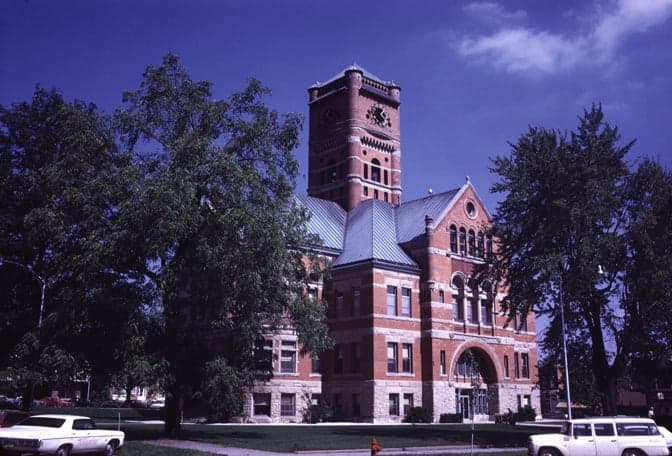
Photo: Wikipedia
Political ClimatePolitical Climate in Noble County
Showing district-level results — no local-only data available.
Local Political AnalysisPolitical Analysis of Noble County
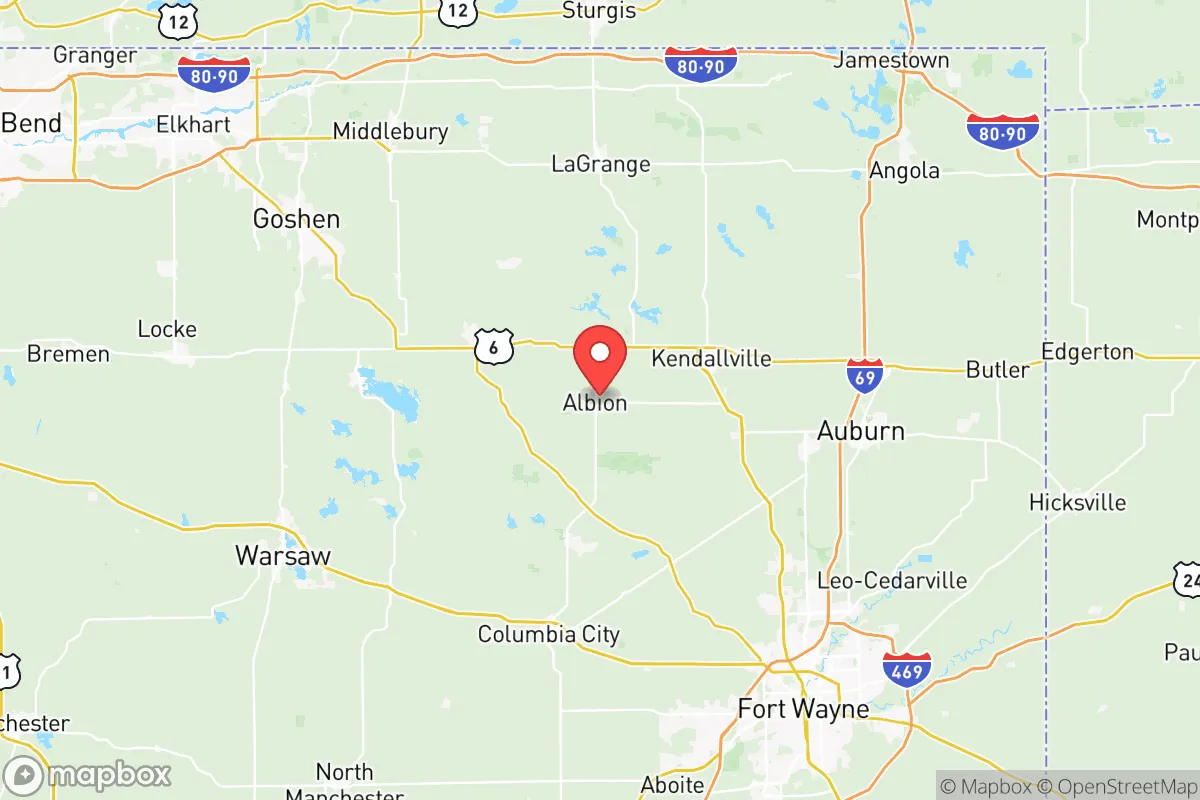
Noble County, Indiana, is a reliably Republican stronghold with a Cook Partisan Voting Index (PVI) of R+16, making it significantly more conservative than the state of Indiana as a whole, which sits at R+9. This isn't a recent shift; the county has been trending red for decades, with the rural and small-town character of the area reinforcing a deeply rooted conservative culture. While the county as a whole is solidly red, there are subtle variations—the city of Kendallville, the county seat, tends to be the most moderate area, occasionally producing closer races, while the more rural townships around Albion and Ligonier lean heavily Republican. The small town of Rome City, with its lakefront communities, can sometimes see a slightly more independent streak, but it still votes reliably red in most elections.
How it compares
The seven-point gap between Noble County’s R+16 and Indiana’s R+9 is substantial. To put it in perspective, Indiana itself is already considered a safe Republican state in presidential elections, but Noble County is in a different league entirely. In the 2024 presidential election, Donald Trump carried Noble County with roughly 72% of the vote, compared to about 58% statewide. This isn't just a presidential phenomenon; down-ballot races for state legislature and county offices see similar margins. The county’s Republican lean is so consistent that Democratic candidates rarely mount serious campaigns for local offices, and when they do, they often struggle to break 35% of the vote. The only real exceptions are in Kendallville, where a more diverse economy and a slightly younger population can produce closer margins—sometimes within 10-15 points in local races—but even there, Republicans hold every elected position.
What this means for residents
For conservative residents, Noble County feels like a natural fit. Local government, school boards, and law enforcement are all run by officials who share their values, and there’s little friction in daily life. The county’s Republican Party is well-organized, and attending a local GOP meeting in Albion or Kendallville is a straightforward way to get involved. For liberal or moderate residents, the reality is more complex. While they are a clear minority, they are not invisible—especially in Kendallville, where a small but vocal Democratic group exists. However, they often feel the weight of the political climate in practical ways: local policy debates on issues like library funding, school curriculum, and zoning tend to skew conservative, and progressive candidates rarely get a fair hearing. That said, most residents, regardless of party, describe the area as polite and neighborly in day-to-day interactions—politics rarely comes up at the grocery store or at a high school football game in Ligonier.
Culturally, Noble County stands apart from more urban parts of Indiana like Indianapolis or Fort Wayne. The county has a strong agricultural and manufacturing base, with companies like Steel Dynamics in nearby Whitley County and local factories in Kendallville shaping the economic conversation. Policy-wise, this means a strong emphasis on low taxes, limited regulation, and support for gun rights—issues that resonate deeply here. There’s also a notable Amish and Mennonite population in the southern part of the county, around the town of Wolcottville, which adds a distinct cultural layer and influences local politics on issues like land use and transportation. For newcomers, the political climate is stable and predictable, but it’s worth knowing that the county’s conservative tilt isn’t just about voting—it’s woven into the fabric of community life, from church attendance to local business practices. If you’re moving here, you’ll find a place where tradition is valued, change comes slowly, and the political landscape is unlikely to shift anytime soon.

State Political ClimatePolitical Climate in Indiana
State Political AnalysisPolitical Environment in the State
Indiana is a reliably Republican state with a Cook PVI of R+9, meaning it votes about nine points more conservative than the nation as a whole. The dominant coalition is a mix of rural and suburban conservatives, with the GOP holding supermajorities in both the state House and Senate and every statewide office. Over the past 20 years, the state has shifted rightward—George W. Bush won it by 21 points in 2004, Donald Trump won it by 16 in 2016 and 11 in 2020, and the GOP has only tightened its grip on the legislature since the 2010 redistricting cycle. That said, the state is not a monolith: the Indianapolis metro area, Lake County (northwest), and a handful of college towns like Bloomington and West Lafayette provide a real counterweight, and the margins in suburban counties like Hamilton and Hendricks have been slowly narrowing.
Urban vs. rural divide
The political map of Indiana is a classic urban-rural split, but with a few wrinkles. The Indianapolis metro area (Marion County and its suburbs) is the state’s Democratic stronghold—Marion County went for Joe Biden by about 20 points in 2020, and the city itself is a reliably blue island in a red sea. The other Democratic-leaning pockets are Lake County (part of the Chicago metro area, heavily unionized and diverse) and Monroe County (home to Indiana University in Bloomington). Tippecanoe County (Purdue in West Lafayette) has been trending blue, too, though it still flips between parties. Meanwhile, the rest of the state—from the rural, conservative counties along the Ohio River like Dubois County and Perry County to the heavily Republican northeast around Fort Wayne (Allen County) and the west-central farm counties like Vigo County (Terre Haute)—votes overwhelmingly red. The suburbs are where the action is: Hamilton County (Carmel, Fishers, Noblesville) is still deep red but has shifted from +40-point Republican margins in 2012 to about +25 in 2020, driven by an influx of younger, college-educated professionals. Hendricks County (Avon, Plainfield) is similar—still safe GOP but narrowing. The rural counties, by contrast, are only getting redder.
Policy environment
Indiana’s policy environment is conservative and business-friendly, with a few distinctive features. The state has a flat income tax rate of 3.15% (as of 2025, down from 3.23% in 2024), with a scheduled phase-down to 2.9% by 2029. Property taxes are capped at 1% of assessed value for owner-occupied homes, 2% for rental properties, and 3% for commercial—a constitutional amendment passed in 2010. There is no estate tax. The regulatory posture is light-touch: Indiana is a right-to-work state (since 2012), and the legislature has consistently preempted local ordinances on everything from minimum wage to plastic bag bans. On education, the state has a robust school choice program—vouchers (the Choice Scholarship Program) are available to most families, and charter schools are widespread. The state also passed a law in 2022 requiring schools to post curriculum materials online and allow parents to opt their children out of certain instruction. Healthcare policy is mixed: Indiana expanded Medicaid under the Affordable Care Act in 2015 (via the HIP 2.0 waiver with a "Healthy Indiana Plan" that includes a small monthly contribution), but the state has not expanded postpartum Medicaid coverage beyond 60 days. Election laws are moderately restrictive: voter ID is required, early voting is available for 28 days (including two Saturdays), and no-excuse absentee voting was made permanent in 2023 after a pandemic-era expansion. The state does not have automatic voter registration.
Recent policy direction
Indiana’s recent legislative sessions have pushed the state further right on a broad range of issues. On gun and self-defense law, the state adopted permitless carry (constitutional carry) in 2022, allowing any adult who can legally possess a firearm to carry it without a license. On parental and education rights, the 2023 session saw a law requiring schools to notify parents of any changes to a student’s health or well-being (including pronoun or name changes) and a ban on instruction about human sexuality in grades K-3. On speech and privacy, the state passed a law in 2023 prohibiting public universities from requiring diversity statements in hiring, and it has a broad "right to farm" law that protects agricultural operations from nuisance lawsuits. On medical and bodily autonomy, Indiana enacted a near-total abortion ban in 2023 (with exceptions for rape, incest, and lethal fetal anomalies up to 10 weeks, and to save the mother’s life), which was upheld by the state Supreme Court in 2024. The state also passed a law in 2023 banning gender-affirming care for minors. On property rights, Indiana has a strong eminent domain law that limits takings for private economic development, and it is a "Dillon’s Rule" state, meaning local governments only have powers explicitly granted by the state. On taxation, the flat income tax is scheduled to drop further, and the state has no sales tax on groceries. On voting and ballot access, the state tightened its voter ID law in 2023 to require a full Social Security number for registration, and it banned private funding of election administration (a response to the 2020 "Zuckerbucks" controversy).
Civil unrest & political movements
Indiana has seen its share of political flashpoints, but they tend to be localized rather than statewide. The 2020 racial justice protests in Indianapolis were large and occasionally violent, with damage to downtown businesses and the City-County Building. The state’s response included a curfew and National Guard deployment, but no lasting policy changes. The abortion ban sparked sustained protests at the Statehouse in 2023, with hundreds of demonstrators on both sides, but the GOP supermajority held firm. On the right, the "Parents’ Rights" movement has been active in school board meetings, particularly in Hamilton County and Johnson County, where groups have pushed for book bans and curriculum transparency. Immigration politics are relatively quiet—Indiana is not a border state, and there are no sanctuary cities. The state passed a law in 2011 (SB 590) requiring local police to enforce federal immigration law, but it was largely symbolic and has not been aggressively enforced. There is no serious secession or nullification movement. Election integrity controversies have been minimal—Indiana’s 2020 election was not heavily contested, and the state’s voter ID law has been in place since 2005. The most visible flashpoint for a new resident might be the annual "Right to Life" rally at the Statehouse in January, which draws thousands, and the occasional counter-protest from groups like the Indiana Abortion Fund.
Projection
Over the next 5-10 years, Indiana is likely to remain solidly Republican, but the margins in the suburbs will continue to narrow. The Indianapolis metro area is growing faster than the rest of the state, and the influx of younger, more diverse residents into Hamilton County and Hendricks County will slowly shift those counties from deep red to light red. The rural counties, however, are aging and depopulating, which will keep the statewide lean red. The state’s flat income tax cuts will be a continued draw for conservative relocators, especially from high-tax states like Illinois and California. The abortion ban and transgender care restrictions will likely remain in place, but could become a wedge issue if national politics shift. The biggest wildcard is the 2030 redistricting cycle—if Democrats ever win the governor’s office or a legislative chamber, the map could be redrawn more competitively. For now, expect the GOP supermajority to continue passing culturally conservative legislation, but with a growing suburban-liberal minority that will make the state’s politics more polarized, not less.
For a new resident, the bottom line is this: if you’re conservative, you’ll find a state that largely aligns with your values on taxes, guns, education, and social issues, with a government that moves quickly to enact your priorities. If you’re liberal, you’ll find a state where your vote counts less in statewide races, but where you can still find like-minded communities in Indianapolis, Bloomington, or the college towns. The practical takeaway is that Indiana is a place where policy changes fast and sticks—so if you’re moving here, be prepared for a state that knows what it wants and isn’t shy about legislating it.
* Values derived from national, state, county, city and local statistics and may differ in a specific area. Last updated: 2026-10-22T15:34:04.000Z
Narrative content on this page is AI-generated and may contain mistakes. Verify any details that matter before acting on them.
ReloMaps may earn a commission from affiliate links at no extra cost to you.

