Photo: Wikipedia
Demographics of Noble County
Affluence Level in Noble County
A middle-class area roughly in line with national averages across income, home values, education, and employment.
People of Noble County
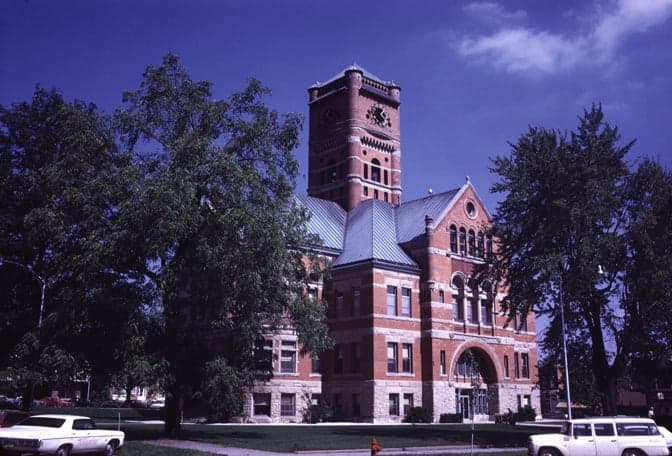
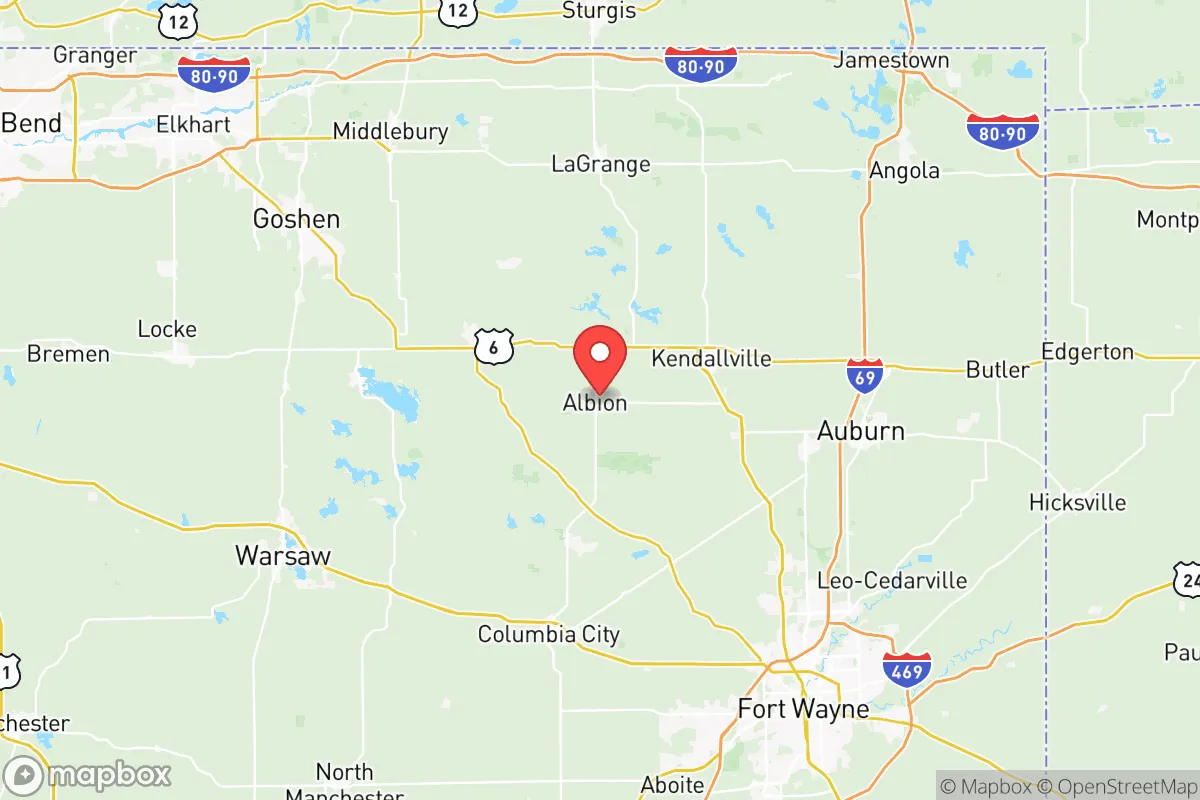
Noble County, Indiana, is a predominantly white, rural community of 47,417 residents where a strong sense of local heritage and agricultural roots defines daily life. With a population that is 85.4% white and a foreign-born share of just 3.4%, the county remains one of the more ethnically homogeneous areas in northeastern Indiana, though a growing Hispanic community now makes up 11.2% of residents. The county’s identity is shaped by its small towns—Albion, Kendallville, Ligonier, and Rome City—each with distinct settlement histories, and by a culture that values self-reliance, faith, and family. For a conservative-leaning individual or family considering relocation, Noble County offers a place where community ties run deep, change comes slowly, and the pace of life is deliberately unhurried.
Settlement & growth (pre-1960)
Before European settlement, the area now known as Noble County was part of the hunting and trading grounds of the Miami and Potawatomi nations, who used the Elkhart River and Sylvan Lake for travel and seasonal camps. The first white settlers arrived in the 1830s, after the 1828 Treaty of Mississinewas forced the Potawatomi to cede their lands. These early pioneers were primarily of Scots-Irish and English stock, moving west from Ohio and Pennsylvania, drawn by cheap federal land offered at $1.25 per acre under the Land Act of 1820. They established the first permanent settlements in what would become Albion (the county seat, platted in 1846) and Kendallville (platted in 1848), clearing forests for farms and building the region’s first sawmills and gristmills.
The next major wave came in the 1840s and 1850s, when German immigrants arrived directly from the Rhineland and Bavaria, as well as via earlier settlements in Pennsylvania and Ohio. These German families were drawn by the promise of rich, well-drained farmland and the opportunity to own land outright—a rarity in their homeland. They concentrated heavily in and around Ligonier, which became a German-speaking enclave for decades, and in the rural townships of Elkhart and Jefferson. The Germans brought with them a tradition of Lutheran and Catholic church-building, family farming, and a work ethic that still defines the county’s agricultural sector. By 1870, Germans and their descendants made up roughly one-third of Noble County’s population.
The 1850s also saw a smaller but notable influx of Irish immigrants, many of whom worked as laborers on the Lake Shore and Michigan Southern Railway, which reached Kendallville in 1854. The Irish settled in Kendallville’s “Irish Hill” neighborhood and in Rome City, where they found work in the limestone quarries and on the railroad. The railroad itself transformed Noble County from a subsistence-farming area into a commercial hub, allowing farmers to ship wheat, corn, and livestock to Chicago and Fort Wayne markets. Kendallville and Ligonier grew into thriving market towns, each with grain elevators, hardware stores, and hotels serving traveling salesmen.
Through the late 19th and early 20th centuries, the population remained overwhelmingly native-born white, with a small number of African American families arriving after the Civil War, mostly as domestic servants or farmhands. The 1900 census recorded just 38 Black residents in the entire county. The Dust Bowl and Great Depression of the 1930s brought a few families from Oklahoma and Arkansas, but Noble County was not a major destination for that migration. Instead, the county’s population actually declined slightly between 1900 and 1940, as young people left for factory jobs in Fort Wayne, South Bend, and Detroit. The post-World War II era saw a modest rebound, driven by the expansion of manufacturing in Kendallville—especially at companies like Dekko Heating Technologies (founded 1954) and Noble Manufacturing—which attracted workers from the surrounding countryside but did not fundamentally alter the county’s ethnic makeup.
Modern era (post-1965)
The 1965 Hart-Cellar Act had a minimal direct impact on Noble County, as the area did not attract the large-scale immigration seen in major cities. However, the broader national shift toward suburbanization and the decline of small-scale farming reshaped the county’s population in other ways. Beginning in the 1970s, the county’s agricultural sector consolidated: the number of farms dropped by nearly half between 1950 and 1990, while the average farm size doubled. This pushed many rural families into the county’s towns, particularly Kendallville and Albion, where they found work in the growing manufacturing and warehousing sectors.
The most significant demographic change since 1965 has been the growth of the Hispanic population. In 1980, Noble County was 99% white. By 2000, the Hispanic share had risen to 4.5%, and by 2024 it reached 11.2%. This growth is almost entirely driven by immigration from Mexico and Central America, with families settling primarily in Ligonier and Kendallville, where they found work in the area’s RV manufacturing plants (such as Jayco in nearby Middlebury) and in food processing at Maple Leaf Farms in Ligonier. Ligonier, in particular, has seen a visible transformation: its downtown now features Mexican grocery stores, taquerias, and a Spanish-language church, and the city’s public schools report that roughly 30% of students are Hispanic. This community is largely working-class, with many families living in rental housing and mobile home parks, and it remains somewhat segregated from the older white population by income and geography.
The Asian population remains tiny at 0.3%, with a handful of families of Chinese and Filipino descent living in Kendallville, mostly professionals employed at the county’s hospitals or at Parkview Noble Hospital. The Indian-subcontinent population is even smaller at 0.2%, concentrated among a few physicians and engineers. The Black population, at 0.3%, has not grown significantly since the 1960s and is scattered across the county. The foreign-born share of 3.4% is well below the Indiana state average of 5.5%, reflecting the county’s limited appeal to international migrants outside the Hispanic labor stream.
Domestic migration patterns since 2000 have been mixed. Noble County has seen a slow net outflow of young adults (ages 18-34) to larger cities, but a modest inflow of retirees and remote workers from the Chicago and Fort Wayne metros, drawn by lower housing costs and the recreational appeal of Sylvan Lake and Bishop Lake. These newcomers tend to be white, middle-class, and politically conservative, reinforcing the county’s existing cultural character. The county’s population has grown by only 2.3% since 2010, compared to 4.5% for Indiana as a whole, indicating a slow-growth, stable demographic profile.
The future
Noble County is likely to become slightly more diverse over the next 10-20 years, but the change will be gradual and concentrated in specific towns. The Hispanic population, currently 11.2%, is projected to reach 15-18% by 2040, driven by higher birth rates and continued labor migration to the RV and food-processing industries. This growth will be most visible in Ligonier, where the Hispanic share could approach 40%, and in Kendallville, where it may reach 20%. The white population will continue to age and decline slowly, as outmigration of young adults and low birth rates among non-Hispanic whites take their toll.
The county is not expected to attract significant Asian, Indian, or Black populations, as there are no major universities, tech employers, or urban amenities to draw those groups. The foreign-born share may rise to 5-6% by 2040, but the county will remain overwhelmingly native-born. Politically and culturally, Noble County will likely stay conservative, with the growing Hispanic population—many of whom are Catholic and socially traditional—potentially aligning with the existing Republican majority on issues like abortion and religious freedom. The county voted +38 points for Donald Trump in 2020, and that margin is unlikely to narrow dramatically.
For new residents, the key trend to watch is the tension between preservation and change. The county’s small towns are actively trying to attract families through tax incentives and infrastructure improvements—Albion recently completed a downtown streetscape project, and Kendallville is investing in its riverwalk and parks. But the lack of rental housing, the limited public transit, and the low college attainment rate (17.8%) may constrain growth. The county will remain a place for those who value quiet, space, and community over diversity and urban opportunity.
Noble County is becoming a slightly more Hispanic, slightly more suburban version of its older self—still overwhelmingly white, still deeply rooted in farming and manufacturing, and still a place where a handshake and a church membership matter more than a resume. For a conservative family seeking affordable land, good schools in Kendallville and Ligonier, and a community where neighbors know each other’s names, it offers a stable, predictable future. For those seeking racial or cultural diversity, or a fast-growing economy, it will likely disappoint. The county’s trajectory is one of slow, careful evolution, not transformation.

* Values derived from national, state, county, city and local statistics and may differ in a specific area. Last updated: 2026-10-22T15:34:04.000Z
Narrative content on this page is AI-generated and may contain mistakes. Verify any details that matter before acting on them.
ReloMaps may earn a commission from affiliate links at no extra cost to you.

