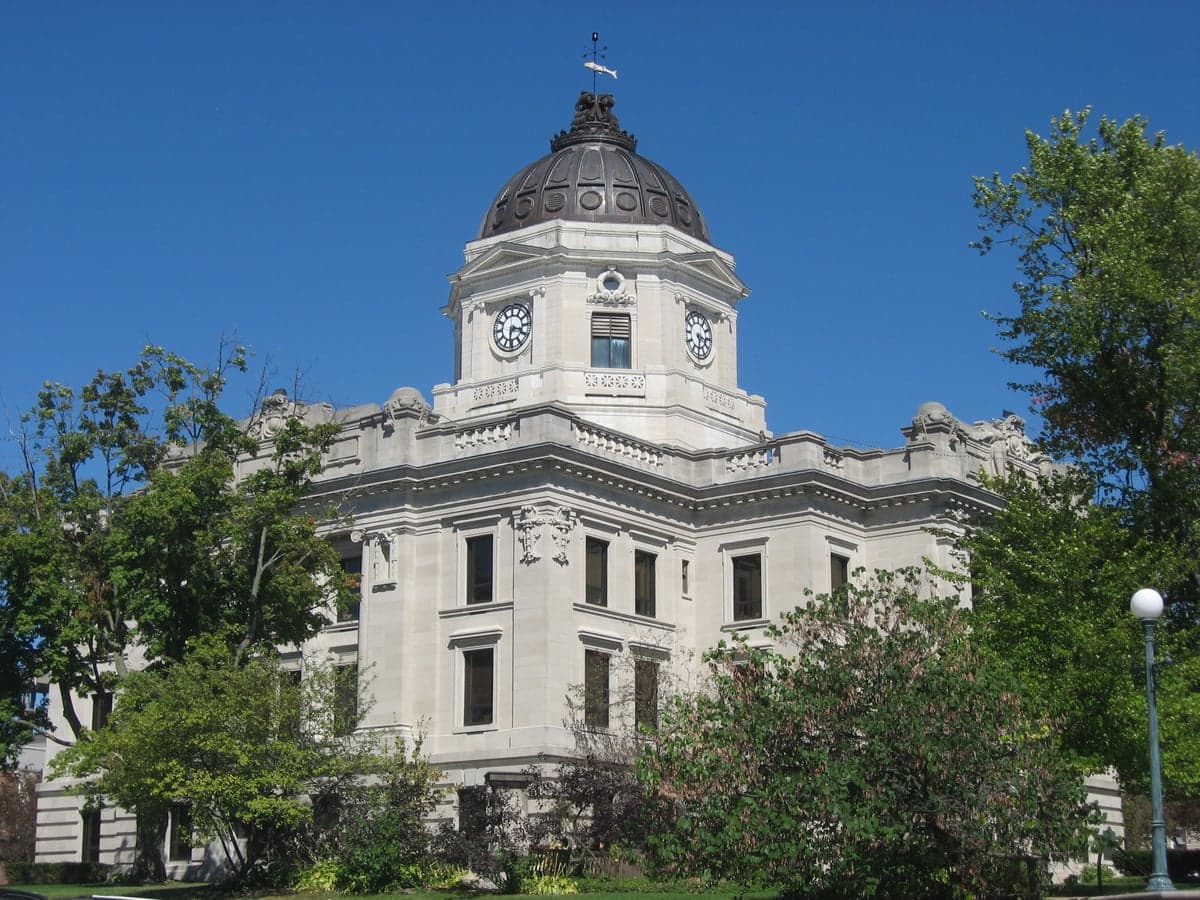
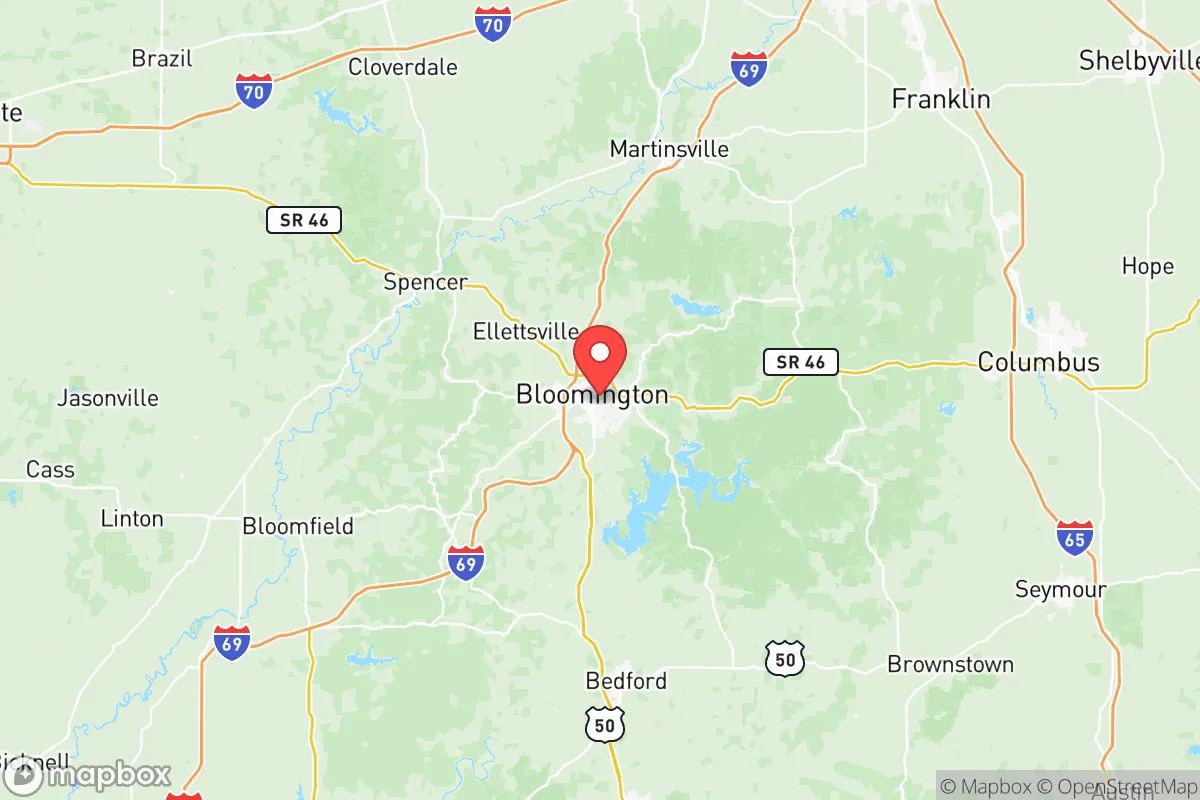
Photo: Wikipedia
Demographics of Monroe County
Affluence Level in Monroe County
A middle-class area roughly in line with national averages across income, home values, education, and employment.
People of Monroe County
Monroe County, Indiana, today is a study in contrasts: a politically liberal college town, Bloomington, surrounded by a more conservative rural landscape, with a population of 139,822 that is 81.6% white, 4.6% Hispanic, 4.4% East/Southeast Asian, 3.5% Black, and 2.3% Indian (subcontinent). The county is defined by the presence of Indiana University, which drives a highly educated populace—49.1% hold a college degree—and a notably high foreign-born share of 5.3%, a figure that far exceeds surrounding rural counties. This creates a distinctive identity: a Midwestern academic and cultural hub where a globally diverse, transient student and professional population coexists with long-standing local families rooted in limestone, farming, and small-town life.
Settlement & growth (pre-1960)
Before American settlement, the land that is now Monroe County was part of the vast hunting and trading grounds of the Miami and Delaware (Lenape) nations, who were gradually pushed out by European-American expansion following the Northwest Ordinance of 1787. The area was formally opened to white settlement after the Treaty of St. Mary's (1818), which ceded Miami and Delaware claims to the U.S. government. The first wave of settlers were overwhelmingly of Scots-Irish and English stock, migrating from Kentucky, Tennessee, and the Upper South between 1818 and 1830. They were drawn by cheap, fertile land in the upland regions and established the earliest communities: Bloomington (founded 1818, became the county seat in 1819), Ellettsville (settled 1820s), and the now-vanished hamlet of Clear Creek.
The second major wave, from the 1830s through the 1850s, brought German immigrants, who were attracted by the region's emerging limestone industry and the availability of farmland in the more rugged southern parts of the county. These German settlers concentrated in the rural townships south of Bloomington, particularly around Smithville and Harrodsburg, where they established Lutheran churches and tight-knit farming communities. A smaller number of Irish immigrants arrived during the same period, working on the construction of the Wabash and Erie Canal and later on the railroads, settling in Bloomington's near-west side and in the railroad hamlet of Stinesville.
The third transformative wave was the rise of Indiana University itself. Founded in 1820 as the state seminary, IU grew slowly until the late 19th century, then exploded after World War II with the G.I. Bill. This brought a massive influx of students and faculty from across the Midwest and the nation, transforming Bloomington from a quiet county seat of about 10,000 in 1940 into a growing college town of 31,000 by 1960. The university's expansion also drew a small but significant number of Black families during the Great Migration (1940s-1960s), who settled primarily in Bloomington's near-east side and the Fairview neighborhood, working in domestic service, the university, and local factories. By 1960, the county's population had reached 59,227, still overwhelmingly white and native-born, but with the seeds of its future diversity already planted.
Modern era (post-1965)
The 1965 Hart-Cellar Act fundamentally reshaped Monroe County's demographics, though the effects were slower and more concentrated here than in coastal metros. The most visible change was the growth of an international student and faculty population at Indiana University. Starting in the 1970s and accelerating through the 1990s, IU recruited heavily from East and Southeast Asia, particularly China, South Korea, and Taiwan. These East/Southeast Asian communities—now 4.4% of the county's population—concentrate in and around the University Heights and Prospect Hill neighborhoods of Bloomington, as well as in the apartment complexes along the College Avenue corridor. A separate wave of Indian (subcontinent) immigration, primarily from India and Nepal, began in the 1990s and accelerated after 2000, driven by IU's graduate programs in computer science, informatics, and business. Today, the Indian community makes up 2.3% of the county and is heavily concentrated in the Southwest Bloomington area near the Jacobs School of Music and the Kelley School of Business.
Domestic migration has also reshaped the county since 1965. The decline of the limestone industry in the 1960s and 1970s led to population loss in rural towns like Ellettsville and Stinesville, but this was offset by suburbanization from Bloomington. From the 1980s onward, families seeking lower taxes and larger lots pushed outward, creating bedroom communities in Ellettsville (which grew from 2,000 in 1980 to 6,600 by 2020) and the unincorporated area of Unionville to the east. The Hispanic population—now 4.6% of the county—grew steadily from the 1990s, driven by labor demand in construction, landscaping, and the restaurant industry, with a notable concentration in the Fairview neighborhood and along the West 3rd Street corridor in Bloomington. The Black population, at 3.5%, has remained relatively stable since the 1970s, with a small but established community centered in Bloomington's near-east side and the Bryan Park area.
The future
Monroe County is becoming more diverse, but the pace is slow and uneven. The white share of the population has declined from roughly 90% in 1990 to 81.6% today, driven almost entirely by international immigration to Bloomington. The East/Southeast Asian and Indian communities are the fastest-growing groups, and their growth is likely to continue as IU maintains its global recruitment. The Hispanic population is also growing steadily, though from a smaller base, and is dispersing from Bloomington into Ellettsville and rural townships as families seek affordable housing. The Black population is projected to remain stable or grow slightly, as Bloomington is not a major destination for Black domestic migration compared to Indianapolis or Chicago.
The key demographic trend over the next 10-20 years is the continued divergence between Bloomington and the rest of the county. Bloomington itself will become more diverse, more transient, and more dominated by students and young professionals, while the outlying towns—Ellettsville, Unionville, and Harrodsburg—will remain overwhelmingly white and more conservative, attracting families priced out of Bloomington's housing market. The county's cultural identity will remain bifurcated: a liberal, globally oriented university town surrounded by a rural, traditionalist hinterland. For someone moving in now, Monroe County offers a choice: the dense, diverse, amenity-rich environment of Bloomington, or the quieter, more homogeneous, and more affordable life in the surrounding towns.
Monroe County is becoming a more layered place—a Midwestern college town where international graduate students, limestone-quarry families, and suburban commuters coexist in distinct but overlapping worlds. The population is slowly diversifying, but the county's character will remain defined by the tension between the university's global pull and the region's deep local roots. For a new resident, the key question is not whether the county is changing, but which of its many communities best fits their life stage and values.

* Values derived from national, state, county, city and local statistics and may differ in a specific area. Last updated: 2026-06-17T18:22:13.000Z
Narrative content on this page is AI-generated and may contain mistakes. Verify any details that matter before acting on them.
ReloMaps may earn a commission from affiliate links at no extra cost to you.

