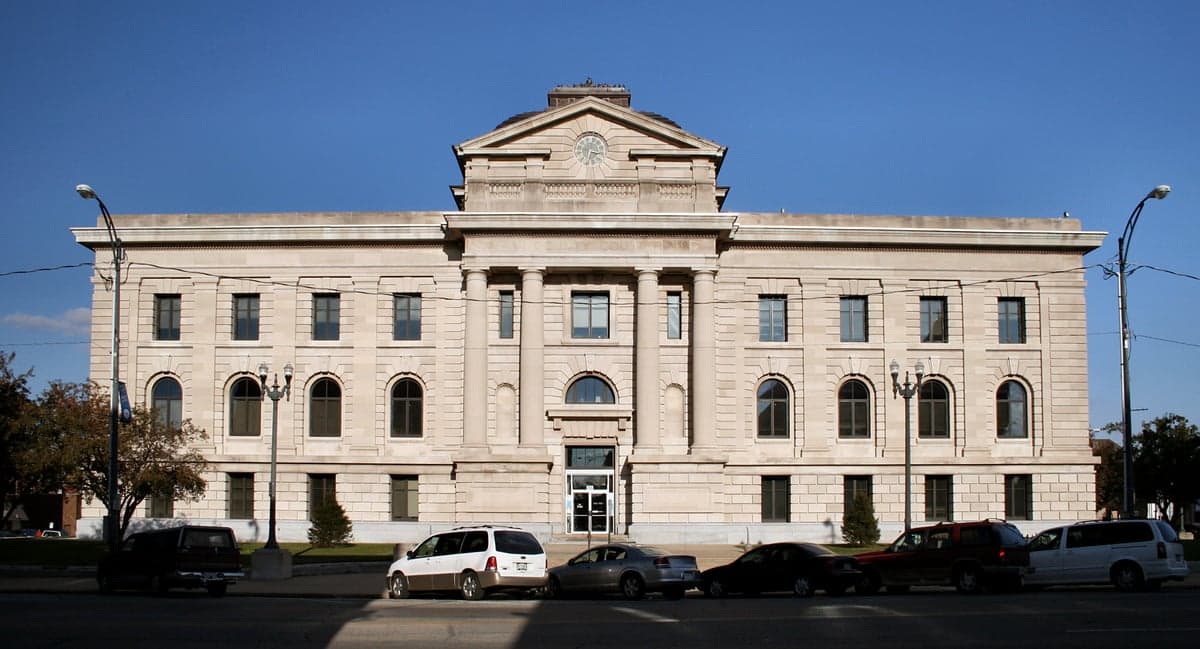
Photo: Wikipedia
Political ClimatePolitical Climate in Miami County
Showing district-level results — no local-only data available.
Local Political AnalysisPolitical Analysis of Miami County
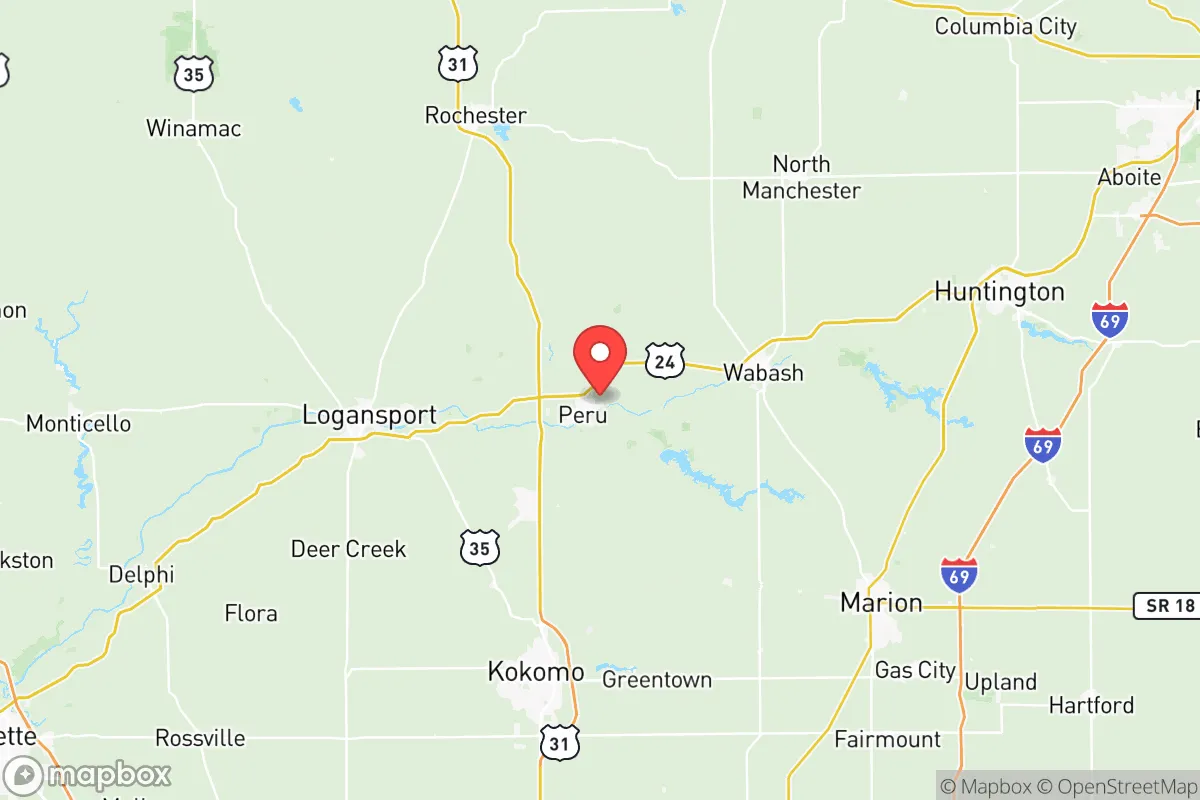
Miami County, Indiana, is a reliably Republican area with a Cook PVI of R+13, making it significantly more conservative than the state of Indiana as a whole, which sits at R+9. This isn't a new development; the county has been a GOP stronghold for decades, but the margin has widened in recent cycles as rural areas have shifted rightward. While the county as a whole votes red, there are notable pockets of blue, particularly in the city of Peru, which has a more mixed voting record due to its larger population and union-heavy manufacturing base. Smaller towns like Bunker Hill and Converse lean heavily Republican, while the precincts around the Mississinewa Reservoir and the eastern part of the county near the Wabash River tend to be the most conservative.
How it compares
Indiana’s R+9 rating already marks it as a solidly red state, but Miami County’s R+13 shows a deeper commitment to conservative candidates. In the 2024 presidential election, Miami County voted for Donald Trump by a margin of roughly 72% to 26%, a wider spread than the statewide average of about 59% to 39%. This pattern holds down-ballot: Republican candidates for state legislature and county offices routinely win by 20-30 points. The difference is most stark when comparing Peru to the rest of the county. In 2024, Peru’s precincts split roughly 55-45 for Trump, while rural precincts like those in Richland Township and Butler Township delivered margins of 80-20 or higher. This internal divide mirrors the broader urban-rural split seen across Indiana, but Miami County’s rural population is large enough to keep the overall lean solidly red.
What this means for residents
For conservative residents, Miami County feels like a natural fit. Local government, school boards, and law enforcement are overwhelmingly Republican, and conservative values are reflected in everything from the county’s approach to taxes (relatively low property tax rates compared to neighboring Howard County) to its stance on Second Amendment rights (the county is a stronghold for gun ownership, with few local restrictions). Liberal residents, particularly in Peru, often find themselves in the minority but not isolated. The city’s Democratic-leaning precincts provide a counterweight, and local issues like economic development and infrastructure often transcend party lines. That said, progressive policy proposals—such as zoning changes for affordable housing or diversity initiatives in schools—face an uphill battle in county-wide votes. The practical reality is that Miami County’s political climate is stable and predictable: elections are rarely competitive, and the local conversation tends to focus on maintaining the status quo rather than pursuing major change.
Culturally, Miami County stands apart from the more moderate suburbs of Indianapolis or the liberal enclaves of Bloomington. The county is deeply rooted in its agricultural and industrial heritage, with a strong emphasis on self-reliance and community. Policy-wise, this translates into a preference for limited government intervention, lower spending, and a focus on local control. The county’s relationship with the state government is generally cooperative, though there is occasional friction over state mandates on education or environmental regulations that locals see as overreach. For anyone moving here, the key takeaway is that Miami County offers a predictable, conservative environment where the pace of change is slow and the political conversation is grounded in tradition. Whether that’s appealing or not depends on your own leanings, but it’s a place where you’ll know exactly what you’re getting.

State Political ClimatePolitical Climate in Indiana
State Political AnalysisPolitical Environment in the State
Indiana has been reliably Republican for decades, carrying a Cook PVI of R+9 that reflects a solid but not overwhelming conservative lean. The state has voted for the GOP presidential candidate in every election since 2008, when Barack Obama narrowly won it by less than 1 point — a fluke driven by high turnout in the Indianapolis metro and the collapse of the rural vote for John McCain. Since then, the trajectory has been steadily rightward: Donald Trump won Indiana by 19 points in 2016 and 16 points in 2020, while the state legislature has held supermajorities since 2012. The dominant coalition is a mix of socially conservative rural voters, fiscally conservative suburbanites, and a growing number of working-class voters in smaller industrial cities who have shifted right on cultural and economic issues.
Urban vs. rural divide
The political map of Indiana is a textbook study in urban-rural polarization. Marion County (Indianapolis) is the Democratic stronghold, delivering about 60% of its vote to Biden in 2020, but it’s surrounded by a ring of deep-red suburban and exurban counties — Hamilton, Hendricks, Johnson, and Boone — that vote 60-70% Republican. Hamilton County, home to Carmel, Fishers, and Noblesville, is one of the wealthiest and fastest-growing counties in the Midwest, and its GOP margins have actually increased over the past decade as new residents tend to be fiscally conservative families. Lake County (Gary and Hammond) in the northwest corner is another Democratic anchor, voting about 55% Democratic, but its population has been shrinking for decades, reducing its statewide influence. The rest of the state is overwhelmingly red: Allen County (Fort Wayne) leans Republican by about 15 points, Vanderburgh County (Evansville) by about 20, and St. Joseph County (South Bend) is a rare swing county that voted for Obama twice but has since moved right, now leaning about 5 points Republican. The rural counties — like Pike, Crawford, and Switzerland — routinely vote 75-80% Republican, driven by gun rights, opposition to abortion, and skepticism of federal regulation. The only notable exception is Monroe County (Bloomington), home to Indiana University, which votes about 60% Democratic and serves as a liberal island in the southern part of the state.
Policy environment
Indiana’s policy environment is consistently conservative, with a few notable quirks. The state has a flat income tax rate of 3.05% (as of 2025, down from 3.15% in 2024), with a scheduled phase-down to 2.9% by 2027. Property taxes are capped at 1% of assessed value for owner-occupied homes, 2% for rental properties, and 3% for commercial — a constitutional amendment passed in 2010 that keeps housing costs relatively low. There is no estate tax and no inheritance tax. The regulatory posture is business-friendly: Indiana is a right-to-work state (though that law was repealed in 2025, a rare reversal), and it has a low corporate income tax rate of 4.9%. On education, the state has a robust school choice program: vouchers are available to any family earning up to 300% of the federal free lunch income limit, and charter schools are widespread. In 2024, the legislature passed a law requiring schools to post curriculum materials online and notify parents of any changes to sex education or health instruction. Healthcare policy is mixed: Indiana expanded Medicaid under the Affordable Care Act in 2015 via a conservative waiver (the Healthy Indiana Plan), but the state has not expanded postpartum Medicaid coverage beyond 60 days. Election laws are moderately restrictive: voters must show a government-issued photo ID at the polls, absentee voting requires an excuse (though no-excuse absentee was temporarily allowed during COVID), and early voting is available for 28 days before an election. The state has not adopted automatic voter registration or same-day registration.
Recent policy direction
The last five years have seen Indiana move decisively to the right on a broad set of issues. On gun rights, Indiana became a permitless carry state in 2022 (House Bill 1296), allowing any law-abiding adult 18 or older to carry a handgun without a license. The law also preempted local ordinances that were stricter than state law. On abortion, the state passed a near-total ban in 2022 (Senate Bill 1), with exceptions only for rape, incest (up to 10 weeks), and life of the mother. A 2024 amendment added a requirement that rape and incest victims must report the crime to law enforcement to qualify. On parental rights, the 2024 law requiring curriculum transparency was paired with a ban on instruction about human sexuality in grades K-3 (House Bill 1608). On medical freedom, Indiana banned COVID-19 vaccine mandates for state employees and contractors in 2023, and a 2024 law prohibits employers from requiring a vaccine that has not received full FDA approval (which effectively covers all COVID vaccines, since they remain under emergency use authorization for children). On property rights, the state has not passed any major eminent domain reform, but it has strengthened protections for landowners against solar and wind farm easements — a 2023 law requires written consent from all adjacent property owners before a renewable energy project can be built. On taxation, the flat income tax is being phased down, and the state eliminated the business personal property tax on new equipment in 2022. On voting, the legislature tightened absentee ballot rules in 2023, requiring that absentee ballots be received by noon on Election Day (rather than postmarked by that date), and banned the use of private funding for election administration.
Civil unrest & political movements
Indiana has not seen the kind of large-scale civil unrest seen in some coastal states, but there have been notable flashpoints. The 2020 Black Lives Matter protests in Indianapolis were significant, with several nights of clashes between demonstrators and police, and the destruction of a statue of a Confederate soldier in Garfield Park. The state legislature responded in 2021 with a law increasing penalties for rioting and blocking highways, which was criticized by civil liberties groups. On the right, the Indiana Freedom Coalition has been active in pushing for school board transparency and parental rights, and the Indiana Firearms Coalition successfully lobbied for permitless carry. Immigration politics are relatively quiet: Indiana has no sanctuary cities, and a 2011 law (Senate Bill 590) requires state and local law enforcement to cooperate with federal immigration authorities when possible. There have been no serious secession or nullification movements, though some rural counties have passed symbolic resolutions opposing federal gun control or vaccine mandates. Election integrity controversies have been minimal: the 2020 election in Indiana was conducted without major incident, and the state’s voter ID law has been in place since 2006 with little controversy. The most visible political flashpoint for a new resident would likely be the abortion debate, which remains heated: Planned Parenthood of Indiana and Kentucky has challenged the near-total ban in court, and the issue is a constant presence in local news and campaign ads.
Projection
Over the next 5-10 years, Indiana is likely to remain solidly Republican, but the margin may narrow slightly as the Indianapolis metro continues to grow and diversify. Hamilton County is adding about 10,000 new residents per year, many of them younger families who are fiscally conservative but more moderate on social issues — a shift that could make the county less reliably red over time. Meanwhile, rural counties are losing population, which reduces their electoral weight. The state’s in-migration is primarily from other Midwestern states (Illinois, Ohio, Michigan) and tends to be conservative-leaning, but not as intensely as the existing rural base. The flat tax phase-down will likely continue, and the legislature may consider further cuts to the corporate income tax. On social issues, the near-total abortion ban is likely to remain in place, though court challenges could carve out exceptions. The biggest wildcard is the education funding debate: as school choice expands, rural public schools are losing enrollment and funding, which could create political pressure for a new funding formula. A new resident moving in now should expect a state that is reliably conservative on taxes, guns, and abortion, but with a growing suburban moderate bloc that could make future primaries more competitive in places like Carmel and Fishers.
For a new resident, the bottom line is straightforward: Indiana offers a low-tax, business-friendly environment with strong gun rights and conservative social policies, especially on abortion and education. A conservative family will find a welcoming political climate and a state government that largely aligns with their values. A liberal resident will find a few blue islands — Indianapolis, Bloomington, and parts of Lake County — but will face a state legislature that is unlikely to pass any progressive legislation for the foreseeable future. The practical takeaway is that Indiana is a place where your vote matters less at the state level than in a swing state, but where local elections — especially school board and county commission races — can have a real impact on daily life. If you value low taxes, school choice, and a limited regulatory environment, you’ll feel at home. If you’re looking for a state that is trending purple or blue, this isn’t it — but the stability and predictability of the political climate is itself a draw for many relocators.
* Values derived from national, state, county, city and local statistics and may differ in a specific area. Last updated: 2026-08-19T02:22:50.000Z
Narrative content on this page is AI-generated and may contain mistakes. Verify any details that matter before acting on them.
ReloMaps may earn a commission from affiliate links at no extra cost to you.

