
Photo: Wikipedia
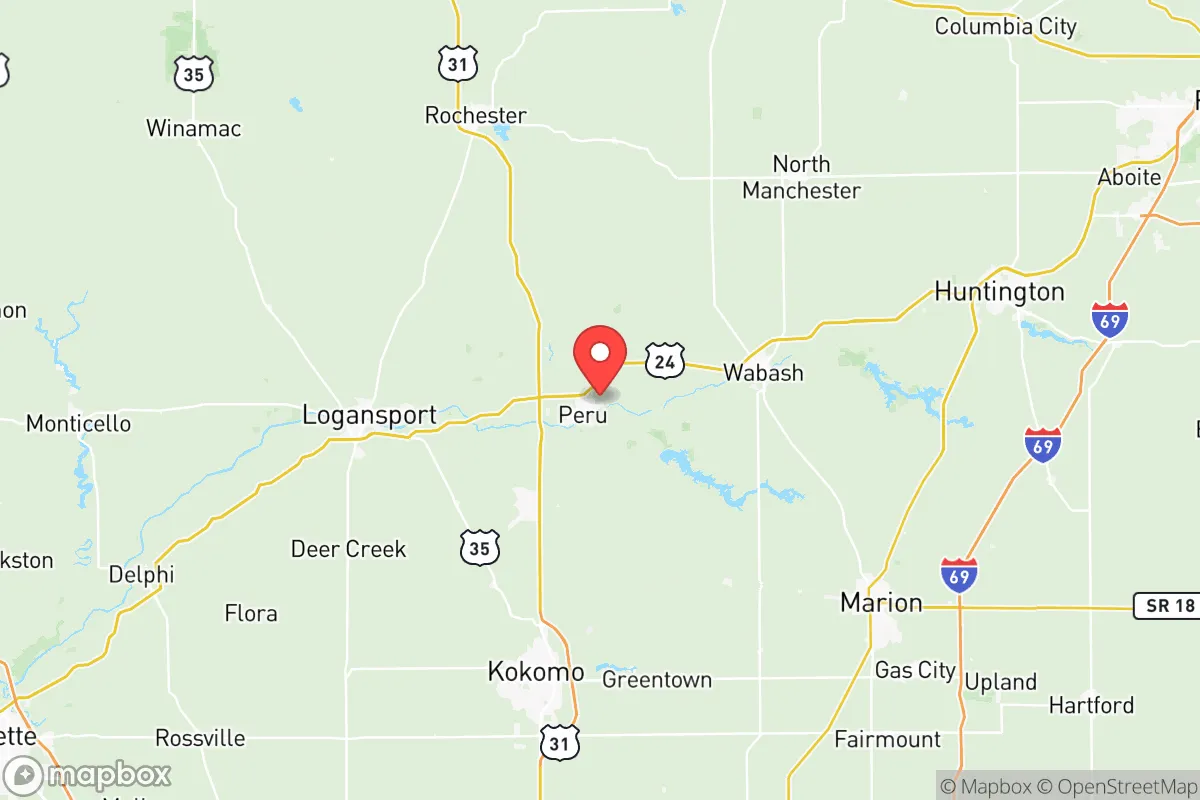
Personal Sovereignty in Miami County
Viable for self-reliance. Generally workable, though some barriers may limit total independence.
What does Personal Sovereignty tell us?
Personal Sovereignty measures your capacity for self-reliance and independence with minimal government friction. Higher scores mean fewer barriers between you and the way you want to live... but it assumes you have the space you need and good neighbors.
What does this tell us?
Personal Sovereignty measures your capacity for self-reliance and independence with minimal government friction. Higher scores mean fewer barriers between you and the way you want to live... but it assumes you have the space you need and good neighbors.
State Policy
Energy independence: Importer (35% of energy produced in-state)
Personal Liberty
Homesteading

Personal Liberty Analysis
Miami County, Indiana, offers a notably high degree of personal sovereignty, grounded in Indiana’s consistently low-tax, limited-government framework and a deeply ingrained culture of self-reliance. For individuals and families prioritizing autonomy, the county provides a regulatory environment where local control is strong, gun rights are robust, and the ability to live independently—whether through homesteading or simply minimizing interaction with government—is well-supported. While not as libertarian-leaning as some rural Western counties, Miami County’s blend of state-level protections and local permissiveness places it among the more freedom-respecting areas in the Midwest, particularly when compared to the higher-tax, more regulated environments of larger Indiana cities like Indianapolis or Fort Wayne.
Tax burden and regulatory posture: How light is the government footprint?
Indiana’s state-level tax structure is among the most favorable in the nation for those seeking to keep more of their earnings. The state imposes a flat income tax rate of 3.15% (as of 2025, with a scheduled decline to 2.9% by 2027), and Miami County’s combined property tax rate is moderate, typically ranging from 0.8% to 1.2% of assessed value depending on the specific township. This is significantly lower than the national average and far below rates in high-tax states like Illinois or New York. The county government, based in Peru, maintains a lean administrative posture—there is no county-level income tax, and business licensing requirements are minimal. Zoning is largely permissive outside of the incorporated towns of Peru, Bunker Hill, and Converse, where municipal codes are more detailed. In unincorporated areas like Miami Township or Richland Township, property owners face few restrictions on land use, making it straightforward to operate a home-based business, keep livestock, or build auxiliary structures without extensive permitting. The overall regulatory climate is best described as light-touch, with the county focusing on essential services like roads and public safety rather than proactive enforcement of land-use or business rules.
Self-defense and gun law specifics: What are the legal protections for carrying and owning firearms?
Indiana is a constitutional carry state, meaning that as of July 1, 2022, any law-abiding adult 18 or older may carry a handgun openly or concealed without a permit. This is a foundational element of personal sovereignty in Miami County. The county sheriff’s office, based in Peru, is known for a pro-Second Amendment stance, and there are no local ordinances that restrict firearm ownership beyond state law. The state also has a strong Stand Your Ground law, which removes the duty to retreat before using deadly force in self-defense, and a Castle Doctrine that presumes a reasonable fear of death or great bodily harm if an intruder unlawfully enters a home or vehicle. For those who wish to carry in other states, Indiana’s non-resident permit is widely recognized. Gun culture is deeply embedded in the area—shooting ranges like the Miami County Conservation Club near Peru are active, and firearm sales at local shops in Bunker Hill and Converse are routine. There are no magazine capacity restrictions, no firearm registration requirements, and no waiting periods for purchases. For a family or individual who views firearm ownership as a core right, Miami County offers one of the most permissive legal environments in the country.
Self-reliance and homesteading viability: Lot sizes, zoning, and off-grid feasibility
Miami County is highly conducive to a self-reliant lifestyle, particularly in its rural townships. Minimum lot sizes in unincorporated areas are typically 1 to 5 acres, though many parcels available for sale are 10 acres or larger, especially in Butler Township and Washington Township. Zoning is minimal: there are no county-wide restrictions on keeping chickens, goats, or even larger livestock like cattle or horses on residential parcels outside town limits. Off-grid living is legally feasible, though Indiana’s building codes require a permanent structure to meet basic safety standards if it is to be occupied. However, many residents in areas like Peru Township or Clay Township use solar panels, rainwater collection, and composting toilets without issue, as long as they are not connected to municipal water or sewer. The county does not actively enforce energy or water self-sufficiency restrictions. For those seeking to grow their own food, the growing season is roughly 160 days, and soil quality is generally good for row crops and gardens. The Amish and Mennonite communities in the area, particularly around Converse, demonstrate that a fully self-sufficient, low-tech lifestyle is not only tolerated but culturally respected. The main limitation is that Indiana’s property tax code does not offer a specific homestead exemption for off-grid properties, but the overall tax burden remains low enough that this is rarely a deterrent.
Personal liberties: Parental rights, medical autonomy, speech, and property
Indiana has strong legal protections for parental rights. State law explicitly affirms that parents have the fundamental right to direct the upbringing, education, and healthcare of their children, and Miami County’s school districts—including Peru Community Schools and Maconaquah School Corporation—generally defer to parental authority on matters like curriculum opt-outs and medical decisions. Medical autonomy is more mixed: Indiana does not have a broad medical freedom law, but it does protect the right to refuse any medical treatment, including vaccines, for oneself and one’s children. The state has no mask or vaccine mandates in effect as of 2026, and local health departments in Miami County have not imposed such requirements. Free speech is fully protected under the First Amendment, and the county has no local ordinances restricting political expression or public assembly. Property rights are strongly guarded: Indiana’s eminent domain laws are among the most restrictive in the nation, requiring a clear public use and just compensation, and Miami County has not been involved in controversial takings. The county’s small-town character means that neighbors generally respect each other’s boundaries, and disputes over property lines or noise are rare. For those who value the ability to live without government interference in family and personal decisions, Miami County provides a solid legal foundation.
Overall, Miami County offers a level of personal sovereignty that is well above the national average and competitive with the most freedom-oriented counties in the Midwest. The combination of constitutional carry, low taxes, permissive zoning, strong parental rights, and a culture of self-reliance creates an environment where individuals and families can largely chart their own course. While it lacks the extreme libertarian ethos of some rural Western counties, it compensates with a stable, community-oriented framework that is both predictable and respectful of personal autonomy. For a conservative-leaning individual or family seeking a place where government is a partner, not a manager, Miami County is a strong candidate.

* Values derived from national, state, county, city and local statistics and may differ in a specific area. Last updated: 2026-08-19T02:22:50.000Z
Narrative content on this page is AI-generated and may contain mistakes. Verify any details that matter before acting on them.
ReloMaps may earn a commission from affiliate links at no extra cost to you.

