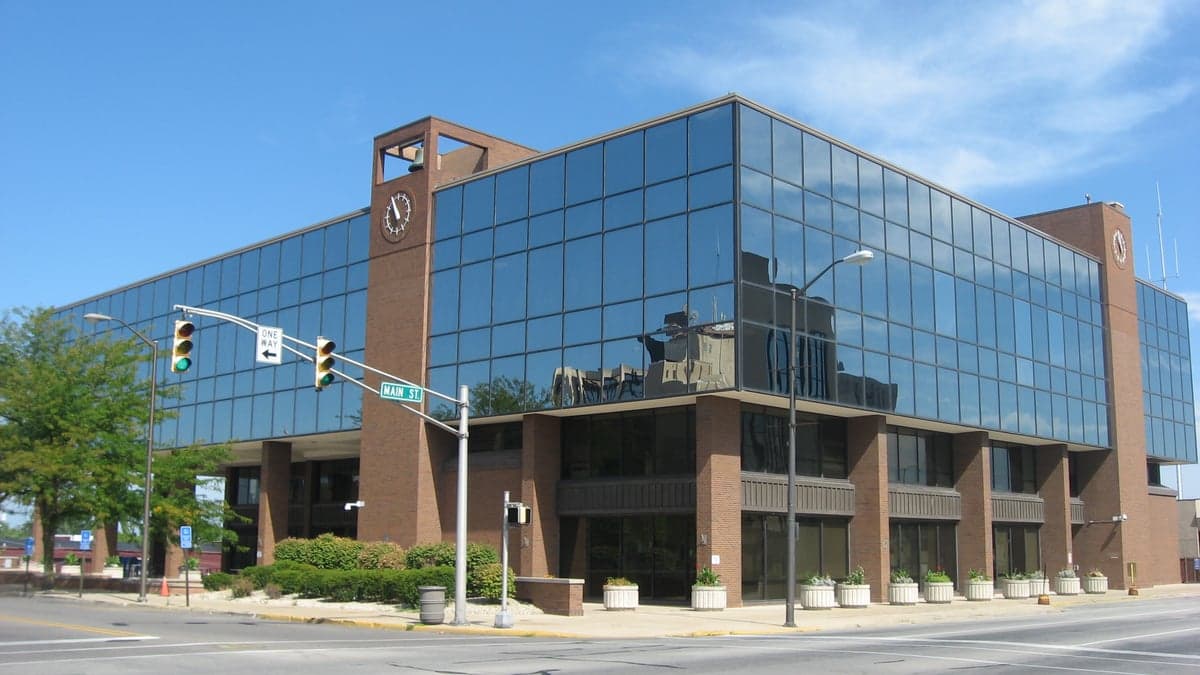
Photo: Wikipedia
Political ClimatePolitical Climate in Madison County
Showing district-level results — no local-only data available.
Local Political AnalysisPolitical Analysis of Madison County
Madison County, Indiana, leans reliably Republican, with a Cook PVI of R+8, making it slightly less conservative than the state of Indiana as a whole, which sits at R+9. This isn't a deep-red monolith, though; the county has a nuanced political geography shaped by its industrial legacy and the presence of Anderson University. The county has been trending rightward over the past decade, but pockets of Democratic strength remain, particularly in the city of Anderson itself, where union ties and a sizable African American community keep precincts competitive. Meanwhile, the suburban and rural townships—places like Pendleton, Lapel, and Elwood—have shifted decisively red, making the county's overall trajectory one of slow but steady Republican consolidation.
How it compares
Compared to Indiana's R+9 statewide lean, Madison County's R+8 is a near match, but the internal dynamics are what set it apart. In Anderson, the county seat and largest city, you'll find precincts that still vote blue, especially around the core neighborhoods near the former Delco Remy plant and the university district. These areas are a holdover from the county's union-heavy manufacturing era. Drive ten miles south to Pendleton, and the story flips hard: Pendleton is a reliably red stronghold, driven by its growing suburban population and the presence of the Pendleton Correctional Facility, a major local employer. Elwood, to the northwest, has also trended red, though its older, working-class base can swing in local races. The swing precincts are mostly in the unincorporated areas between Anderson and Pendleton—places like the neighborhoods around the intersection of State Road 9 and 67—where independent voters decide county commission races. In short, Madison County mirrors the state's overall lean but with a more pronounced urban-rural split than Indiana's average.
What this means for residents
For conservative residents, the county's R+8 lean means their values are reflected in most local offices—the county commissioners, sheriff, and council are reliably Republican, and policy tends toward low taxes and limited government. School board races in Pendleton and Lapel are often decided in GOP primaries. For liberal residents, the picture is more mixed. Anderson provides a blue island where Democratic candidates can win city council seats and where progressive voices are heard, especially on issues like public transit and affordable housing. However, countywide, liberal policy priorities like expanding Medicaid or stricter environmental regulations face an uphill battle. The practical reality is that both sides coexist: conservatives enjoy a comfortable majority in county governance, while liberals find their strongest representation in Anderson's city hall and in the cultural sphere around the university. Neither group is silenced, but the political center of gravity is clearly right of center.
Culturally, Madison County has a few distinctions that set it apart from the broader Indiana landscape. The county is home to the historic Paramount Theatre in Anderson, a venue that draws a more arts-oriented crowd than you'd find in many similarly-sized Indiana counties. The annual Madison County 4-H Fair in Alexandria is a deeply traditional affair, while Anderson's "First Friday" events lean more eclectic. On policy, the county has been slower than some neighboring counties to embrace solar farm development, reflecting a cautious, property-rights-oriented conservatism. The presence of Anderson University, a Church of God-affiliated school, adds a moderate evangelical influence that tempers some of the harder-edge cultural conservatism found in rural Indiana. For anyone moving here, the key takeaway is that Madison County is politically predictable at the county level but offers genuine variety town-to-town—a place where a Pendleton Republican and an Anderson Democrat can both find their community, even if they rarely agree on who should run it.

State Political ClimatePolitical Climate in Indiana
State Political AnalysisPolitical Environment in the State
Indiana has been a reliably Republican state for decades, with a Cook Partisan Voting Index of R+9, meaning it votes about nine points more Republican than the nation as a whole. The state hasn't backed a Democrat for president since 2008, when Barack Obama narrowly carried it, and that win is widely seen as a fluke driven by the financial crisis and a strong ground game in the industrial northwest. Over the last 10-20 years, the GOP has tightened its grip on every level of government, from the statehouse to county commissions, while the Democratic Party has become increasingly concentrated in a handful of urban and college-town strongholds.
Urban vs. rural divide
The political map of Indiana is a textbook example of the urban-rural split that defines American politics today. The Democratic base is almost entirely contained within Marion County (Indianapolis), Lake County (Gary and the Chicago suburbs), and Monroe County (Bloomington, home to Indiana University). In 2024, Marion County voted about 60% Democratic, while Lake County was closer to 55% Democratic. Outside of these three counties, the state is overwhelmingly red. Hamilton County, just north of Indianapolis, is the wealthiest and fastest-growing county in the state and votes about 60% Republican, though it has a noticeable moderate wing. Allen County (Fort Wayne) and Vanderburgh County (Evansville) lean Republican but are less lopsided than the deep-red rural counties. The real GOP strongholds are the small-town and agricultural counties like Kosciusko (Warsaw), Elkhart, and Dubois (Jasper), where Republican margins often exceed 70%. The northwest corner, around Michigan City and La Porte, is a rare swing area, mixing Chicago commuters with rural conservatives.
Policy environment
Indiana's policy environment is consistently conservative, with a strong emphasis on low taxes, limited regulation, and traditional social values. The state has a flat income tax rate of 3.05% as of 2025, with a scheduled phase-down to 2.9% by 2027. Property taxes are capped at 1% of assessed value for owner-occupied homes, 2% for rental properties, and 3% for commercial property — a constitutional amendment that is very popular. There is no inheritance tax. The regulatory posture is business-friendly, with a right-to-work law on the books (though it was repealed in 2025 after a long labor fight, a notable shift). Education policy has been dominated by school choice: Indiana has one of the largest and most expansive voucher programs in the country, with no income cap for eligibility as of 2023. Healthcare policy is limited; the state did not expand Medicaid under the Affordable Care Act until 2015 under a conservative waiver, and it has some of the strictest abortion laws in the nation, banning the procedure at conception with narrow exceptions for rape, incest, and lethal fetal anomalies. Election laws are moderately restrictive: voter ID is required, early voting is available but not expansive, and same-day registration is not permitted.
Recent policy direction
Over the past five years, Indiana has moved decisively to the right on several fronts. In 2022, the legislature passed a near-total abortion ban, which was temporarily blocked by the courts but ultimately upheld by the state supreme court in 2023. On gun rights, Indiana became a permitless carry state in 2022, allowing any law-abiding adult to carry a handgun without a license. The state also passed a "stand your ground" law in 2023, eliminating the duty to retreat in self-defense situations. On education and parental rights, Indiana enacted a law in 2023 requiring schools to notify parents of any changes to a student's gender identity or expression, and it banned instruction on human sexuality through third grade. On the privacy and surveillance front, the state passed a consumer data privacy law in 2023, but it is relatively weak compared to California or Virginia, with no private right of action. Property rights are generally strong, with no statewide rent control and limited eminent domain abuse. On voting and ballot access, the state has tightened its absentee ballot rules and purged voter rolls aggressively, which has drawn lawsuits but no major court losses. The overall direction is toward more individual liberty on guns and less on bodily autonomy, with a strong tilt toward parental control in education.
Civil unrest & political movements
Indiana has not seen the kind of large-scale civil unrest that has hit states like Oregon or Minnesota, but there have been notable flashpoints. The 2020 George Floyd protests in Indianapolis were large and occasionally violent, leading to property damage and a heavy police response. The state has a small but active antifa and anarchist scene in Bloomington and Indianapolis, but it is not a major factor in daily life. On the right, the most organized movement is the gun rights community, which is highly active at the statehouse and successfully pushed permitless carry and stand your ground. There is also a growing school choice advocacy network that is well-funded and politically connected. Immigration politics are relatively quiet compared to border states, but there have been controversies over sanctuary city policies. In 2019, the state passed a law requiring local governments to cooperate with federal immigration enforcement, effectively banning sanctuary cities. No Indiana city has openly defied it, though some activists in Bloomington and Indianapolis have pushed back. Election integrity has been a recurring theme since 2020, with Republican legislators passing stricter voter ID laws and limiting mail-in voting, but there have been no major fraud scandals or recounts that changed outcomes. The most visible political flashpoint for a new resident would likely be the abortion debate, which remains highly charged, especially in college towns.
Projection
Over the next 5-10 years, Indiana is likely to remain solidly Republican, but the margins may narrow slightly as the Indianapolis suburbs continue to grow and diversify. Hamilton County, once a GOP stronghold, is becoming more competitive as tech and finance workers move in from other states. The Democratic base in Marion County is growing, but not fast enough to offset the rural vote. In-migration is modest compared to Sun Belt states, but the people moving in tend to be younger and more moderate, especially around Indianapolis and Bloomington. The state's abortion ban may become a political liability over time, as it is unpopular with suburban women, but the GOP's grip on the legislature is so strong that a major shift is unlikely before the next redistricting cycle in 2030. Expect continued conservative policy on guns, taxes, and education, with possible further restrictions on abortion and transgender rights. The wild card is the state's manufacturing economy: if the EV and battery plant boom (like the Stellantis-Samsung plant in Kokomo) creates enough high-paying jobs, it could attract a more diverse workforce that slowly shifts the political center.
For a new resident, the bottom line is straightforward: if you are conservative, you will find a state that largely aligns with your values on taxes, guns, education, and regulation. If you are liberal, you will find a few welcoming enclaves — Indianapolis, Bloomington, and parts of Lake County — but you will be living under a state government that is actively hostile to many of your policy preferences. The practical takeaway is that Indiana offers a stable, predictable political environment with low taxes and a business-friendly climate, but it is not a place where political change happens quickly. You can expect the same basic policy direction for the foreseeable future, with incremental shifts rather than dramatic swings.
* Values derived from national, state, county, city and local statistics and may differ in a specific area. Last updated: 2026-07-03T23:54:40.000Z
Narrative content on this page is AI-generated and may contain mistakes. Verify any details that matter before acting on them.
ReloMaps may earn a commission from affiliate links at no extra cost to you.

