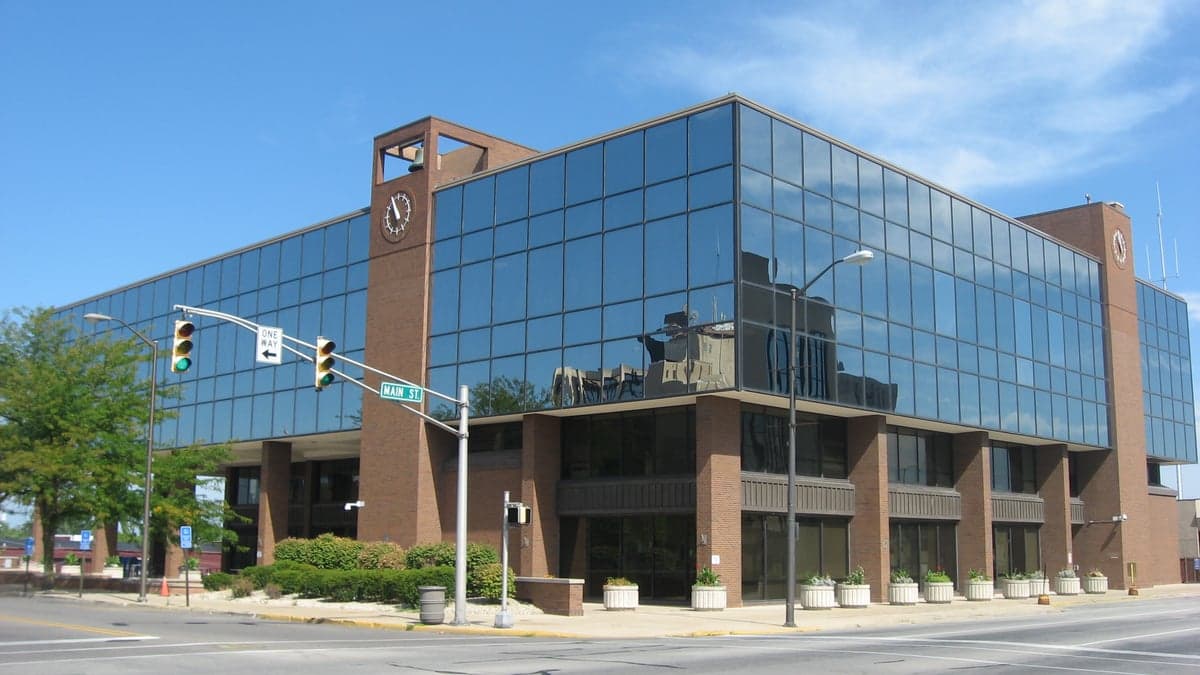
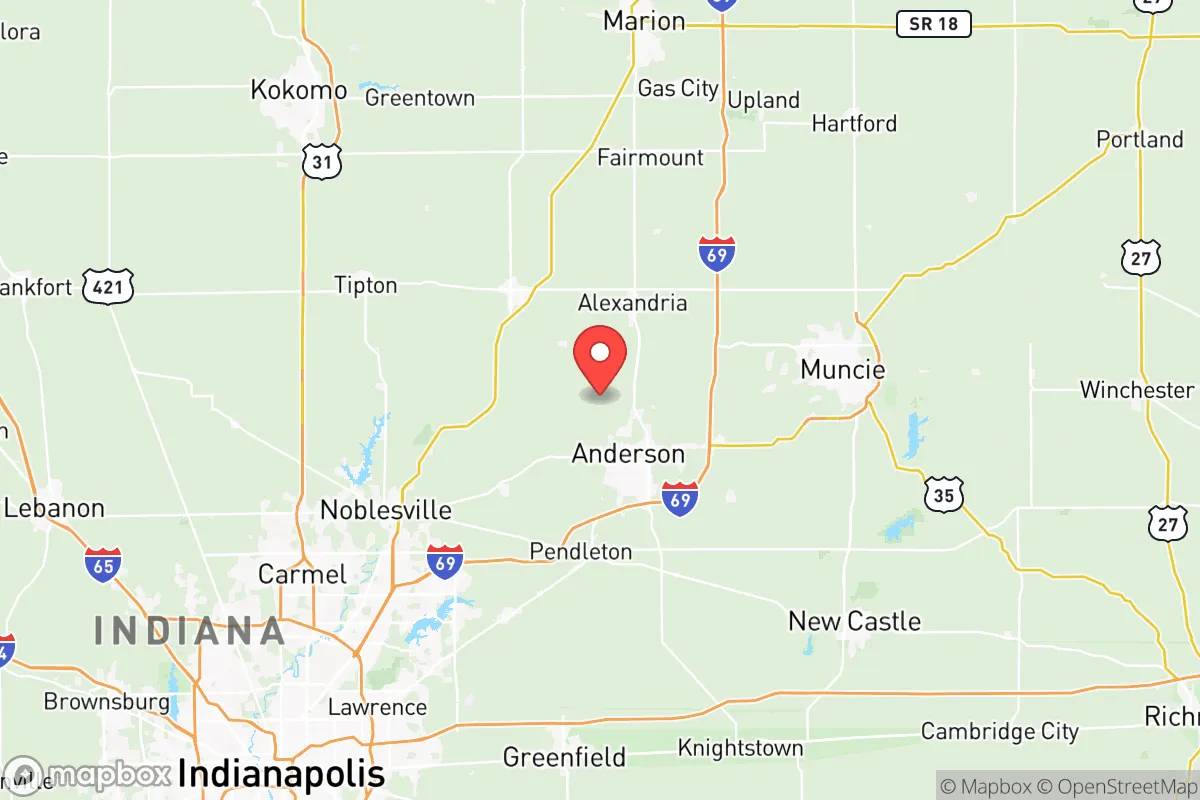
Photo: Wikipedia
Demographics of Madison County
Affluence Level in Madison County
A middle-class area roughly in line with national averages across income, home values, education, and employment.
People of Madison County
Today, Madison County, Indiana is home to roughly 130,949 residents, a population that is predominantly white (82.6%) with a small but established Black community (6.3%) and a growing Hispanic population (5.1%). The county's character is defined by its industrial and agricultural roots, with a population density of about 200 people per square mile, concentrated in the cities of Anderson, Elwood, and Pendleton. Distinctive identity markers include a strong union heritage from the auto manufacturing era, a notable conservative political leaning, and a sense of place shaped by the slow decline of heavy industry and the steady growth of suburban commuter towns along the I-69 corridor.
Settlement & growth (pre-1960)
Before American settlement, the land that is now Madison County was inhabited by the Miami and Delaware (Lenape) nations, who used the area for hunting and seasonal villages. The region was part of the New Purchase of 1818, a treaty that opened central Indiana to Euro-American settlers. The first permanent American settlers arrived in the early 1820s, primarily of Scots-Irish and English stock, moving west from Ohio, Kentucky, and Pennsylvania. They were drawn by the promise of cheap, fertile land and established the first county seat at Pendleton in 1823.
The construction of the Indiana Central Canal in the 1830s and later the arrival of railroads in the 1850s spurred the county's growth. Anderson, founded in 1827, became the new county seat in 1829 and grew as a trading and milling center. The discovery of natural gas in the 1880s triggered an industrial boom, pulling in a wave of European immigrants. German and Irish immigrants arrived in significant numbers during the 1880s and 1890s, finding work in the new glass factories, iron foundries, and machine shops that sprang up in Anderson and Elwood. Smaller numbers of Italian and Polish immigrants also settled in Anderson during this period, forming tight-knit ethnic neighborhoods near the factories.
The 20th century brought the county's defining industry: automobile manufacturing. The founding of the Remy Electric Company in Anderson in 1896 and later the establishment of a General Motors (Delco Remy) plant in the 1920s transformed the county. From the 1920s through the 1970s, Anderson became a company town for GM, attracting a steady stream of domestic migrants from rural Indiana, Kentucky, and Tennessee. This was a period of relative prosperity and population growth, peaking at around 138,000 residents in 1970. The Black population in Anderson also grew during this era, as African American workers moved north during the Great Migration, finding employment in the auto plants and related industries. By 1960, the Black community in Anderson was well-established, concentrated in the city's west side and near the industrial corridors.
Modern era (post-1965)
The post-1965 era in Madison County has been defined by deindustrialization and demographic stagnation. The Hart-Cellar Act of 1965, which reshaped U.S. immigration, had a minimal direct impact on Madison County. The county's foreign-born population today is just 0.9%, far below the national average. Unlike many Midwestern counties that saw new waves of immigration from Latin America and Asia after 1965, Madison County remained overwhelmingly native-born. The small Hispanic population (5.1%) is a relatively recent development, with most growth occurring since 2000 as Mexican and Central American immigrants moved into the region for work in agriculture, food processing, and construction. These families are dispersed across the county, with small but visible communities in Anderson and Alexandria.
The dominant demographic story of the modern era is domestic out-migration. Between 1970 and 2020, Madison County lost roughly 30,000 residents, driven by the decline of General Motors. The Delco Remy plant, once the county's largest employer, shed thousands of jobs through the 1980s and 1990s, and GM's final departure from Anderson in the early 2000s was a severe blow. This triggered a sustained exodus of working-age families, particularly white and Black residents, who moved to Indianapolis, the Sun Belt, or other Midwestern cities with stronger job markets. The county's population aged significantly during this period, and the college-educated share remains low at 20.1%.
Suburbanization within the county has been modest but notable. Pendleton, the original county seat, has grown as a commuter town for Indianapolis, attracting families seeking lower housing costs and a small-town atmosphere. The town's historic square and the Pendleton Correctional Facility provide a stable economic base. Similarly, the southern part of the county, near the towns of Ingalls and Lapel, has seen new residential development as the Indianapolis metro area expands northward along I-69. These areas tend to be whiter and more affluent than the county average, while Anderson continues to struggle with population loss, aging housing stock, and a higher poverty rate.
The future
Madison County's population is projected to remain relatively flat or decline slightly over the next 10-20 years, with modest growth in the southern commuter towns offsetting continued losses in Anderson and Elwood. The county is becoming slightly more diverse, driven by the growth of the Hispanic population, which is expected to rise from 5.1% to perhaps 8-10% by 2040, and a small but steady increase in the East/Southeast Asian population (currently 0.4%) as some families move from Indianapolis for lower housing costs. The Black population share is likely to remain stable or decline slightly, as younger Black residents continue to leave for larger cities with more economic opportunity.
The county's cultural identity is evolving from a blue-collar, union-heavy manufacturing identity toward a more mixed economy of logistics, healthcare, and commuter-based employment. The I-69 corridor is the primary engine of change, with new distribution centers and warehouses being built near the interstate exits. This is attracting a slightly younger, more suburban demographic to places like Pendleton and Ingalls, while Anderson works to reinvent itself as a hub for advanced manufacturing and healthcare services. The county remains politically conservative, and this is unlikely to shift significantly, though the growing Hispanic population may introduce new political dynamics over time.
For someone moving in now, Madison County offers a low-cost, relatively safe, and quiet lifestyle with easy access to Indianapolis. The county is becoming a bedroom community for the state capital, with the southern towns growing and the northern industrial cities continuing their long, slow adjustment to a post-GM economy. The population is aging, but the southern corridor is seeing a modest influx of young families. The county's future is not one of dramatic growth or transformation, but of gradual, incremental change, with the I-69 corridor acting as the main artery connecting a historically industrial county to the suburban future of central Indiana.

* Values derived from national, state, county, city and local statistics and may differ in a specific area. Last updated: 2026-07-03T23:54:40.000Z
Narrative content on this page is AI-generated and may contain mistakes. Verify any details that matter before acting on them.
ReloMaps may earn a commission from affiliate links at no extra cost to you.

