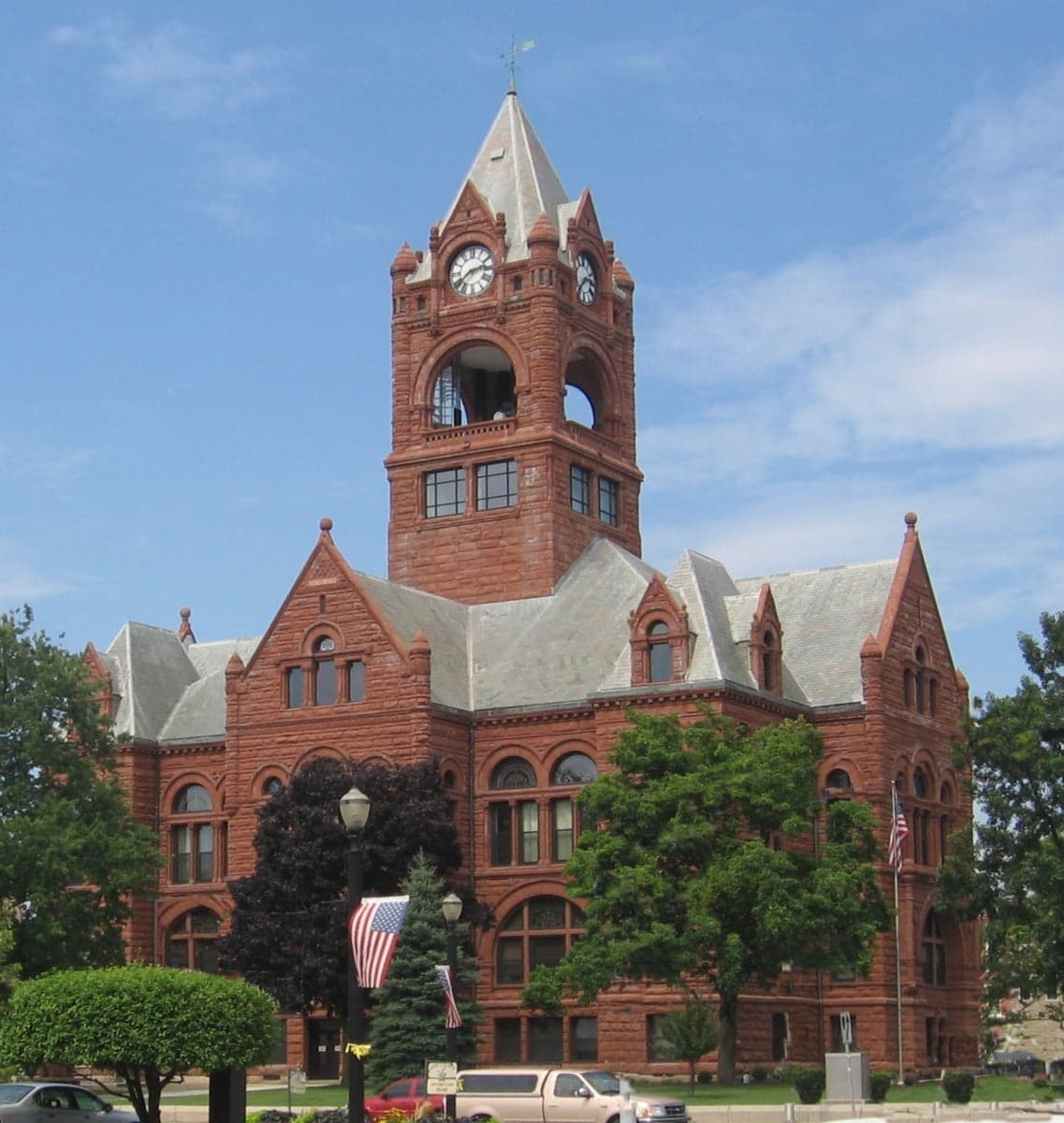
Photo: Wikipedia
Political ClimatePolitical Climate in Laporte County
Showing district-level results — no local-only data available.
Local Political AnalysisPolitical Analysis of Laporte County
LaPorte County, Indiana, is a genuine political battleground in a state that has shifted decisively red. With a Cook Partisan Voting Index of D+1, it is one of the few remaining competitive counties in Indiana, which as a whole carries a PVI of R+9. This means the county votes nearly identically to the national average, making it a bellwether for closely watched races, while the state around it has become reliably Republican. The county's trajectory has been a slow drift rightward, but it has not flipped as dramatically as many of its neighbors.
How it compares
The contrast between LaPorte County and the rest of Indiana is stark. While the state leans heavily Republican by nearly 10 points, LaPorte County is essentially a toss-up. This is largely driven by the urban and suburban core of Michigan City, which consistently delivers strong Democratic margins thanks to its unionized industrial workforce and growing minority populations. In contrast, the rural townships and smaller communities like LaPorte city and Kingsford Heights are more conservative, often voting in line with the rest of the state. The swing precincts are typically found in the unincorporated areas between Michigan City and LaPorte, where independent and moderate voters decide elections. For example, in the 2024 presidential race, Michigan City precincts went for the Democratic candidate by 15-20 points, while precincts around Westville and Wanatah went Republican by similar margins. This internal split means the county's overall result often mirrors the national popular vote, a rarity in Indiana.
What this means for residents
For conservative residents, living in a D+1 county means their votes are genuinely competitive in local races, unlike in much of the rest of Indiana where Republican primaries are often the only real contest. They have a strong voice in county commission and council races, where the balance of power can shift every election cycle. For liberal residents, the county provides a political home where their values are represented at the local level, particularly in Michigan City where the city council and school board are reliably progressive. However, both sides must contend with the reality that state-level policies—from abortion restrictions to gun laws—are set by a heavily Republican legislature in Indianapolis. This creates a tension where local preferences on issues like housing density or environmental regulations can clash with state mandates. The practical effect is that residents experience a more moderate, pragmatic local governance than the state's overall red tilt might suggest, but with less influence over broader state policy.
Culturally, this political divide manifests in everyday life. Michigan City has a more diverse, urban feel with a strong arts scene and lakefront development, while the southern part of the county around LaPorte city retains a small-town, agricultural character. The county's status as a swing area means that local politicians tend to be more centrist and coalition-building than in deep-red or deep-blue counties. You'll find Democrats who are pro-business and Republicans who support environmental conservation along Lake Michigan. This pragmatic streak is the county's defining political feature—neither side can take victory for granted, which forces a level of compromise that is increasingly rare in American politics. For anyone moving here, the key takeaway is that your vote will matter more than it does in most of Indiana, and you'll be living in a place where political conversations are still about persuasion, not just mobilization.

State Political ClimatePolitical Climate in Indiana
State Political AnalysisPolitical Environment in the State
Indiana has been a reliably Republican state for decades, with a Cook PVI of R+9 that reflects a solid but not overwhelming conservative lean. The state hasn't voted for a Democratic presidential candidate since 2008, when Barack Obama narrowly won it, but that was an anomaly driven by the financial crisis and a strong ground game in the industrial northwest. In the 2024 election, Donald Trump carried Indiana by about 19 points, consistent with the 16-point margins of 2016 and 2020. The dominant political coalition is a blend of small-government fiscal conservatives, social conservatives from the rural and suburban areas, and a growing libertarian streak. Over the last 20 years, the GOP has tightened its grip on the state legislature and every statewide office, but the state is not a monolith—pockets of Democratic strength persist, and the urban-rural divide has only deepened.
Urban vs. rural divide
Indiana's political map is a textbook example of the urban-rural split. Marion County, home to Indianapolis, is the state's Democratic stronghold, routinely delivering 60-65% of its vote to Democratic presidential candidates. The city's core and close-in suburbs like Lawrence and the Near Eastside lean heavily blue, while the outer ring suburbs like Carmel, Fishers, and Zionsville have shifted rightward over the past decade as they've grown more affluent and family-oriented. Lake County in the northwest corner, part of the Chicago metro area, is the other major Democratic anchor, powered by working-class union households and a significant Black and Hispanic population in Gary, Hammond, and East Chicago. In 2020, Lake County gave Joe Biden his largest raw vote margin in the state.
Outside of these two counties, the landscape is overwhelmingly red. Hamilton County, just north of Indianapolis and home to the aforementioned Carmel and Fishers, has actually become more Republican over time, voting for Trump by 20 points in 2024 despite being educated and affluent. Meanwhile, rural counties like Greene, Daviess, and Jennings routinely vote 70-80% Republican. The state's second-largest city, Fort Wayne (Allen County), is a swing county that leans Republican by about 10 points, while Evansville (Vanderburgh County) in the southwest is more reliably red. The state's university towns—Bloomington (Monroe County) and West Lafayette (Tippecanoe County)—are notable exceptions, with Bloomington being a blue island in a sea of red, home to Indiana University and a vibrant, progressive student and faculty population.
Policy environment
Indiana's policy environment is consistently conservative but pragmatic. The state has a flat income tax rate of 3.05%, set to decline to 2.9% by 2027, and no estate or inheritance tax. Sales tax is 7%, one of the higher rates in the Midwest, but the overall tax burden is below the national average. Regulatory posture is business-friendly, with a right-to-work law (passed in 2012) and a low corporate tax rate of 4.9%.
Education policy leans toward school choice; Indiana has one of the strongest voucher programs in the country, allowing public funds to follow students to private and religious schools. The state's academic standards and testing regime are rigorous but not as ideologically charged as in some neighboring states. Healthcare policy is limited; Indiana expanded Medicaid under then-Governor Mike Pence's "HIP 2.0" plan, which includes modest work requirements and premiums for some participants. Abortion is heavily restricted: after the fall of Roe v. Wade, a near-total ban was enacted in 2023, with narrow exceptions for rape, incest, and life endangerment. The ban was challenged in court but is currently in effect.
Election laws are moderately restrictive: Voter ID is required in person, early voting runs for 28 days including two Saturdays, and absentee voting requires an excuse (though COVID-era no-excuse absentee voting was ended in 2024). The legislature is heavily gerrymandered, giving Republicans supermajorities in both chambers even when Democrats win 40% of the statewide vote. Marion County's consolidated city-county government provides some local control, but the state has preempted local authority on issues like minimum wage, paid leave, and firearms regulation.
Recent policy direction
The last five years have seen a conservative acceleration. In 2022, Indiana adopted a constitutional amendment declaring no right to an abortion, and then passed the near-total abortion ban. On gun rights, the state enacted permitless carry (constitutional carry) in 2022, becoming the 23rd state to do so. Gun laws are among the most permissive in the country: no license or training required to carry, no state-level ban on any firearm type, and a strong preemption law blocking local restrictions. Stand-your-ground and castle doctrine protections are in place.
Parental rights and education have been a flashpoint. The state passed a law in 2023 requiring schools to post all instructional materials online for parental review and restricting instruction on human sexuality through grade 2. Controversy flared over library books and classroom content, with some school boards becoming battlegrounds between conservative and liberal factions. On taxation, the trend has been toward cuts. The state budget signed in 2023 included the income tax rate reductions and increased funding for K-12 tuition and vocational education. On privacy and surveillance, Indiana has no comprehensive state privacy law, and law enforcement faces few restrictions on accessing cell phone location data or conducting warrantless searches absent a court ruling. Property rights are generally strong, but the state has used eminent domain aggressively for economic development projects, such as the LEAP District development in Boone and Hamilton counties, which has drawn criticism from some property owners. Medical marijuana remains illegal, and attempts to legalize have made no headway—the legislature is dominated by social conservatives who see that as an issue in the same moral category as other drugs.
Civil unrest & political movements
Compared to some states, Indiana has been relatively quiet on the civil unrest front. The 2020 George Floyd protests in Indianapolis saw some property damage and clashes with police, but the response was less intense than in Portland or Seattle. The Black Lives Matter movement has a presence in Indianapolis and Bloomington, but has not sustained mass mobilizations. On the right, the state was a staging ground for the Tea Party in the early 2010s, particularly around the passage of right-to-work legislation. There is an active and vocal Second Amendment advocacy community, with organizations like the Indiana Gun Owners that have been effective in pushing permitless carry and blocking any new restrictions.
Immigration politics are less visible in Indiana than in border states, but a small but growing population of immigrants, particularly in Indianapolis and the Elkhart-Goshen area (home to a large Hispanic community in the RV manufacturing hub), has drawn some attention. There are no sanctuary city policies; in fact, a state law requires local law enforcement to cooperate with federal immigration authorities. The state was a leader in the so-called "county-level sanctuary" movement for gun rights rather than immigration, with dozens of counties passing Second Amendment sanctuary resolutions in 2020-2021. Election integrity controversies were limited; the state's strict voter ID law and relatively low turnout (among the lowest in the nation) meant there were no high-profile post-2020 election audits or disputes. The most visible recent political flashpoint has been around books in school libraries and public libraries, with some communities seeing contentious library board meetings and the removal of LGBTQ-themed books.
Projection
Over the next 5-10 years, Indiana is likely to remain a solidly Republican state, but the margin may narrow slightly. The primary drivers of change are demographic: Indianapolis is growing more diverse and younger, while the city's inner suburbs are becoming more moderate. However, the greatest growth is happening in the red outer suburbs of Hamilton and Hendricks counties, which will likely keep the state's overall lean intact. The biggest question is whether the state's near-total abortion ban will mobilize suburban women and moderate Republicans away from the party. The 2024 elections saw this effect modestly; Democrats gained several seats in the state house but not enough to break the supermajority. The state's low population growth relative to the Sun Belt means its political power in national electoral votes will continue to wane. Someone moving in now should expect that Indiana will be a Republican-controlled state for at least the next decade, but with a more contested and less polarized political culture than deeply red states like Alabama or Oklahoma. The legislature will continue to pass conservative legislation on social issues and taxes, but will likely avoid the most extreme forms of cultural war—Indiana tends to be a follower, not a leader, on the most contentious national fights.
For a new resident, the practical takeaway is that Indiana's political reality is about stability and predictability. If you're a conservative, you'll find a state where your values are reflected in law and culture, with low taxes and a business-friendly environment, but with some frustrations like limited school choice in rural areas and a state government that can be slow to innovate. If you're a liberal, you'll find a state where your neighbors are often polite and tolerant, but where you have little political power outside of Indianapolis and Bloomington, and where some social policies cut against your worldview. The state is not ideologically rigid—there is room for pragmatism and compromise, particularly on fiscal issues—but the overall trajectory is unmistakable: Indiana is and will remain a red state, but without the partisan intensity of the coasts or the deep South.
* Values derived from national, state, county, city and local statistics and may differ in a specific area. Last updated: 2026-06-29T01:09:44.000Z
Narrative content on this page is AI-generated and may contain mistakes. Verify any details that matter before acting on them.
ReloMaps may earn a commission from affiliate links at no extra cost to you.

