
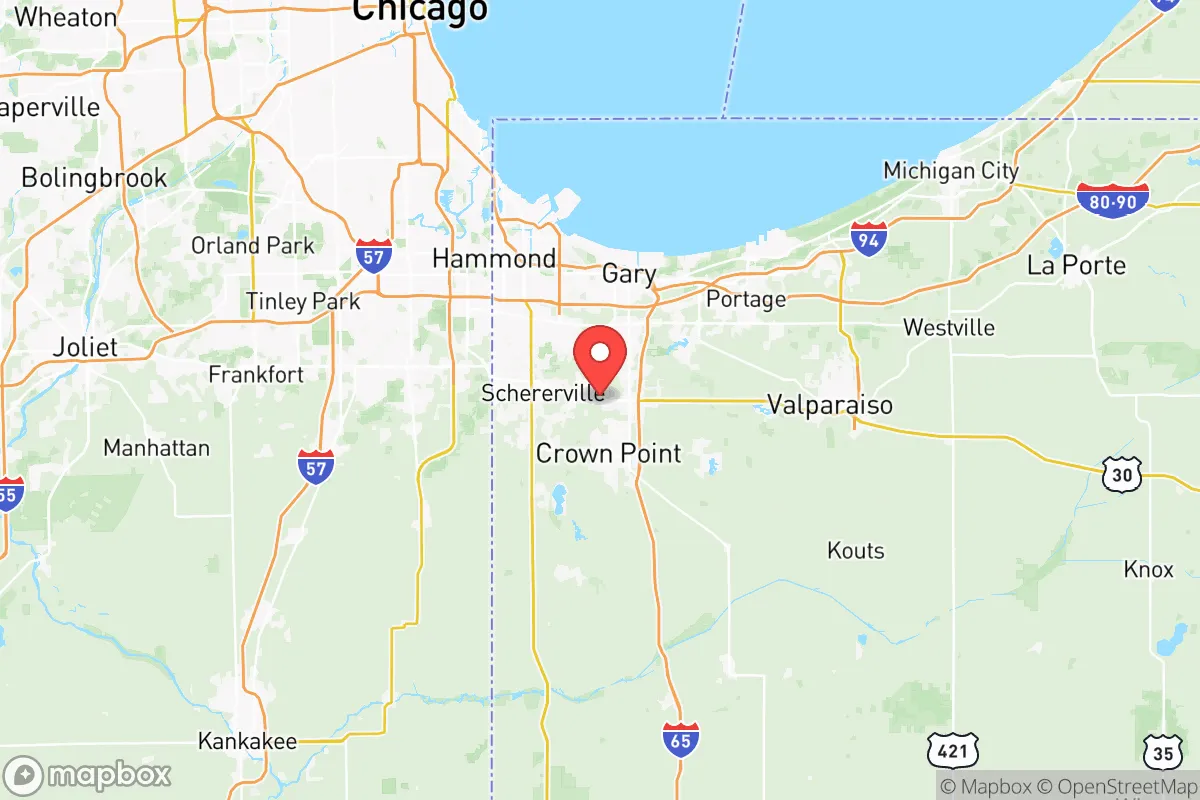
Photo: Wikipedia
Personal Sovereignty in Lake County
Viable for self-reliance. Generally workable, though some barriers may limit total independence.
What does Personal Sovereignty tell us?
Personal Sovereignty measures your capacity for self-reliance and independence with minimal government friction. Higher scores mean fewer barriers between you and the way you want to live... but it assumes you have the space you need and good neighbors.
What does this tell us?
Personal Sovereignty measures your capacity for self-reliance and independence with minimal government friction. Higher scores mean fewer barriers between you and the way you want to live... but it assumes you have the space you need and good neighbors.
State Policy
Energy independence: Importer (35% of energy produced in-state)
Personal Liberty
Homesteading

Personal Liberty Analysis
Lake County, Indiana, presents a nuanced personal sovereignty environment where state-level protections for gun rights and parental authority coexist with a moderately active local regulatory apparatus, particularly in its densely populated northern townships. For individuals and families prioritizing autonomy, the county offers a meaningful degree of self-determination, though the experience varies sharply between the urbanized lakefront communities and the more rural southern reaches. The overall autonomy picture is one of practical trade-offs: strong Second Amendment protections and low property taxes relative to neighboring Illinois, but with zoning and permitting structures that can constrain off-grid living and unpermitted construction.
Tax burden and regulatory posture: how Lake County compares to surrounding areas
Lake County's tax burden is a significant draw for those seeking fiscal autonomy, especially when compared directly across the state line. The county's property tax rate averages roughly 1.8% of assessed value, which is substantially lower than Cook County, Illinois's typical 2.2%+ rate. This difference can save a homeowner in Munster or Schererville thousands annually versus a comparable property in Chicago's south suburbs. Indiana's state income tax is a flat 3.15% as of 2026, with no county-level income tax surcharge in Lake County, keeping the overall state-local tax bite moderate. The regulatory posture is mixed: the county follows Indiana's relatively light-touch state building code, but individual municipalities—particularly Gary, Hammond, and East Chicago—maintain their own permitting and inspection regimes that can be more demanding. Unincorporated areas like St. John Township offer the lightest regulatory touch, with fewer zoning hurdles for accessory structures and home-based businesses. However, the county's stormwater management and environmental regulations, tied to its proximity to Lake Michigan, add layers of permitting for any significant land disturbance.
Self-defense and gun law specifics: what Indiana's preemption means for Lake County
Indiana is a "shall-issue" state for concealed carry permits, and since 2022, it has allowed permitless carry for law-abiding adults aged 18 and older. This means Lake County residents can carry a handgun openly or concealed without a license, though a permit remains available for reciprocity purposes when traveling to other states. The state's preemption law is strong: no city or county in Indiana, including Lake County, may enact its own firearm ordinances that are more restrictive than state law. This preemption has been tested and upheld, preventing municipalities like Gary or Hammond from imposing local magazine bans, waiting periods, or registration requirements. Stand-your-ground law applies statewide, with no duty to retreat in any place where a person has a legal right to be. Gun ranges and firearm retailers are common in the county's southern and central areas, particularly around Crown Point and Lowell, where rural zoning allows for outdoor ranges. The practical effect for residents is that self-defense rights are uniform across Lake County, regardless of the local political leanings of individual towns.
Self-reliance and homesteading viability: lot sizes, zoning, and off-grid feasibility
Homesteading and off-grid living are viable in Lake County's southern half but face significant constraints in the urbanized north. Minimum lot sizes in unincorporated areas of Cedar Creek Township and West Creek Township are typically one to two acres, with some agricultural zones allowing five-acre minimums. This contrasts sharply with Munster or Dyer, where residential lots are often under a quarter-acre and HOAs restrict livestock, composting toilets, and solar panel placement. Off-grid feasibility is limited by Indiana's statewide building code, which requires a permanent foundation and connection to a septic system for any habitable dwelling; true "off-grid" living without utility connections is effectively illegal for primary residences. However, rural areas near Lowell and Shelby allow for rainwater collection, private wells, and solar arrays as supplemental systems, provided a conventional septic system is installed. Zoning in unincorporated Lake County permits chickens, goats, and even small-scale livestock on parcels over one acre, though pigs and cattle require larger agricultural zoning. The county's soil and drainage conditions—heavy clay in many areas—make septic system installation more expensive than in sandy-soil regions, a practical constraint on self-reliant land use.
Personal liberties: parental rights, medical autonomy, speech, and property
Indiana law provides robust protections for parental rights, including a 2024 statute that requires school districts to notify parents of any curriculum involving human sexuality and to obtain parental consent before administering mental health surveys. Lake County school districts, including Crown Point Community School Corporation and Tri-Creek School Corporation, have generally complied with these requirements, though enforcement varies by district. Medical autonomy is more constrained: Indiana has a near-total abortion ban with limited exceptions, and the state requires parental consent for minors seeking any medical procedure, including vaccinations. Vaccine mandates are prohibited for public school attendance, giving families choice in that area. Free speech protections are strong under both the Indiana Constitution and the First Amendment, with no local "hate speech" ordinances that would criminalize protected expression. Property rights are reinforced by Indiana's right-to-farm law, which protects agricultural operations from nuisance lawsuits in rural zones, and by a 2023 law limiting local governments' ability to ban short-term rentals like Airbnb. However, property owners in Gary and East Chicago face higher rates of tax delinquency and title issues due to decades of population decline, which can complicate the exercise of property rights for buyers of distressed properties.
Overall, Lake County offers a solid baseline of personal sovereignty that is strongest in its southern, less densely populated townships and weakest in its older industrial cities. The county's tax burden is favorable compared to Illinois, its gun laws are among the most permissive in the Midwest, and its parental rights protections are meaningful. The trade-off is a regulatory environment that, while lighter than coastal alternatives, still requires compliance with state building codes and local zoning that limit radical off-grid independence. For a family seeking a balance of personal freedom, affordable land, and access to Chicago's job market, Lake County's southern tier—particularly around Lowell, Shelby, and St. John—provides a sovereignty profile that outperforms most suburban counties in the region, while the northern lakefront communities remain more restrictive and better suited to those who prioritize urban amenities over personal autonomy.

* Values derived from national, state, county, city and local statistics and may differ in a specific area. Last updated: 2026-06-29T00:14:21.000Z
Narrative content on this page is AI-generated and may contain mistakes. Verify any details that matter before acting on them.
ReloMaps may earn a commission from affiliate links at no extra cost to you.

