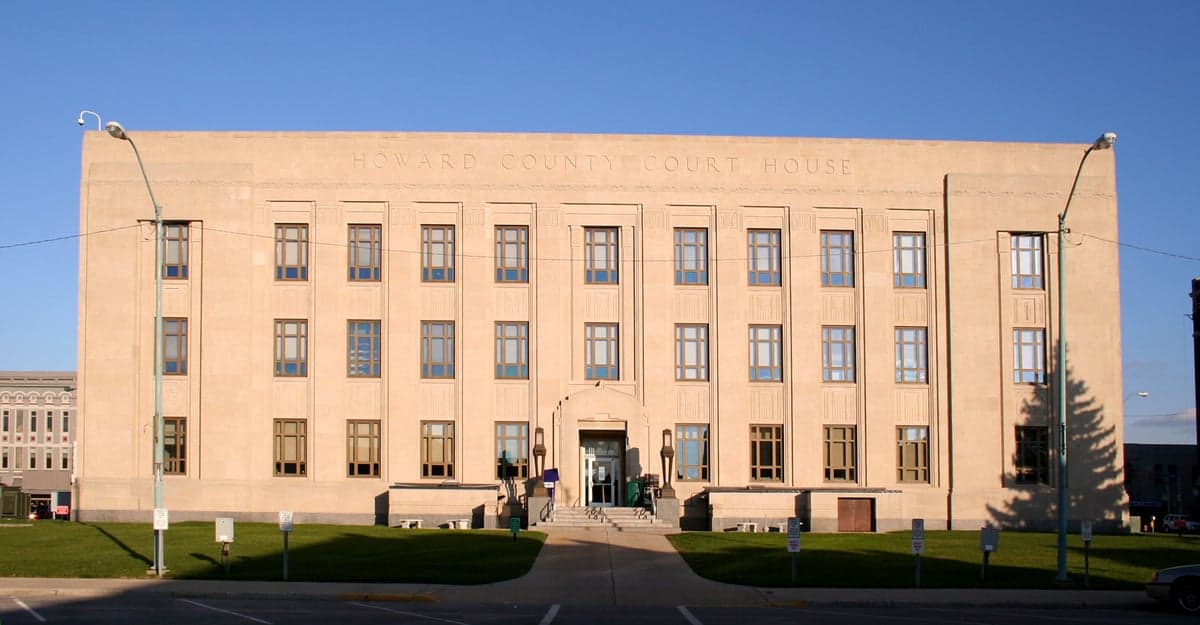
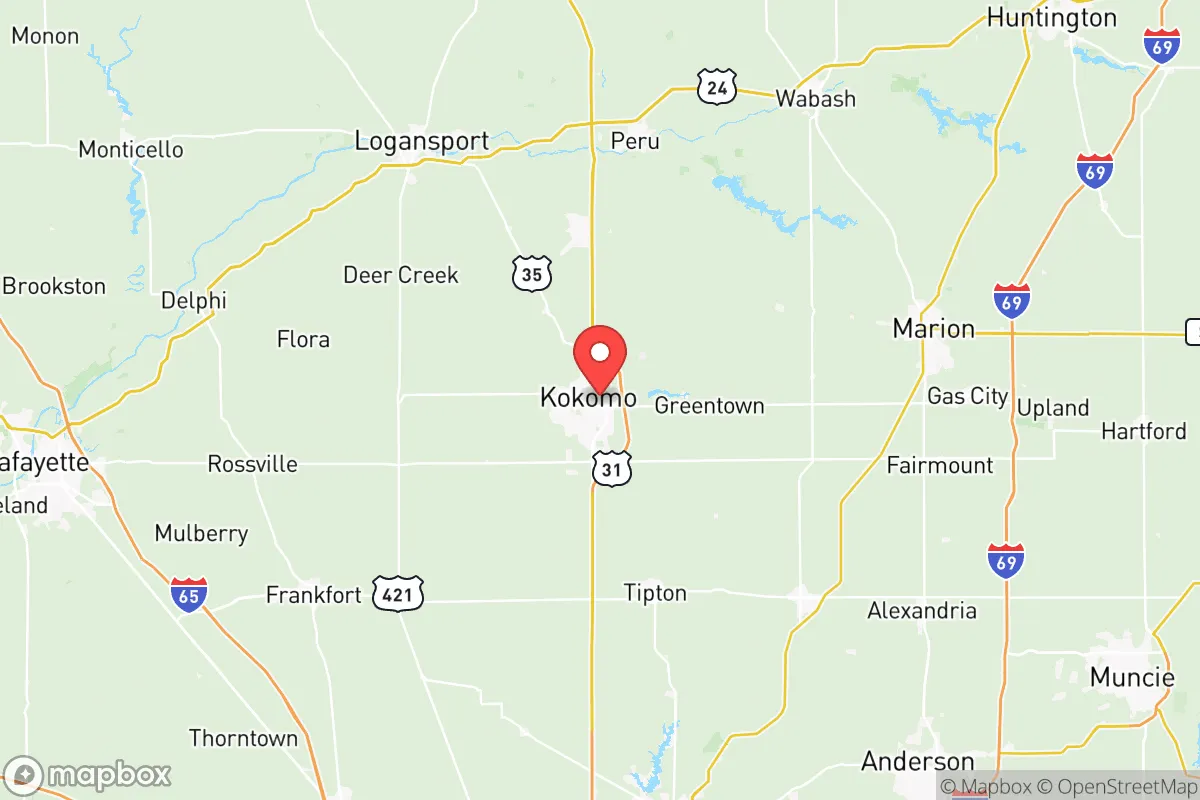
Photo: Wikipedia
Political ClimatePolitical Climate in Howard County
Showing district-level results — no local-only data available.
Local Political AnalysisPolitical Analysis of Howard County
Howard County, Indiana, is a reliably Republican area that leans slightly more conservative than the state as a whole, with a Cook PVI of R+8 compared to Indiana’s R+9. This means the county is about one point more Republican than the state average, but in practice, it’s a solid red stronghold where GOP candidates typically win by comfortable margins. The county’s political trajectory has been steadily rightward over the past two decades, mirroring the broader shift in rural and small-town Indiana, though the city of Kokomo—the county seat and economic hub—introduces some meaningful variation. Kokomo itself is a classic blue-collar town with a strong union history tied to the auto industry, and while it’s still more Democratic than the surrounding areas, its lean has softened considerably since the 1990s.
How it compares
Compared to Indiana’s overall R+9 rating, Howard County’s R+8 is essentially a wash—both are comfortably red, but the county’s internal dynamics are more interesting than the raw number suggests. The real split is between Kokomo and the smaller towns. Kokomo’s precincts, especially those near the old Chrysler (now Stellantis) plants and the downtown core, have historically leaned blue; in 2020, Biden won several Kokomo precincts by 5-10 points. But the surrounding towns—Russiaville, Greentown, and Sharpsville—are deeply red, often voting 70%+ Republican. The swing precincts are in the newer suburban developments on Kokomo’s south and west sides, like the areas around Western High School and Indian Heights, where voters are more moderate and can flip depending on the candidate. In the 2024 primary, these areas broke for Nikki Haley over Trump, hinting at a small but present moderate streak. Overall, Howard County is a microcosm of Indiana’s political reality: the rural and small-town vote dominates, but the urban core provides a persistent Democratic floor.
What this means for residents
For conservative residents, Howard County is a comfortable place to live politically. Local offices—county commissioners, sheriff, school boards—are almost entirely held by Republicans, and conservative policy priorities like low taxes and Second Amendment rights are broadly supported. The county’s Republican Party is active and well-organized, with regular meetings in Kokomo. For liberal residents, the picture is more mixed. While Kokomo provides a blue-leaning enclave, especially in the Old Silk Stocking neighborhood and near Indiana University Kokomo, the countywide tilt means Democratic candidates often struggle to gain traction outside the city. Progressive residents tend to find community through local advocacy groups like the Howard County Democratic Party or issue-specific organizations focused on labor rights and environmental justice. The practical effect is that political conversations are generally civil but can feel one-sided in rural areas; most residents simply avoid discussing politics at the dinner table or at work.
Culturally, Howard County is a place where the old union Democrat tradition still echoes, but it’s fading fast. Kokomo’s labor history—once a powerhouse for the UAW and the United Steelworkers—has been diluted by plant closures and a shift to non-union manufacturing and service jobs. This has eroded the Democratic base and pushed the county rightward. Policy-wise, the county is typical of Indiana: no local income tax, a strong push for economic development through tax abatements for manufacturers, and a general resistance to zoning reform. The most notable distinction is the county’s heavy reliance on the automotive supply chain, which makes local politics unusually sensitive to national trade policy and union negotiations. If you’re moving here, expect a place where the political temperature is warm but not boiling—most folks just want good jobs and decent schools, and they vote accordingly.

State Political ClimatePolitical Climate in Indiana
State Political AnalysisPolitical Environment in the State
Indiana has been a reliably Republican state for decades, with a Cook PVI of R+9 that reflects a consistent 8-12 point GOP advantage in presidential elections. The state hasn't voted for a Democratic presidential candidate since 2008, when Barack Obama narrowly won it, and that now looks like an anomaly driven by the financial crisis and a strong ground game in the industrial northwest. Over the last 10-20 years, the trajectory has been a slow but steady rightward shift, driven by the hollowing out of union power in the northwest and the explosive growth of the Indianapolis suburbs and exurbs. The dominant coalition is a mix of socially conservative rural voters, fiscally conservative suburbanites, and a growing number of libertarian-leaning independents who are drawn to the state's low taxes and light-touch regulation.
Urban vs. rural divide
The political map of Indiana is a classic study in contrast. The state's two major urban centers, Indianapolis (Marion County) and Fort Wayne (Allen County), are blue islands in a sea of red. Marion County has voted Democratic in every presidential election since 2008, and its margins have grown as the city has become more diverse and professional. Fort Wayne, while still competitive, has been trending blue in recent cycles, driven by a growing immigrant population and a revitalized downtown. The real engine of Republican dominance, however, is the suburban ring around Indianapolis. Counties like Hamilton (Carmel, Fishers, Noblesville), Hendricks (Avon, Plainfield), and Johnson (Greenwood) are among the fastest-growing and most Republican in the state. Hamilton County alone often delivers a 30-point GOP margin, enough to offset the entire vote of Marion County. The rest of the state—the small towns and farm counties of central, southern, and eastern Indiana—is deeply red. Places like Kokomo, Terre Haute, and Muncie were once union strongholds that voted for Democrats, but they've flipped hard to the right over the past two decades as manufacturing jobs disappeared and cultural issues took center stage. The only other notable blue pocket is Monroe County (Bloomington), home to Indiana University, which reliably votes Democratic by wide margins.
Policy environment
Indiana's policy environment is defined by a low-tax, low-regulation posture that appeals to conservatives and many libertarians. The state has a flat income tax rate of 3.15%, which is scheduled to drop to 2.9% by 2027. Property taxes are capped at 1% of assessed value for owner-occupied homes, a constitutional amendment that has kept housing costs relatively low. The state is a "right-to-work" state, meaning union membership is voluntary, and it has a "right-to-farm" law that protects agricultural operations from nuisance lawsuits. On education, Indiana has a robust school choice program, including vouchers that can be used at private and religious schools, and a growing number of charter schools. The state's election laws are moderately restrictive: voter ID is required, early voting is available but not as expansive as in some states, and same-day registration is not allowed. On healthcare, Indiana expanded Medicaid under the Affordable Care Act in 2015, but the program is administered through a conservative "Healthy Indiana Plan" that includes premiums and health savings accounts. The state has a near-total abortion ban, with exceptions only for rape, incest, and to save the mother's life, passed in 2023.
Recent policy direction
The last few years have seen a clear acceleration of conservative policy in Indiana. In 2022, the state passed a near-total abortion ban, which went into effect in 2023 after a court challenge. On gun rights, Indiana became a "constitutional carry" state in 2022, meaning no permit is required to carry a handgun. The state also has a "stand your ground" law and a preemption law that prevents local governments from enacting their own gun restrictions. On parental rights, a 2023 law requires schools to notify parents of any "instructional materials" related to human sexuality, and a 2024 law restricts the use of preferred pronouns by students without parental consent. On education, the state has expanded its school voucher program to near-universal eligibility, and a 2023 law prohibits the teaching of "divisive concepts" related to race and sex in K-12 schools. On property rights, Indiana has a strong eminent domain law that limits the use of condemnation for private economic development. On taxes, the state has been on a steady path of rate reduction, with the flat income tax scheduled to drop to 2.9% by 2027. On voting, a 2023 law tightened the rules for absentee ballots and required more frequent purges of voter rolls. On privacy and surveillance, the state has no comprehensive data privacy law, but it does have a law restricting the use of license plate readers by law enforcement. On medical and bodily autonomy, the state has banned gender-affirming care for minors, effective 2023.
Civil unrest & political movements
Indiana has seen its share of political flashpoints, though they tend to be less dramatic than in some other states. The most visible recent unrest was in 2020, when protests over the murder of George Floyd in Indianapolis turned violent, with property damage and clashes with police. The city also saw a significant "defund the police" movement, though it ultimately failed to gain traction at the ballot box. On the right, the state has a strong and active gun rights movement, with the Indiana Gun Owners group being a major force in state politics. The "Parents' Rights" movement has been particularly active in suburban school board meetings, especially in Hamilton County and Johnson County, where debates over curriculum and library books have been heated. Immigration politics are less of a flashpoint than in border states, but there is a small but vocal movement against sanctuary cities, even though Indiana has no such cities. There have been no serious secession or nullification movements in Indiana. Election integrity has been a topic of debate, with some Republican activists pushing for more restrictive voting laws, but the state's elections are generally considered well-run and secure. A new resident would notice that political activism is more visible in the suburbs than in the rural areas, where it tends to be quieter but deeply held.
Projection
Over the next 5-10 years, Indiana is likely to remain solidly Republican, but the nature of that Republicanism may shift. The biggest demographic trend is the continued growth of the Indianapolis suburbs, which are becoming more diverse and more educated. This could lead to a slow moderation on some social issues, as younger, college-educated voters tend to be less focused on cultural battles. However, the rural and small-town areas are not shrinking as fast as in some other Midwestern states, and they remain deeply conservative. The in-migration pattern is also a factor: Indiana is attracting a significant number of people from Illinois and California, many of whom are fleeing high taxes and crime. These newcomers tend to be fiscally conservative but may be more libertarian on social issues, which could push the state in a more "live and let live" direction. The state's political leadership is likely to remain conservative, but the specific flavor may evolve. A new resident moving in now should expect to find a state that is reliably Republican, with low taxes and a business-friendly environment, but with a growing suburban population that may gradually shift the conversation on issues like education and healthcare. The abortion ban is likely to remain a flashpoint, but it's unlikely to be repealed unless there is a major shift in the state legislature.
For a new resident, the bottom line is this: Indiana is a place where conservative values are the norm, and the policy environment reflects that. If you're a conservative, you'll find a state that aligns with your values on taxes, guns, and education. If you're a liberal, you'll find a state where your vote is unlikely to matter much in statewide elections, but where you can find like-minded communities in Indianapolis, Bloomington, and Fort Wayne. The practical takeaway is that Indiana offers a stable, predictable political environment with low taxes and a light regulatory touch, but with a clear conservative tilt that is unlikely to change in the near future. The key is to choose your community wisely: the suburbs of Indianapolis offer a mix of conservative and moderate politics, while the rural areas are deeply red, and the urban centers are blue.
* Values derived from national, state, county, city and local statistics and may differ in a specific area. Last updated: 2026-07-10T05:47:51.000Z
Narrative content on this page is AI-generated and may contain mistakes. Verify any details that matter before acting on them.
ReloMaps may earn a commission from affiliate links at no extra cost to you.

