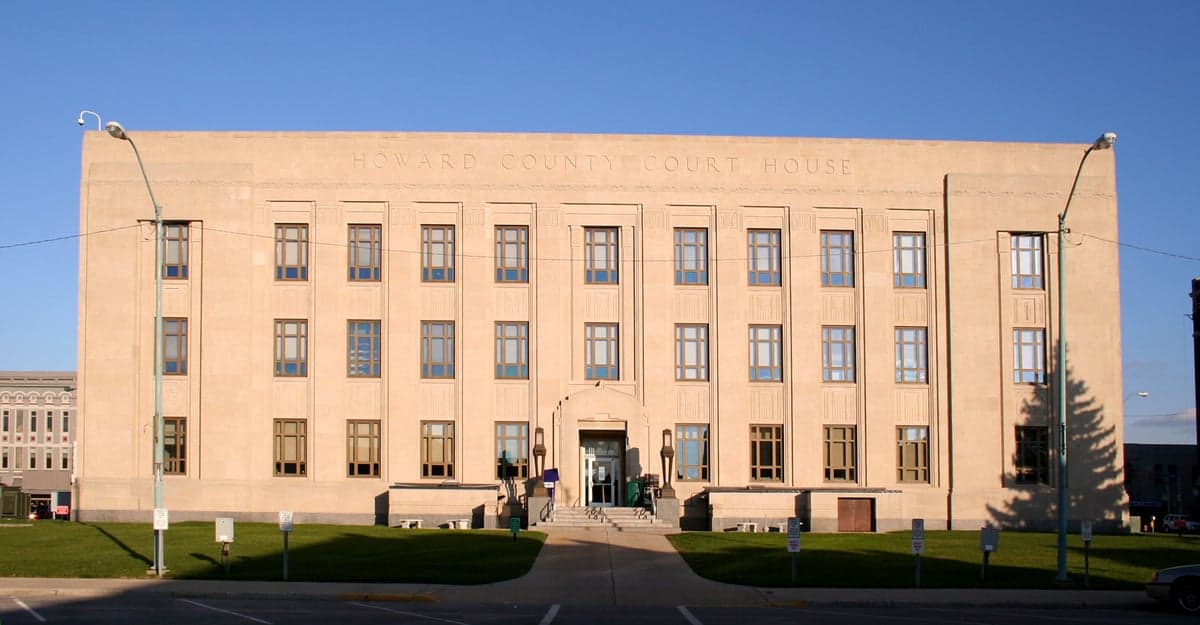
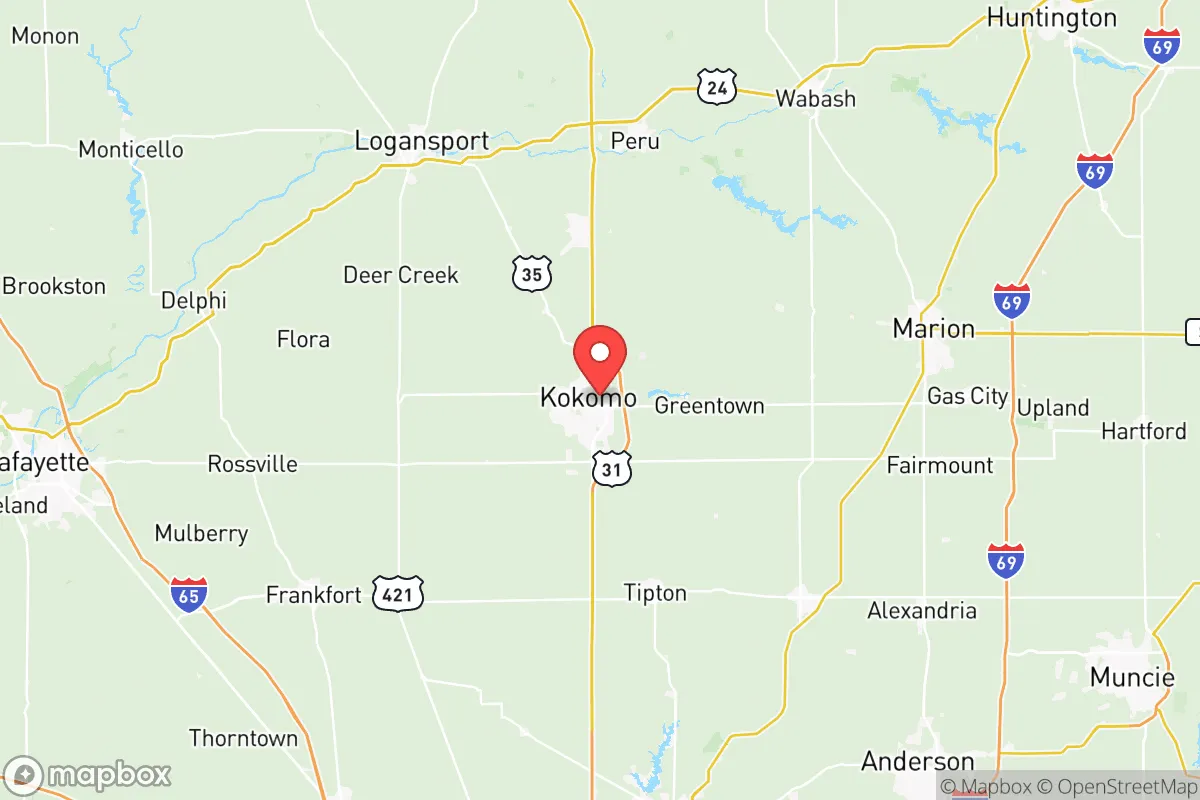
Photo: Wikipedia
Demographics of Howard County
Affluence Level in Howard County
A below-average socioeconomic profile. Incomes, home values, and educational attainment trail the U.S., with higher poverty and unemployment.
People of Howard County
The people of Howard County, Indiana, today number 83,610, forming a predominantly white (83.1%) and notably less diverse population than the national average, with a foreign-born share of just 0.7%. The county’s identity is rooted in its industrial and agricultural past, centered on the city of Kokomo, which anchors a region where manufacturing employment and a blue-collar work ethic remain defining cultural markers. Despite modest recent growth in Hispanic (3.9%) and Black (7.8%) populations, Howard County remains one of Indiana’s more ethnically homogeneous counties, with a population that is older and less college-educated (20.0%) than the state average, reflecting a community shaped by decades of economic stability and gradual demographic change.
Settlement & growth (pre-1960)
Before American settlement, the area that is now Howard County was part of the traditional homelands of the Miami and Potawatomi nations, who used the region for hunting and seasonal camps along the Wildcat Creek and the Wabash River tributaries. The first permanent American settlers arrived in the 1830s and 1840s, following the forced removal of Native peoples under the 1826 Treaty of Mississinewas. These early pioneers were primarily of Scots-Irish and English stock, moving westward from Ohio, Kentucky, and the Mid-Atlantic states, drawn by cheap federal land offered at $1.25 per acre under the Land Act of 1820. They established small farming communities like Russiaville (founded 1842) and Greentown (1848), where subsistence agriculture and gristmills defined early economic life.
The county’s character shifted dramatically with the arrival of the railroad in the 1850s. The Lake Erie, Wabash & St. Louis Railroad connected Kokomo to regional markets, and by the 1880s, the discovery of natural gas in the Trenton Gas Field sparked an industrial boom. This period drew a wave of German and Irish immigrants who settled in Kokomo to work in the new glass factories, iron foundries, and automobile parts plants. The German community, in particular, left a lasting imprint, founding churches, breweries, and social clubs in Kokomo’s near-west side. By 1900, Kokomo’s population had surged past 10,000, and the county became a hub for the nascent automobile industry, with companies like Haynes-Apperson (later Haynes Automobile Company) employing hundreds of skilled workers.
The Great Migration brought a smaller but significant wave of African American families from the Deep South to Howard County between 1910 and 1940. They were drawn by jobs at Kokomo’s steel mills, foundries, and the Continental Steel Corporation, which became the county’s largest employer. These Black families settled primarily in Kokomo’s near-east side and the South Side neighborhood, forming a tight-knit community centered on churches like Second Missionary Baptist Church (founded 1919). By 1950, Black residents made up roughly 4% of the county’s population, a share that would grow modestly in the decades to follow. The post-World War II era saw a final wave of domestic migrants: Appalachian whites from Kentucky and Tennessee, who arrived in the 1950s and 1960s seeking work in Kokomo’s expanding auto parts and electronics factories, settling in working-class neighborhoods like West Kokomo and the unincorporated community of Indian Heights.
Modern era (post-1965)
The 1965 Hart-Cellar Act had a muted effect on Howard County compared to major metropolitan areas. The county’s foreign-born population remains exceptionally low at 0.7%, and the limited post-1965 immigration has been overwhelmingly from East and Southeast Asia (1.2% of the population), primarily families from Vietnam, Laos, and the Philippines who arrived in the 1980s and 1990s. These immigrants were recruited by Kokomo’s manufacturing sector, particularly by Chrysler’s Kokomo Transmission Plant and Delphi Electronics, and they settled in small clusters in Kokomo’s east side and near the Indiana University Kokomo campus. The Indian subcontinent population (0.2%) is even smaller, consisting mostly of professionals employed at the local hospitals and the university.
Domestic migration has been the more significant demographic force since 1965. The decline of heavy manufacturing in the 1980s and 1990s triggered a slow but steady out-migration of younger residents to Indianapolis, Fort Wayne, and other Sun Belt cities. This “brain drain” has left Howard County with an aging population and a lower-than-average college attainment rate (20.0%). However, the county has also attracted a modest influx of Hispanic families (now 3.9% of the population), primarily of Mexican origin, who have moved into Kokomo’s west side and the town of Greentown to work in light manufacturing, warehousing, and the service industry. The Black population has grown to 7.8%, concentrated in Kokomo’s central and east-side neighborhoods, with a smaller presence in Russiaville and Oakford.
Suburbanization has been limited but visible. The unincorporated areas around Kokomo, particularly along U.S. 31 and State Road 22, have seen new subdivisions built since the 1990s, attracting middle-class families seeking larger lots and newer homes. Yet Howard County lacks the sprawling exurban development seen in counties closer to Indianapolis, and its population density remains low outside the city limits. The county’s cultural identity has shifted from a purely industrial, union-heavy character to a more mixed economy, with healthcare (Community Howard Regional Health) and education (Indiana University Kokomo) now major employers alongside remaining manufacturing.
The future
Howard County’s population is projected to remain relatively stable or decline slightly over the next 10–20 years, as the aging Baby Boomer cohort passes away and out-migration of young adults continues. The county is becoming modestly more diverse, with the Hispanic and Black shares expected to grow gradually, driven by natural increase and continued domestic migration from other parts of Indiana and the Midwest. The East/Southeast Asian and Indian populations will likely remain small, as the county lacks the professional job base and ethnic infrastructure to attract significant new immigration. New residential development is concentrating in Kokomo’s southern and western fringe, along the U.S. 31 corridor, and in the town of Greentown, which has seen some growth as a bedroom community for commuters to Indianapolis (about 45 minutes south).
The county’s cultural identity is evolving from a purely manufacturing, union-oriented past toward a more service-based and healthcare-driven economy, but the pace of change is slow. The population remains overwhelmingly white, native-born, and politically conservative, with a strong attachment to local institutions like the Kokomo High School sports teams and the Howard County 4-H Fair. For a newcomer, this means moving into a community where social networks are deep and long-established, and where the pace of life is slower than in the Indianapolis suburbs. The county is not becoming a melting pot, but it is gradually becoming a more diverse place, particularly in its urban core.
Howard County is becoming a quieter, older, and slightly more diverse version of its industrial-era self—a place where the manufacturing legacy still shapes the landscape and the people, but where healthcare, education, and small-town living are the new anchors. For someone moving in now, the county offers affordable housing, low crime, and a strong sense of community, but limited ethnic diversity and a job market that rewards skilled trades and healthcare credentials more than a college degree. It is a stable, predictable place for families who value tradition and proximity to nature, but not a destination for those seeking rapid change or a globalized cultural scene.

* Values derived from national, state, county, city and local statistics and may differ in a specific area. Last updated: 2026-07-10T05:47:51.000Z
Narrative content on this page is AI-generated and may contain mistakes. Verify any details that matter before acting on them.
ReloMaps may earn a commission from affiliate links at no extra cost to you.

