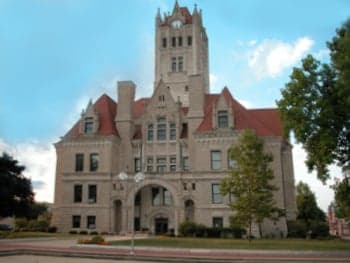
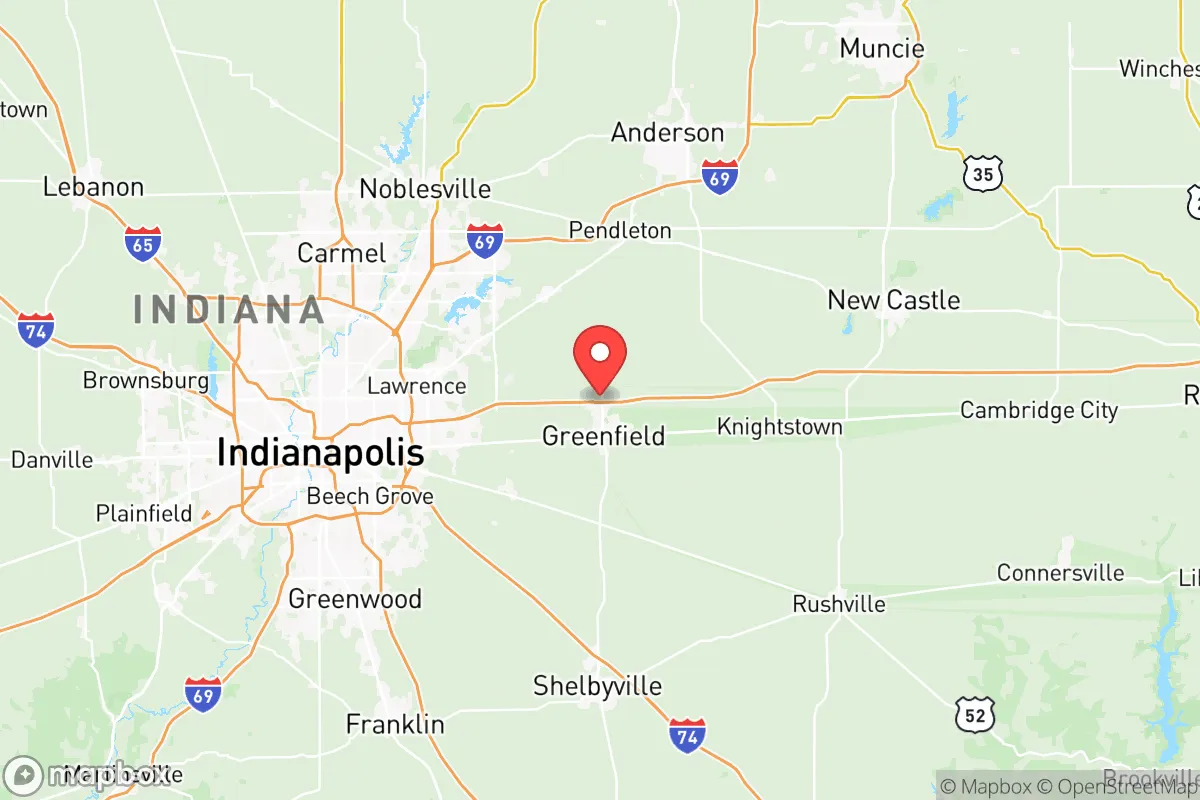
Photo: Wikipedia
Political ClimatePolitical Climate in Hancock County
Showing district-level results — no local-only data available.
Local Political AnalysisPolitical Analysis of Hancock County
Hancock County is about as reliably Republican as it gets in Indiana, with a Cook PVI of R+16 that puts it among the reddest counties in the central part of the state. If you look at the trajectory over the last couple of election cycles, it's actually been trending even redder, largely because the parts of the county that are growing fastest—places like McCordsville and Fortville—tend to attract families moving out of Indy who want low taxes and conservative school boards. The county seat, Greenfield, still has a small pocket of moderate and even a few liberal voters, especially around the historic downtown, but it's not enough to swing anything. The real story is how the county's politics differ from the statewide average. Indiana overall is R+9, so Hancock is essentially 7 points more conservative than the state as a whole. That's a meaningful gap. In 2020, Donald Trump carried Hancock County with about 65% of the vote, compared to 57% statewide. You see that Republican tilt in every down-ballot race too; the county commission and council seats are all held by Republicans, and there hasn't been a Democrat in a countywide office in decades.
How it compares
Compared to the rest of Indiana, Hancock County is a standout for its consistency. Neighboring Hamilton County, which is also very red, has a PVI of R+15, so it's basically a tie—but Hamilton has a few more swing precincts in places like Carmel and Fishers. Here, it's more uniform. Fortville is deep red, McCordsville is red but with a slightly higher share of liberal transplants from Indy, and Greenfield has a few precincts near the Hancock County courthouse that occasionally vote 55-45 in favor of a Republican. The swing precincts, if you can call them that, are in the southeastern part of the county around Shirley and Wilkinson, where you get a handful of voters who split tickets for local races. But overall, the county's voting patterns are remarkably stable. The long-term trend, as I see it, is that Hancock will only get redder as the rural edges get built out with new subdivisions. The kind of people moving here are looking for exactly what the county offers: conservative values, low taxes, and a school system that isn't as progressive as what you'd find in Marion County.
What this means for residents
For conservative residents, this is a comfortable place to live. You're surrounded by people who share your views on taxes, gun rights, and local governance. The county government is responsive to that base—zoning decisions favor development, and there's no real push for public transit or progressive housing policies. For liberal residents, it's a different story. You're definitely in the minority, but it's not hostile. Most folks are polite, and you can find like-minded people in Greenfield's library scene or at local coffee shops. The bigger issue is feeling represented in local government. If you're a Democrat, you probably won't see your candidate win a county race, but you can still have an impact on non-partisan school board elections, where a couple of seats have been competitive in recent years. The cultural distinction is that Hancock County is a place where "small government" is a lived reality, not just a campaign slogan. There's no county income tax, property taxes are relatively low, and the county fair is still a bigger deal than any political rally. That's the kind of place it is.

State Political ClimatePolitical Climate in Indiana
State Political AnalysisPolitical Environment in the State
Indiana has been a reliably Republican state for decades, with a Cook PVI of R+9, meaning it votes about nine points more Republican than the nation as a whole. The dominant coalition is a mix of socially conservative rural and small-town voters, fiscally conservative suburbanites, and a growing number of working-class voters who have shifted right. Over the last 10-20 years, the state has moved steadily redder, driven by the collapse of Democratic strength in rural areas and the realignment of white working-class voters, even as the Indianapolis suburbs have become more competitive.
Urban vs. rural divide
The political map of Indiana is a classic study in contrasts. The Democratic strongholds are concentrated in a few urban islands: Marion County (Indianapolis), Lake County (Gary), and Monroe County (Bloomington). These three counties alone deliver the bulk of Democratic votes statewide. Indianapolis itself has become a reliably blue city, with its inner suburbs like Lawrence and Speedway trending left, while the outer suburbs like Hamilton County (Carmel, Fishers, Noblesville) remain Republican but have shifted from deep red to light red as educated professionals move in. The rest of the state is overwhelmingly Republican. Rural counties like Adams County (near Fort Wayne) and Gibson County (in the southwest) routinely vote 70-80% Republican. The notable exception is St. Joseph County (South Bend), which has become a swing county—it voted for Obama twice, then Trump, then Biden narrowly. This urban-rural split means that a Democrat running statewide must win Indianapolis by a massive margin and carry Lake County, while keeping losses manageable everywhere else—a math problem that has become nearly impossible as rural turnout has surged.
Policy environment
Indiana’s policy environment is shaped by a Republican supermajority that has held both chambers of the legislature since 2010. The state has a flat income tax rate of 3.15% (scheduled to drop to 2.9% by 2027), a low corporate tax rate, and no inheritance tax. Property taxes are capped at 1% of assessed value for owner-occupied homes, 2% for rental properties, and 3% for commercial property—a constitutional amendment passed in 2010. The state is a right-to-work state (enacted in 2012) and has some of the weakest labor unions in the Midwest. Education policy is dominated by school choice: Indiana has one of the largest voucher programs in the country, with over 60,000 students using vouchers in 2024, and a robust charter school sector. Healthcare policy is conservative: the state did not expand Medicaid under the ACA until 2015, and then only under a conservative waiver program (HIP 2.0) that requires monthly premiums and work referrals. Election laws have tightened: voter ID is required, early voting is limited to 28 days before an election, and same-day registration is not allowed. The state also has a "ballot selfie" ban that was upheld in court.
Recent policy direction
Recent legislation in Indiana has pushed the state further right on a broad range of issues. On gun rights, Indiana became a permitless carry state in 2022 (House Enrolled Act 1296), allowing any adult who can legally possess a firearm to carry it without a license. On education and parental rights, the state passed a "Parents’ Bill of Rights" in 2022 (Senate Enrolled Act 167), requiring schools to notify parents of any changes to a student’s health or well-being, and in 2023 banned instruction on human sexuality in grades K-3 (House Enrolled Act 1608). On abortion, Indiana was one of the first states to pass a near-total ban after Dobbs (Senate Enrolled Act 1, 2022), prohibiting abortion at all stages except in cases of rape, incest, or lethal fetal anomaly, with a 10-week limit for rape and incest. On privacy and surveillance, the state has no comprehensive data privacy law, though a 2023 law restricts the use of facial recognition technology by law enforcement. On property rights, Indiana has strong eminent domain protections and a "right to farm" law that shields agricultural operations from nuisance lawsuits. On voting, the state passed a law in 2021 (Senate Enrolled Act 398) that requires absentee ballots to be received by Election Day (no postmark grace period) and limits the use of drop boxes. The overall direction is toward less regulation of firearms, more parental control in schools, and tighter restrictions on abortion and voting.
Civil unrest & political movements
Indiana has seen its share of political flashpoints, though large-scale civil unrest is rare. The most notable recent event was the 2020 protests in Indianapolis following the murder of George Floyd, which included clashes with police and property damage downtown. These protests were smaller than in many other major cities but still significant for a state capital. On the right, the "Parents’ Rights" movement has been highly active, particularly in suburban school board meetings in Hamilton County and Johnson County, where debates over curriculum and library books have been heated. Immigration politics are less visible than in border states, but there have been localized controversies, such as the 2018 proposal to allow local police to enforce immigration law (which failed). There is no sanctuary city policy anywhere in Indiana; in fact, a 2011 state law (Senate Enrolled Act 590) requires local governments to cooperate with federal immigration authorities. Election integrity has been a recurring theme, with Republican legislators citing "confidence" concerns to justify tighter voting laws, though no major fraud scandals have emerged. The most visible political movement in recent years has been the anti-abortion activism around the state capitol, which has been energized by the 2022 ban.
Projection
Over the next 5-10 years, Indiana is likely to remain solidly Republican, but the margins may narrow slightly in the suburbs. The Indianapolis metro area is growing faster than the rest of the state, and the influx of younger, more educated workers from out of state is slowly making places like Carmel and Fishers more competitive. However, rural areas are also growing more conservative, and the state’s population is aging and becoming more white, which favors Republicans. The biggest wild card is the city of Fort Wayne (Allen County), which has been trending right as its manufacturing base shrinks and its suburban fringe expands. If Democrats can’t make inroads in Fort Wayne or the South Bend area, they will continue to lose statewide races by 10-15 points. The state’s policy trajectory will likely continue: more school choice, further tax cuts, and continued restrictions on abortion and voting. A new resident moving in now should expect a state that is politically stable, with a conservative policy environment that changes slowly and predictably.
For a new resident, the bottom line is straightforward: if you lean conservative, you’ll find a state that largely aligns with your views on taxes, guns, education, and abortion. If you lean liberal, you’ll find a state where your vote in statewide elections will be in the minority, but where you can still find like-minded communities in Indianapolis, Bloomington, or South Bend. The practical takeaway is that Indiana is a low-cost, low-regulation state with a stable political climate—but one that is unlikely to shift left in the foreseeable future.
* Values derived from national, state, county, city and local statistics and may differ in a specific area. Last updated: 2026-07-26T23:10:54.000Z
Narrative content on this page is AI-generated and may contain mistakes. Verify any details that matter before acting on them.
ReloMaps may earn a commission from affiliate links at no extra cost to you.

