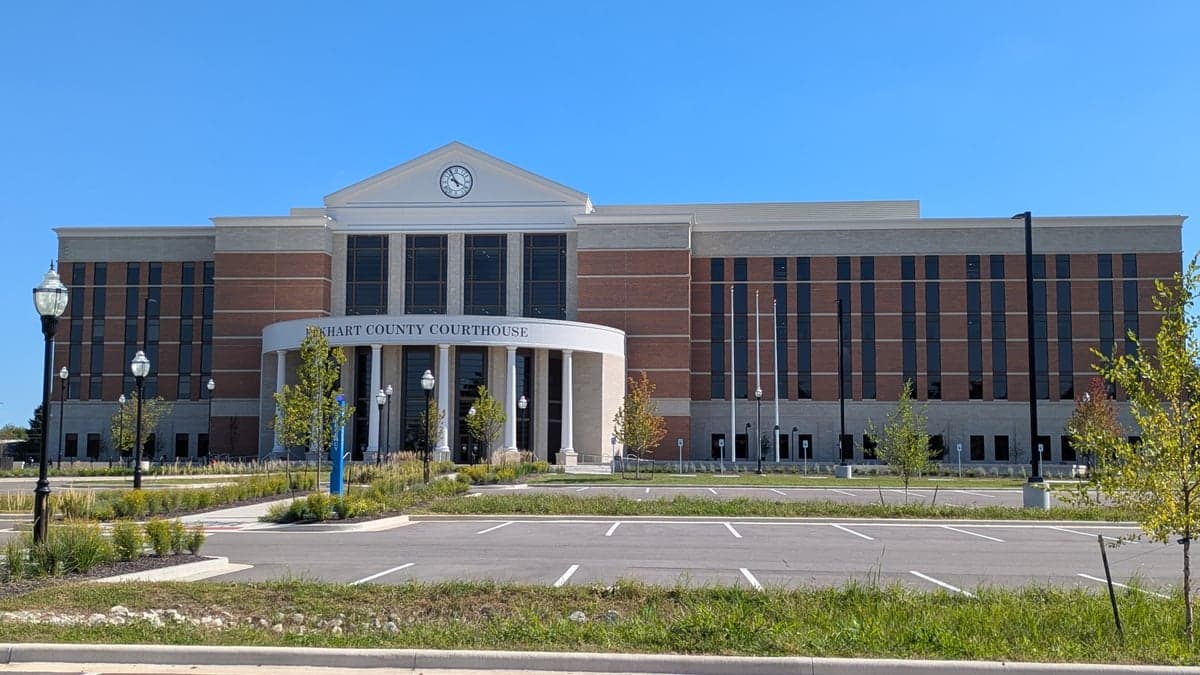
Photo: Wikipedia
Political ClimatePolitical Climate in Elkhart County
Showing district-level results — no local-only data available.
Local Political AnalysisPolitical Analysis of Elkhart County
Elkhart County is a reliably Republican stronghold, with a Cook PVI of R+13 that makes it significantly more conservative than the state of Indiana as a whole (R+9). This isn't a new development—the county has voted for the GOP presidential candidate in every election since 2000, often by margins exceeding 20 points. The real story, however, is the subtle but real variation within the county, where the urban core of Elkhart and the college town of Goshen show signs of Democratic resilience, while the rural townships and suburbs like Bristol, Middlebury, and Nappanee are deeply red. The overall trajectory is one of steady, if not intensifying, Republican dominance, though the county's growing Hispanic population—now over 15%—is beginning to shift the political calculus in a few key precincts.
How it compares to Indiana
Elkhart County's R+13 rating places it roughly 4 points to the right of the state average, which is itself a reliably red state. To put that in perspective, while Indiana has trended slightly more Republican in recent cycles—driven by rural and exurban growth—Elkhart County has held steady or even moved a bit further right. The biggest difference is in the margins: in 2020, Donald Trump won Elkhart County by 22 points, while he won Indiana by 16 points. That 6-point gap is consistent with the county's PVI differential. The county's political geography is also more polarized internally than the state's. In Elkhart County, you can drive from a precinct in the city of Elkhart that voted for Joe Biden by 10 points to a precinct in rural Concord Township that went for Trump by 40 points in under 15 minutes. That kind of sharp contrast is less common in more uniformly red parts of the state like rural southern Indiana.
What this means for residents
For conservative residents, Elkhart County's deep red lean means their values are reflected in local governance—the county commission, school boards, and city councils in places like Goshen and Elkhart are majority Republican, and policy tends to favor low taxes, limited regulation, and Second Amendment rights. For liberal residents, the reality is more nuanced. While they are a clear minority countywide, they have strongholds in the city of Elkhart's 1st and 2nd wards and around Goshen College, where progressive candidates can and do win local office. The practical effect is that a liberal resident in Elkhart City might feel politically at home in their neighborhood but out of step with the county's broader culture, while a conservative in Goshen might feel the reverse. The county's political climate also shapes daily life in tangible ways: local news coverage leans conservative, public discourse on issues like immigration (a hot topic given the RV industry's reliance on immigrant labor) is often polarized, and community events like the Elkhart County 4-H Fair are deeply rooted in conservative, agrarian traditions.
One of the most telling cultural distinctions is how the county's politics intersect with its economy. Elkhart County is the RV capital of the world, and the industry's boom-and-bust cycles have a direct impact on political sentiment. During the 2008 recession, the county swung hard toward Obama in 2008 (he lost it by only 9 points) before swinging back to Romney in 2012. That economic pragmatism means that while the county is culturally conservative, it's not ideologically rigid—pocketbook issues can override party loyalty in a way that's less common in more affluent, suburban red counties. For newcomers, the key takeaway is that Elkhart County is a place where politics is lived, not just discussed, and where the local flavor of conservatism is shaped by manufacturing, faith, and a strong sense of community identity that can feel both welcoming and insular depending on where you land.

State Political ClimatePolitical Climate in Indiana
State Political AnalysisPolitical Environment in the State
Indiana is a solidly Republican state with a Cook PVI of R+9, meaning it typically votes about nine points more Republican than the national average. Over the past 20 years, the state has shifted rightward, driven by the exurbanization of Indianapolis suburbs and the consolidation of rural, small-town, and manufacturing-heavy regions behind the GOP. While Democrats can still win statewide in wave years (like Joe Donnelly’s 2012 Senate win), the state’s overall trajectory is one of deepening red, with the last Democratic presidential candidate to carry Indiana being Barack Obama in 2008 — and that was a narrow 1-point win.
Urban vs. rural divide
The political map of Indiana is a classic urban-rural split, but with a few wrinkles. Indianapolis (Marion County) is the Democratic stronghold, voting about 60-40 for Biden in 2020, but it’s surrounded by a ring of fast-growing, deeply Republican suburbs. Hamilton County (Carmel, Fishers, Noblesville) is the wealthiest and most reliably GOP county in the state, routinely voting 60-65% Republican. Lake County (Gary, Hammond) in the northwest corner is the other major Democratic bastion, driven by union-heavy industrial workers and a significant Black population. The rest of the state — from the Fort Wayne area (Allen County, which is trending redder) to the Evansville region (Vanderburgh County, a GOP-leaning swing county) to the vast rural stretches of the Wabash Valley and southern Indiana — is solidly Republican. The notable exception is Monroe County (Bloomington), home to Indiana University, which votes reliably Democratic. The divide is stark: drive 15 minutes outside any of these blue islands, and you’re in deep red territory where Trump signs outnumber Biden signs 10 to 1.
Policy environment
Indiana’s policy environment is consistently conservative, with a focus on low taxes, limited regulation, and school choice. The state has a flat income tax rate of 3.05% (down from 3.23% in 2023, with a scheduled phase-down to 2.9% by 2029). Property taxes are capped at 1% of assessed value for owner-occupied homes, 2% for rental properties, and 3% for commercial — a constitutional amendment passed in 2010. There is no inheritance or estate tax. The state is a right-to-work state (since 2012), which has weakened union influence, particularly in manufacturing. Education policy is dominated by a robust school voucher program (the Choice Scholarship Program), one of the most expansive in the nation, allowing state funds to follow students to private and religious schools. Indiana also has a constitutional carry law (permitless carry for adults 18 and older, effective July 2022) and a near-total abortion ban (Senate Enrolled Act 1, 2023), with exceptions only for rape, incest (up to 10 weeks), and to save the mother’s life. Election laws include strict voter ID requirements (one of the earliest in the nation, 2005) and a 30-day residency requirement to register. The state does not have a state-level data privacy law, but it does have a biometric privacy law (similar to Illinois’s BIPA) that has spurred class-action lawsuits.
Recent policy direction
Over the past five years, Indiana has moved decisively to the right on several fronts. Gun and self-defense law: The 2022 permitless carry law (HEA 1296) eliminated the requirement for a license to carry a handgun, though a background check is still required for purchases from licensed dealers. Parental and education rights: The 2023 law (HEA 1608) requires schools to notify parents if a student requests a name or pronoun change, and it bans instruction on human sexuality in grades K-3. The state also expanded its school voucher program to cover nearly all families, regardless of income. Medical and bodily autonomy: The 2023 abortion ban (SEA 1) is among the strictest in the Midwest, with no exceptions for fetal anomalies. The law is currently being challenged in court, but the state Supreme Court upheld it in 2024. Property rights: Indiana has a strong eminent domain framework, but recent legislation (HB 1190, 2023) tightened the process for private takings, requiring a higher burden of proof for economic development projects. Voting and ballot access: The state has not moved to restrict mail-in voting, but it also hasn’t expanded it; absentee voting still requires an excuse. The 2023 law (SB 380) shortened the window for curing mismatched signatures on absentee ballots to 10 days. Privacy and surveillance: Indiana has no comprehensive data privacy law, but a 2023 law (HB 1442) restricts the use of facial recognition technology by law enforcement without a warrant. Taxation: The flat income tax is on a glide path to 2.9% by 2029, and the state eliminated the business personal property tax for small businesses (under $80,000 in assessed value) in 2022.
Civil unrest & political movements
Indiana has seen its share of political flashpoints, but they tend to be localized and less intense than in coastal states. The 2020 George Floyd protests in Indianapolis were significant, with several nights of clashes and property damage, but the city has since seen a more organized push for police reform, including a civilian review board (passed in 2021). On the right, the Indiana Freedom Coalition and local chapters of Moms for Liberty have been active in school board races, particularly in Hamilton County and Johnson County, pushing for book bans and curriculum transparency. Immigration politics are relatively muted, as Indiana is not a border state and has a small foreign-born population (about 5%). There are no sanctuary cities; in fact, a 2011 law (SEA 590) requires local law enforcement to cooperate with federal immigration authorities. The election integrity debate has been less heated than in some states, though the 2020 election saw Trump win Indiana by 16 points, and there were no major controversies. The state’s nullification rhetoric is minimal, though there have been occasional resolutions from rural counties (like Rush County) asserting Second Amendment sanctuary status. The most visible political movement in recent years has been the pro-life activism around the abortion ban, with large rallies at the Statehouse both for and against the law.
Projection
Over the next 5-10 years, Indiana is likely to remain solidly Republican, but the margins may narrow slightly in suburban areas. The Indianapolis suburbs (Hamilton, Hendricks, Boone counties) are growing fast, attracting transplants from blue states who are often moderate Republicans or independents. This could soften the GOP’s edge on social issues, but the state’s legislative and congressional maps are heavily gerrymandered in favor of Republicans, so the partisan balance of power is unlikely to shift. The Fort Wayne area is becoming more conservative as manufacturing jobs stabilize and the city’s Hispanic population grows (now about 15%), but that community tends to lean moderate-to-conservative on social issues. The Lake County Democratic machine is aging, and the county is slowly trending redder as white working-class voters shift right. The biggest wildcard is the abortion ban: if it remains in place, it could drive suburban women toward Democrats in state-level races, but the effect on presidential elections is likely minimal. In-migration is modest (Indiana is not a boom state like Texas or Florida), but the people moving in tend to be from the Midwest and are often looking for lower taxes and a slower pace of life, which aligns with the state’s conservative bent. Expect the flat income tax to continue its phase-down, school choice to expand further, and no major shifts on gun or abortion policy.
For a new resident, the bottom line is this: Indiana is a reliably conservative state where your taxes are low, your gun rights are broad, and your school choices are plentiful. If you’re a conservative, you’ll find a welcoming policy environment and a political culture that matches your values. If you’re a liberal, you’ll find strong communities in Indianapolis, Bloomington, and parts of Lake County, but you’ll be living under a state government that is actively pursuing the opposite of your priorities. The state is stable, predictable, and unlikely to surprise you — for better or worse. The practical takeaway: know which county you’re moving to, because the difference between Hamilton County and Monroe County is the difference between a red state and a blue state in miniature.
* Values derived from national, state, county, city and local statistics and may differ in a specific area. Last updated: 2026-07-17T00:37:15.000Z
Narrative content on this page is AI-generated and may contain mistakes. Verify any details that matter before acting on them.
ReloMaps may earn a commission from affiliate links at no extra cost to you.

