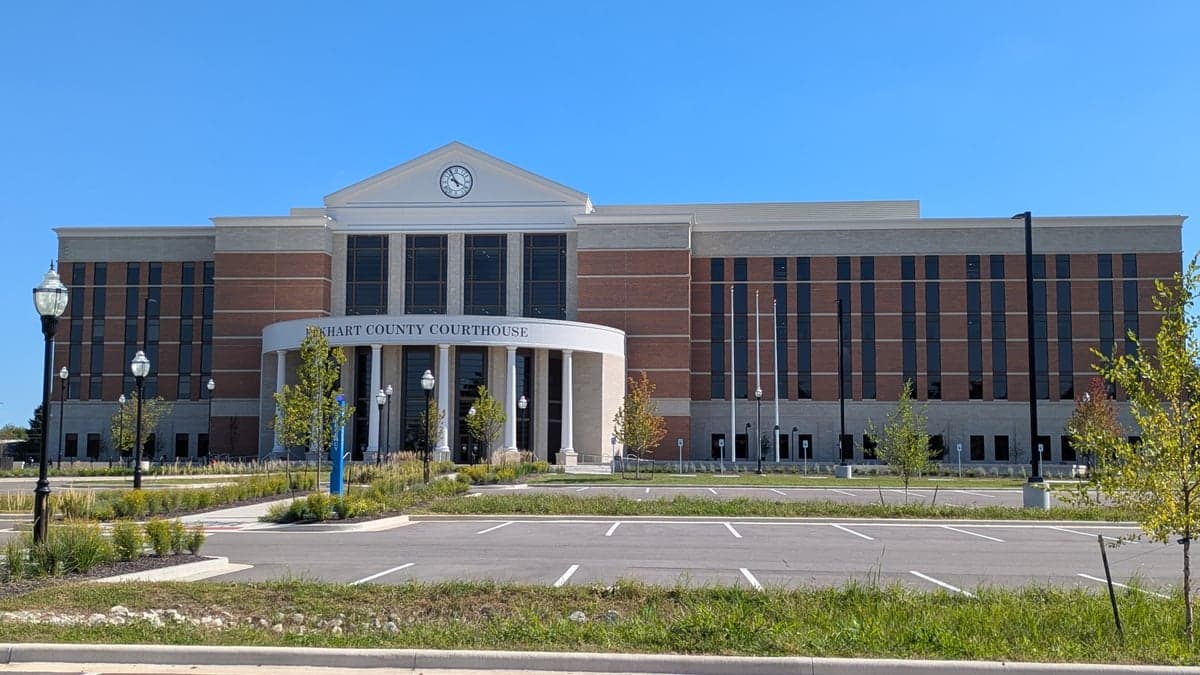
Photo: Wikipedia
Personal Sovereignty in Elkhart County
Viable for self-reliance. Generally workable, though some barriers may limit total independence.
What does Personal Sovereignty tell us?
Personal Sovereignty measures your capacity for self-reliance and independence with minimal government friction. Higher scores mean fewer barriers between you and the way you want to live... but it assumes you have the space you need and good neighbors.
What does this tell us?
Personal Sovereignty measures your capacity for self-reliance and independence with minimal government friction. Higher scores mean fewer barriers between you and the way you want to live... but it assumes you have the space you need and good neighbors.
State Policy
Energy independence: Importer (35% of energy produced in-state)
Personal Liberty
Homesteading

Personal Liberty Analysis
Elkhart County, Indiana, offers a notably high degree of personal sovereignty, blending a conservative-leaning state framework with local governance that generally respects individual autonomy. The county's regulatory environment is light-touch compared to many Midwestern urban centers, and its culture strongly emphasizes self-reliance, making it a compelling option for families and individuals who prioritize freedom from government overreach. While not a libertarian enclave, the area's tax burden, gun laws, and zoning policies create a foundation for independent living that is increasingly rare in the United States.
Tax burden and regulatory posture in Elkhart County
Indiana's state-level tax structure is among the most favorable in the Midwest for those seeking to keep more of their earnings. The state's flat income tax rate of 3.15% (as of 2025, with scheduled reductions to 2.9% by 2027) is low, and Elkhart County's local option income tax adds roughly 1.5%, keeping the combined rate well under 5%. Property taxes are also restrained: the state's constitutional caps limit residential property taxes to 1% of assessed value, with commercial and agricultural land capped at 2% and 3% respectively. In practice, a $250,000 home in the county typically carries an annual tax bill of $2,000–$2,800, depending on the specific township. Goshen, the county seat, has a slightly higher tax base due to its school district and municipal services, while Bristol and Middlebury often see lower effective rates. The regulatory posture is equally restrained: there is no county-wide building code for unincorporated areas, and towns like Wakarusa and Nappanee maintain minimal zoning ordinances, allowing residents to operate home businesses, park RVs, or keep livestock with few bureaucratic hurdles. The county's economic development office actively promotes a "business-friendly" ethos, and permitting for new construction or renovations is typically a matter of weeks, not months.
Self-defense and gun law specifics in Elkhart County
Indiana is a constitutional carry state, meaning no permit is required to carry a handgun openly or concealed for anyone legally allowed to possess a firearm. This law, effective since July 2022, is fully respected in Elkhart County. Local sheriffs in Goshen and Elkhart issue lifetime handgun permits for reciprocity purposes (covering 35+ states) with a straightforward application process and a typical turnaround of 30–60 days. The county has no local ordinances restricting magazine capacity, ammunition types, or firearm storage requirements. Stand-your-ground and castle doctrine laws are codified in state statute, providing strong legal protection for defensive use of force. Elkhart city proper has a slightly higher crime rate than the county average, but the sheriff's department and local police maintain a pro-Second Amendment posture; there are no "gun-free zones" beyond the federally mandated ones (schools, courthouses). The county's gun culture is robust, with multiple indoor and outdoor ranges, including the Elkhart County Conservation Club near Bristol, and a strong presence of gun shops and gunsmiths. For a relocation reader, this is a jurisdiction where self-defense rights are not merely theoretical but actively protected by local law enforcement and judicial practice.
Self-reliance and homesteading viability in Elkhart County
Elkhart County is one of the most homestead-friendly areas in the Midwest, thanks to its agricultural zoning and low land costs. Unincorporated areas and townships like Osolo, Jefferson, and Benton allow for residential lots of 1–5 acres with minimal restrictions on livestock, gardens, and outbuildings. A 2-acre parcel in the county's rural fringe can be purchased for $30,000–$60,000, and a 5-acre plot with a modest home often falls under $250,000. Zoning in these areas permits chickens, goats, and even small-scale cattle operations without special permits. Off-grid feasibility is moderate: Indiana's net metering policy allows solar panel owners to sell excess power back to the grid at retail rates, and the county's building department does not require grid connection for new homes in unincorporated areas, though a septic system and well permit are mandatory. Nappanee and Wakarusa are particularly known for their Amish and Mennonite populations, creating a local infrastructure for off-grid supplies, animal feed, and farm equipment. The county's soil is fertile (part of the Michiana region), and the growing season runs roughly April to October, supporting substantial vegetable gardens and small orchards. Water rights are generous: homeowners can drill a well without a permit for domestic use, though a licensed contractor is recommended. For those seeking a self-reliant lifestyle, Elkhart County offers a regulatory environment that actively enables, rather than hinders, independent living.
Personal liberties in Elkhart County: parental rights, medical autonomy, speech, and property
Indiana's legal framework strongly supports parental rights in education and healthcare. The state's "Parents' Bill of Rights" (enacted 2023) requires schools to notify parents of any curriculum changes involving human sexuality and to obtain parental consent for medical or mental health services. Elkhart County's school districts—including Goshen Community Schools and Concord Community Schools—generally comply with these statutes, and the county's conservative school board majorities in most districts resist progressive curriculum overhauls. Medical autonomy is similarly robust: Indiana has no state-level vaccine mandate for adults, and the county's healthcare providers (including Goshen Health and Elkhart General Hospital) respect patient choice in treatment decisions, though the state does require parental consent for minors' medical procedures. Free speech protections are strong, with no local hate speech ordinances or permit requirements for public demonstrations outside of standard time-place-manner restrictions. Property rights are well-defended: Indiana's "right to farm" law shields agricultural operations from nuisance lawsuits, and the county's assessor's office is transparent about property valuations. Elkhart city has a few more rental inspection and noise ordinances than the county's rural towns, but overall, the regulatory touch is light. For a reader concerned about government overreach into family life, medical decisions, or property use, Elkhart County presents a jurisdiction where personal liberty is the default, not the exception.
Compared to other Midwestern counties, Elkhart County stands out for its combination of low taxes, constitutional carry, and homestead-friendly zoning. While not as deregulated as some rural Western counties, it offers a practical, middle-ground sovereignty that is accessible to families and individuals who want to live independently without moving to a remote frontier. The county's Amish and Mennonite presence reinforces a culture of self-reliance, and its proximity to South Bend and Fort Wayne provides urban amenities without the regulatory creep of larger cities. For a relocation researcher, Elkhart County represents a stable, freedom-respecting environment where personal sovereignty is not just a slogan but a lived reality.

* Values derived from national, state, county, city and local statistics and may differ in a specific area. Last updated: 2026-07-17T00:37:15.000Z
Narrative content on this page is AI-generated and may contain mistakes. Verify any details that matter before acting on them.
ReloMaps may earn a commission from affiliate links at no extra cost to you.

