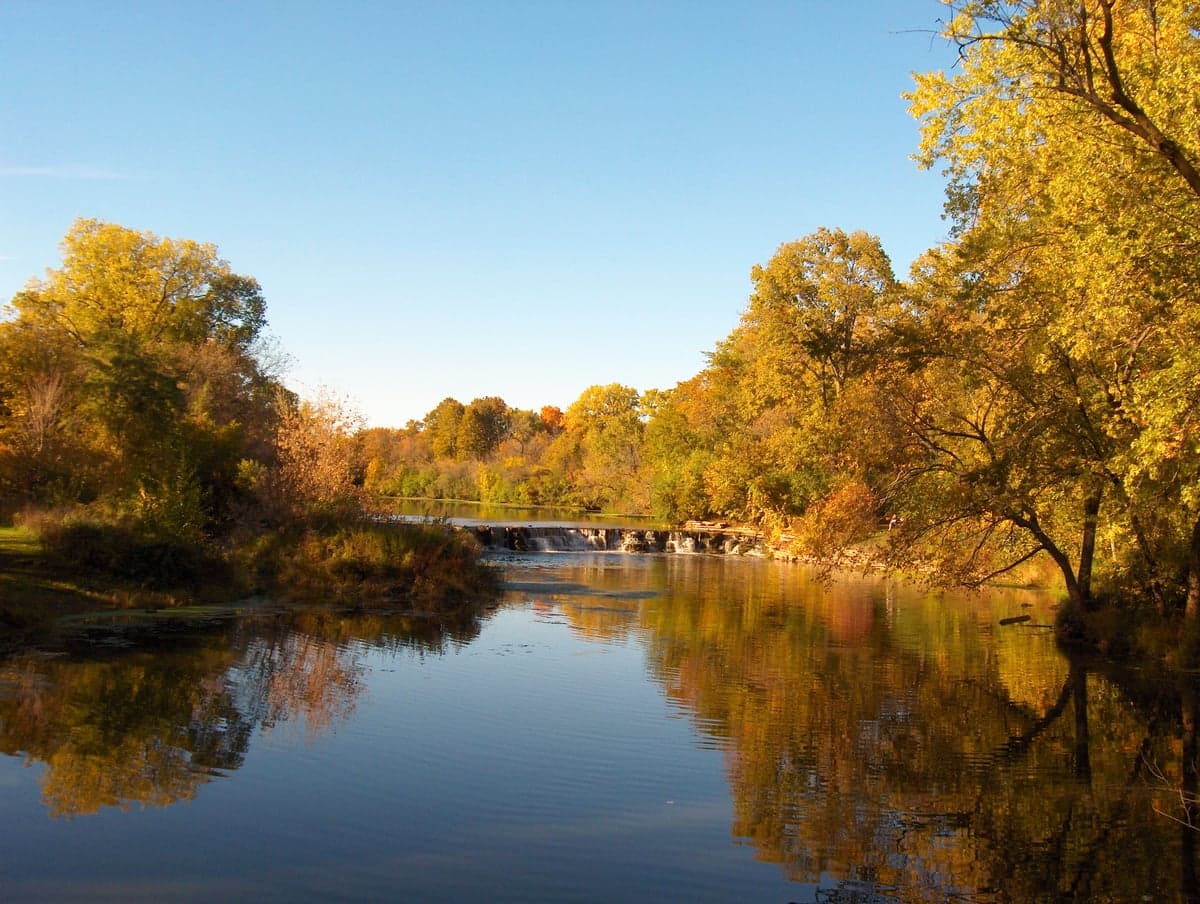
Photo: Wikipedia
Demographics of Dupage County
Affluence Level in Dupage County
An upper-middle-class area. Household wealth, education levels, and homeownership run ahead of national benchmarks.
People of Dupage County
DuPage County, Illinois, is a predominantly white, highly educated suburban powerhouse of over 927,000 residents, characterized by a blend of affluent commuter towns and historic agricultural centers. Its population is notably diverse for the Midwest, with a significant and growing Indian-subcontinent community (7.2%) and a substantial Hispanic population (15.7%), alongside a smaller East/Southeast Asian presence (5.4%). The county’s identity is shaped by its deep-rooted Yankee and German heritage, its transformation from farmland to a corporate corridor, and its current status as a politically moderate-to-conservative stronghold within the Chicago metropolitan area.
Settlement & growth (pre-1960)
Before European settlement, the area now known as DuPage County was inhabited by the Potawatomi people, who used the DuPage River as a travel and trade route. The first white settlers were primarily of Yankee stock—English-descended Americans from New England and upstate New York—who arrived in the 1830s after the Black Hawk War and the subsequent forced removal of Native tribes. These pioneers founded the county’s earliest towns, including Naperville (1831), Wheaton (1837), and Downers Grove (1832), establishing a pattern of small, self-governing farming communities.
The next major wave came from German immigrants, who began arriving in significant numbers in the 1840s and 1850s, drawn by cheap land and the promise of work on the expanding Galena & Chicago Union Railroad. They settled heavily in Addison and Bensenville, where German remained the dominant language in churches and schools well into the early 1900s. A smaller but notable influx of Irish immigrants arrived during the same period, finding work on railroad construction and settling in Lisle and Glen Ellyn. By 1900, DuPage was a mosaic of Yankee-led towns with dense German and Irish enclaves, its economy still rooted in dairy farming and brickmaking.
The period from 1900 to 1960 saw slower, steady growth. The county remained largely rural and Republican-leaning, with its population hovering around 150,000 as late as 1950. The post-World War II boom, however, transformed it. The construction of the Eisenhower Expressway (I-290) and the East-West Tollway (I-88) opened the county to massive suburbanization. Families—overwhelmingly white, middle-class, and often of German or Irish descent—fled Chicago for new subdivisions in Lombard, Villa Park, and Elmhurst. This wave was driven by the GI Bill, affordable housing, and a desire for larger lots and better schools. By 1960, the population had doubled to over 300,000, and DuPage had become a prototypical American suburb.
Modern era (post-1965)
The 1965 Hart-Cellar Act fundamentally reshaped DuPage’s demographics, though the effects were slower to arrive than in coastal suburbs. The first post-1965 immigrants were East/Southeast Asian professionals—primarily Chinese and Indian engineers and doctors—who came in the 1970s and 1980s to work at the growing corporate campuses in Naperville and Lisle, including Bell Labs (later Lucent/Alcatel-Lucent) and Amoco (now BP). These highly educated arrivals settled in the county’s western towns, drawn by top-ranked school districts like Naperville 203 and Indian Prairie 204.
The Indian-subcontinent community grew explosively after 1990, driven by H-1B visa holders in technology and pharmaceuticals. Today, Indians are the largest non-white group in DuPage at 7.2%, with a strong concentration in Naperville and Aurora (the latter straddling the county line). This community is notably affluent and well-educated, with many families owning businesses in healthcare, IT consulting, and retail. The East/Southeast Asian population (5.4%) is smaller but similarly concentrated, with a visible Chinese and Korean presence in Westmont and Woodridge.
The Hispanic population (15.7%) has a different trajectory. Many are Mexican-American families who arrived in the 1990s and 2000s, drawn by construction and service jobs in the booming suburban economy. They settled in older, more affordable towns like Addison, Bensenville, and West Chicago, where they now form a significant share of the population. Unlike the Asian and Indian communities, the Hispanic population is more working-class and less geographically dispersed, with higher rates of multi-generational households. The Black population (4.9%) is smaller and more recent, with growth driven by middle-class families moving from Chicago’s South Side to towns like Bolingbrook and Naperville since 2000.
Domestic migration has also shifted. Since 2010, DuPage has seen net out-migration of white families to exurban counties like Kendall and McHenry, while attracting new residents from the coasts—particularly California and New York—who are drawn by lower housing costs and strong schools. This has slightly moderated the county’s white share (now 63.1%) while increasing its racial and economic diversity.
The future
DuPage County is likely to continue its gradual diversification, but without the rapid demographic upheaval seen in Cook County or the Sun Belt. The Indian-subcontinent community is the fastest-growing group, projected to approach 10% of the population by 2035, driven by both immigration and high birth rates. This community is assimilating economically but maintaining distinct cultural enclaves in Naperville and Aurora, with Indian grocery stores, temples, and festivals becoming permanent fixtures. The Hispanic population is also growing, though more slowly, and is expected to stabilize around 18-20% as immigration from Mexico slows and second-generation families move to more affordable exurbs.
The white population, while still the majority, is aging and declining in share. Younger white families are increasingly choosing denser, walkable suburbs like Downers Grove and Glen Ellyn over large-lot subdivisions, a trend that may slow out-migration. The county’s high college attainment rate (51.4%) and strong job market in finance, healthcare, and technology will continue to attract educated immigrants and domestic migrants, reinforcing its character as a prosperous, politically moderate suburb. Tribalization into distinct ethnic enclaves is mild—most towns are mixed, though Addison and West Chicago remain heavily Hispanic, and Naperville has a visible Indian-majority neighborhood near the I-88 corridor.
For a conservative-leaning newcomer, DuPage offers a stable, family-oriented environment with excellent schools and low crime, but with increasing cultural and political diversity. The county voted for Donald Trump in 2016 and 2020 by narrow margins, reflecting its shift from solidly Republican to competitive. The next decade will likely see continued growth in the Indian and Hispanic populations, a stable white majority, and a slow but steady increase in the foreign-born share (currently 8.3%). DuPage is becoming less homogeneous but not less prosperous—a place where traditional suburban values coexist with a genuinely multi-ethnic population.
For someone moving in now, DuPage County is a well-educated, economically resilient suburb that is diversifying without losing its core identity. The schools remain top-tier, the job market is strong, and the political climate is moderate-conservative. The key trade-off is between the established, largely white and older towns in the east and the newer, more diverse and dynamic communities in the west. Either way, the county offers a stable, family-focused environment that is likely to remain attractive to both domestic migrants and immigrants for the foreseeable future.

* Values derived from national, state, county, city and local statistics and may differ in a specific area. Last updated: 2026-05-12T08:50:46.000Z
Narrative content on this page is AI-generated and may contain mistakes. Verify any details that matter before acting on them.
ReloMaps may earn a commission from affiliate links at no extra cost to you.

