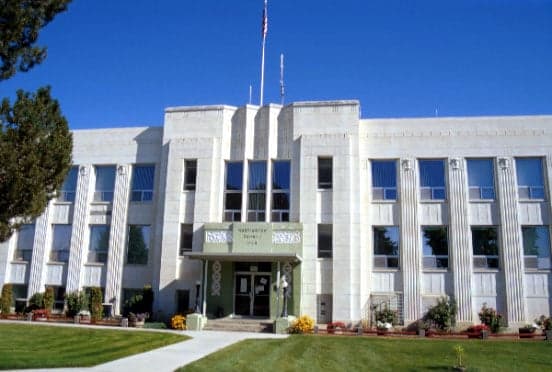
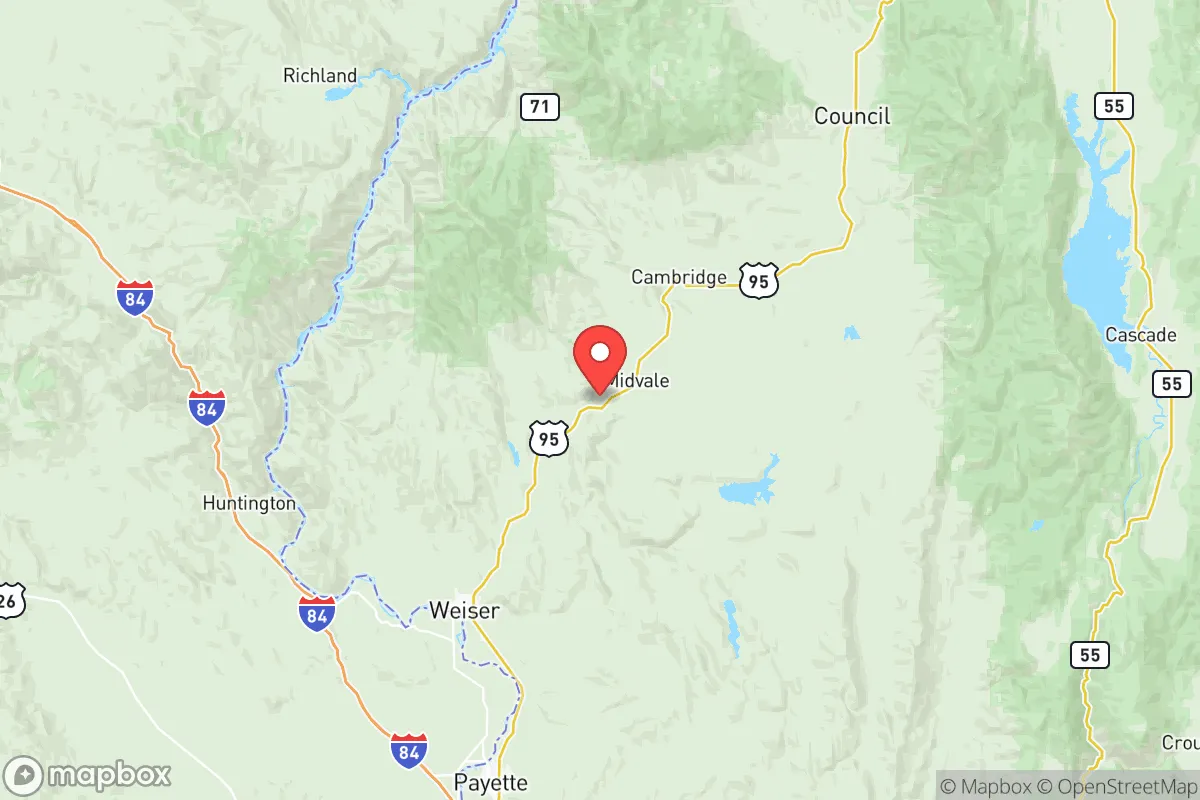
Photo: Wikipedia
Demographics of Washington County
Affluence Level in Washington County
A middle-class area roughly in line with national averages across income, home values, education, and employment.
People of Washington County
The people of Washington County, Idaho, today number just under 11,000, forming a predominantly white, rural population with a significant and growing Hispanic minority. With a population density of roughly 7 people per square mile, the county's character is defined by its agricultural roots, small towns like Weiser and Cambridge, and a conservative, family-oriented culture. Distinctive identity markers include a strong Basque heritage, a deep connection to the Snake River and its tributaries, and a community pride centered around the annual National Oldtime Fiddlers' Contest in Weiser.
Settlement & growth (pre-1960)
The human history of Washington County begins with the Northern Shoshone and Bannock peoples, who used the area as seasonal hunting and fishing grounds, particularly along the Weiser River. The first non-Native presence was that of fur trappers and traders in the early 19th century, but permanent settlement did not begin until the 1860s, following the discovery of gold in the Boise Basin. This triggered a wave of American and European miners, many of whom filtered into the lower valleys after the initial gold rush subsided.
The county's true founding population arrived through the Homestead Act of 1862. The first major wave of settlers were predominantly of Northern European stock—English, Scots-Irish, and German—who took up land claims along the Weiser River and the Snake River plain. They established the towns of Weiser (1871) and Cambridge (1885) as agricultural service centers. A distinct and lasting group arrived in the 1890s: Basque sheepherders, who were recruited to work the vast open ranges. They concentrated in the area around Weiser and Midvale, establishing a cultural footprint that remains visible today in the form of Basque boarding houses and family-run ranches.
The arrival of the Oregon Short Line Railroad in the 1880s spurred the growth of Weiser as the county seat and commercial hub. The railroad also enabled the expansion of dry-land wheat farming and apple orchards, attracting more settlers of German and Scandinavian descent. A smaller but notable wave of Dust Bowl refugees from Oklahoma and Arkansas arrived in the 1930s, settling in the more marginal farming areas around Fruitland and Council (the latter now in Adams County, but historically tied to Washington County's economy). By 1960, the population had reached roughly 8,000, and the county was overwhelmingly white, native-born, and employed in agriculture, timber, and small-town commerce.
Modern era (post-1965)
The post-1965 era brought two major demographic shifts to Washington County: the growth of the Hispanic population and the outmigration of younger, college-educated residents. The 1965 Hart-Cellar Act did not directly drive immigration to this rural county, but it did open the door for a wave of Mexican and Central American laborers who came to work in the region's agricultural sector—particularly in the onion, sugar beet, and hay fields around Weiser and Cambridge. By 2020, the Hispanic share of the population had grown to 16.0%, making it the largest minority group by far. These families have concentrated in Weiser, where they form a visible and integrated part of the community, with bilingual services and a growing presence in local schools and small businesses.
Domestic migration patterns have been more modest. The county has not experienced the explosive growth seen in Idaho's Treasure Valley (Boise area), but it has seen a steady trickle of retirees and remote workers from California, Oregon, and Washington seeking lower taxes and a slower pace of life. These newcomers tend to settle on acreages near Weiser or in the smaller communities of Midvale and Council. The county's foreign-born population remains low at 3.8%, and the Black (0.1%), East/Southeast Asian (0.2%), and Indian subcontinent (0.0%) populations are negligible. The college-educated share is just 19.0%, reflecting the county's working-class, agricultural economy and the outmigration of young adults who leave for higher education and do not return.
Suburbanization has been minimal. Unlike the sprawling subdivisions of Ada County, Washington County's growth has been infill—new homes on existing lots in Weiser and Cambridge, plus a few hobby farms along the river corridors. The county remains deeply rural, with no incorporated place exceeding 5,000 people.
The future
The population of Washington County is projected to grow slowly, reaching perhaps 12,000 by 2040. The county is becoming slightly more diverse, driven by natural increase among the Hispanic population and continued in-migration of white retirees and remote workers. The Hispanic share is likely to rise to 20-22% over the next decade, with most growth concentrated in Weiser, where the school district is already majority-minority. The white population is aging, and the county's median age (44.5) is above the state average, suggesting that natural increase will be modest.
New communities are not forming; instead, existing towns are slowly densifying. The cultural identity of the county is evolving from a purely Anglo-Basque agricultural society to a more layered, bilingual community. The Basque influence, while still celebrated, is fading as the older generation passes. The Hispanic community is becoming more politically and economically active, though the county's overall conservative lean remains strong. For a newcomer, the county offers a stable, low-cost, family-oriented environment, but with limited job diversity and a population that is still overwhelmingly white and native-born outside of the growing Hispanic enclave in Weiser.
Washington County is becoming a quieter, slightly more diverse version of its past—a place where agricultural rhythms still set the pace, and where the biggest change is the slow, steady growth of its Hispanic population in Weiser. For someone moving in now, it offers a tight-knit, conservative community with a strong sense of place, but little of the economic dynamism or demographic churn found in Idaho's faster-growing regions.

* Values derived from national, state, county, city and local statistics and may differ in a specific area. Last updated: 2026-06-29T00:18:47.000Z
Narrative content on this page is AI-generated and may contain mistakes. Verify any details that matter before acting on them.
ReloMaps may earn a commission from affiliate links at no extra cost to you.

