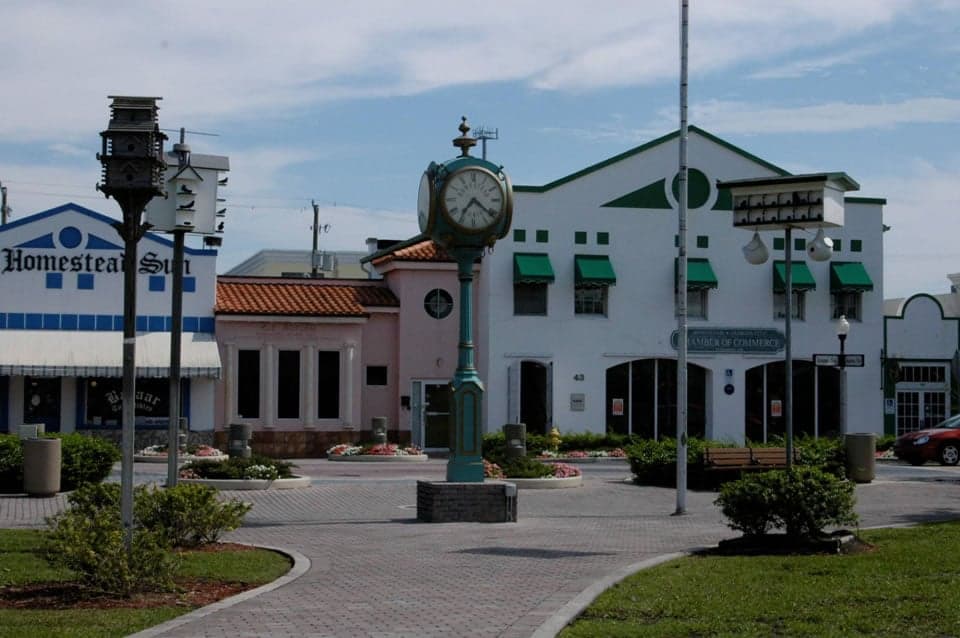
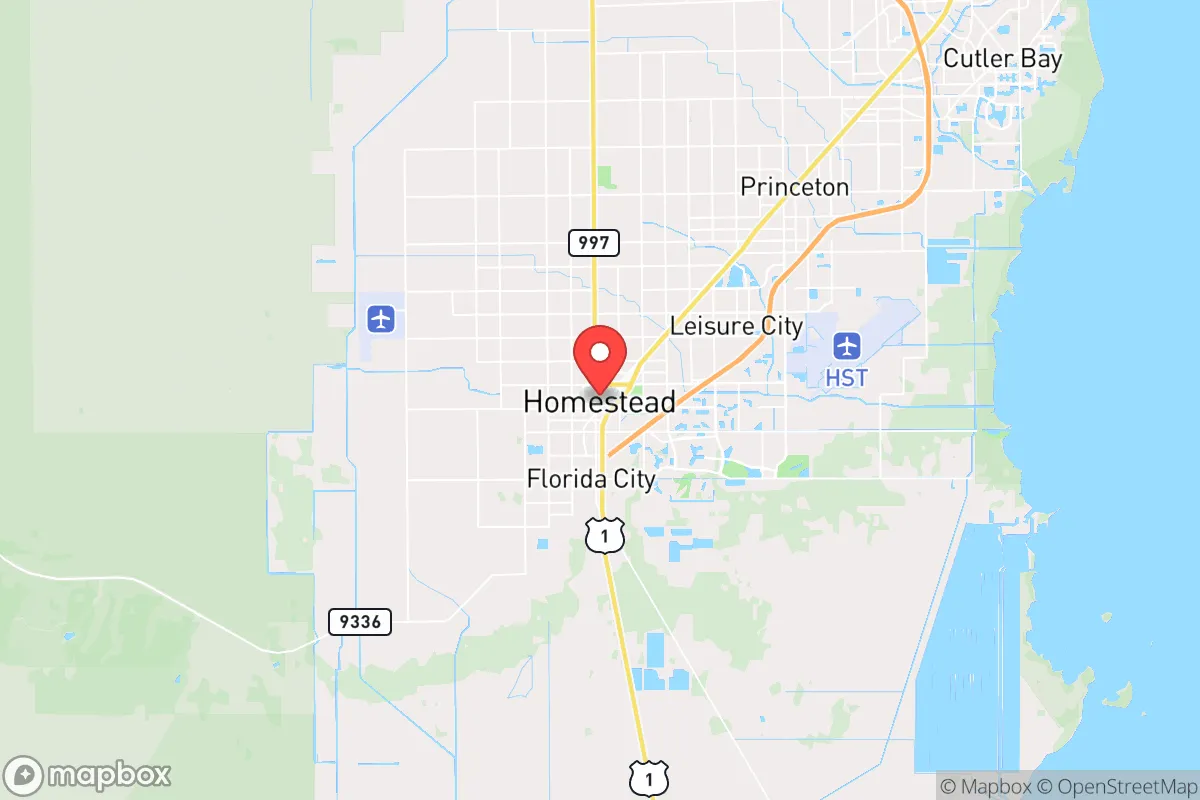
Photo: Wikipedia
Political ClimatePolitical Climate in Homestead, FL
District shown is the primary district for this city’s centroid. Cities may span multiple districts.
Local Political AnalysisPolitical Analysis of Homestead, FL
Homestead, Florida, has long been a conservative stronghold in Miami-Dade County, and it’s leaning even further that way. With a Cook Partisan Voting Index (PVI) of R+10, this is a place where Republican candidates routinely win by double digits, and the local culture reflects that. You can feel it in the air—folks here value their Second Amendment rights, push back hard against heavy-handed government mandates, and tend to vote for leaders who promise to keep taxes low and regulations light. Over the past decade, as Miami-Dade’s more progressive pockets have grown louder, Homestead has actually doubled down on its red roots, with voter registration trends showing a steady shift toward the GOP. It’s not just a trend; it’s a statement that this community isn’t interested in the kind of top-down control you see in places like Miami Beach or Coral Gables.
How it compares
Drive 30 minutes north to Kendall or Cutler Bay, and you’ll find a more purple mix—still conservative in parts, but with a noticeable progressive undercurrent, especially among younger transplants. Head east to Homestead Air Reserve Base’s surrounding neighborhoods, and you’ll see a military-friendly, deeply patriotic vibe that’s even more conservative than the city average. But the real contrast is with Miami proper, where city council debates often center on rent control, sanctuary policies, and climate activism. Homestead, by contrast, has consistently rejected such measures. The city council has pushed back against state-level overreach on local zoning and business regulations, but it’s also been a vocal opponent of federal mandates on everything from vaccine passports to environmental restrictions that would hurt agriculture. When you compare Homestead to nearby Florida City or even the more liberal enclaves of South Miami, the difference is stark: Homestead votes like a rural Texas town, not a South Florida suburb.
What this means for residents
For the people living here, the political climate translates into a daily life with fewer government intrusions. You won’t see the kind of mask mandates or business shutdowns that plagued other parts of the state during the pandemic—Homestead’s leaders prioritized personal choice and economic stability. Property taxes are relatively low compared to Broward County, and there’s a strong resistance to any new sales tax hikes or impact fees that would burden families. The downside? If you’re hoping for progressive social programs or heavy public transit investment, you’ll be disappointed. The city’s budget leans toward public safety and infrastructure, not social engineering. For conservatives, this is a relief; for anyone expecting a more activist government, it’s a dealbreaker. The long-term trajectory looks solidly red, especially as retirees and families from more liberal states continue to move here specifically to escape the policies they left behind.
Culturally, Homestead stands apart from the rest of Miami-Dade in a few key ways. The city’s agricultural roots—think Redland and the surrounding farmlands—mean there’s a strong libertarian streak when it comes to land use and property rights. You’ll hear locals grumble about state water restrictions or federal environmental rules that affect their nurseries and groves. There’s also a palpable distrust of the Miami-Dade County government, which many residents see as too cozy with developers and too eager to impose county-wide rules that don’t fit Homestead’s rural character. Politically, the city has become a bit of a refuge for those who feel the rest of the county has gone too far left. If you value personal freedom, low taxes, and a government that stays out of your business, Homestead is one of the last places in South Florida where you can still find that—and the locals intend to keep it that way.

State Political ClimatePolitical Climate in Florida
State Political AnalysisPolitical Environment in the State
Florida has transformed from a classic swing state into a solidly Republican-leaning powerhouse over the past two decades, with a registered Republican voter advantage of over 700,000 as of 2026 and a 13-point GOP win in the 2024 presidential election. The dominant coalition is a blend of conservative retirees, Hispanic voters who have shifted right (especially in Miami-Dade), and fast-growing exurban families from the Midwest and Northeast who fled high taxes and lockdowns. The trajectory has been unmistakable: in 2008, Obama won the state by 2.8 points; by 2024, Trump carried it by 13 points, a 16-point swing that reflects a deep cultural and political realignment.
Urban vs. rural divide
The political map of Florida is starkly divided. The major urban cores—Miami, Orlando, Tampa, and Jacksonville—are Democratic strongholds, but their influence is shrinking relative to the exploding suburbs and exurbs. Miami-Dade County, once reliably blue, flipped to Trump in 2024 by 11 points, driven by Cuban, Venezuelan, and Nicaraguan voters who associate socialism with the Democratic Party. Orlando (Orange County) remains blue but is surrounded by red-ring counties like Lake and Osceola, the latter of which is trending right as Puerto Rican and other Hispanic voters prioritize economic freedom over identity politics. Tampa (Hillsborough County) is a purple battleground, but its northern suburbs in Pasco County are deep red and growing fast. Jacksonville (Duval County) is a classic Southern city that voted for Biden in 2020 but flipped back to Trump in 2024, reflecting the broader trend. The rural Panhandle—places like Panama City, Pensacola, and Tallahassee’s surrounding counties—is as red as any place in America, with some precincts voting 80%+ Republican. The real story is the I-4 corridor from Tampa to Daytona Beach: this swing region now leans GOP by 5-8 points, a dramatic shift from the 2000s when it decided razor-thin elections.
Policy environment
Florida’s policy environment is a conservative’s dream compared to states like New York or California. There is no state income tax, a massive draw for high-earners and retirees. Property taxes are moderate, and the state’s Save Our Homes amendment caps annual assessment increases at 3% for homesteaded properties, protecting long-time residents from being taxed out of their homes. The regulatory posture is business-friendly: Florida is a right-to-work state, and Governor Ron DeSantis has aggressively cut red tape, especially in housing and construction. Education policy is a national flashpoint: Florida’s Parental Rights in Education Act (HB 1557, the “Don’t Say Gay” law) and the Stop WOKE Act (HB 7) restrict classroom discussions on sexual orientation and critical race theory, and the state’s school choice program—the Family Empowerment Scholarship—is one of the most expansive in the country, allowing tax dollars to follow students to private or charter schools. Healthcare is mixed: Florida did not expand Medicaid under the ACA, and the state has a robust private insurance market, but rural hospital closures are a concern. Election laws were tightened after 2020: SB 90 (2021) restricted drop boxes, required ID for mail-in ballot requests, and banned “ballot harvesting,” making Florida a model for election integrity in the eyes of conservatives.
Trajectory & freedom
Florida is unequivocally becoming more free for those who value personal liberty, especially in the realms of parental rights, gun rights, and economic freedom. The Constitutional Carry law (HB 543, 2023) allows permitless carry of concealed firearms, joining 25 other states. The Parental Rights in Education Act (2022) and the Stop WOKE Act (2022) have been upheld in court, giving parents more control over their children’s education and limiting government-imposed ideology in the workplace and schools. The Florida Freedom Act (2023) prohibits state and local governments from enforcing any federal gun control measures that don’t exist in state law—a direct nullification stance. On medical autonomy, Florida banned COVID-19 vaccine mandates for private employers (HB 1, 2023) and prohibited mask mandates in schools (SB 252, 2023). Property rights were strengthened with the Live Local Act (2023), which preempts local zoning to allow affordable housing development, though some conservatives worry this infringes on local control. The only area of concern is the state’s anti-riot law (HB 1, 2021), which enhanced penalties for protest-related offenses—some see this as necessary for public safety, others as government overreach. Overall, the trajectory is toward more individual freedom, not less.
Civil unrest & political movements
Florida has seen its share of political flashpoints, but the scale is far smaller than in states like Oregon or Minnesota. The 2020 George Floyd protests in Miami, Orlando, and Tampa led to some property damage and curfews, but the state’s quick passage of the anti-riot law (HB 1) in 2021 effectively deterred large-scale unrest. The “Freedom Convoy” movement in 2022 saw truckers rally in Tallahassee against vaccine mandates, but it was a fraction of the size of Canada’s protests. Immigration politics are front and center: Governor DeSantis’s SB 1718 (2023) requires businesses with 25+ employees to use E-Verify, bans local “sanctuary” policies, and makes it a felony to transport undocumented immigrants into the state. This has led to some labor shortages in agriculture and construction, but also to a visible reduction in illegal immigration. The “Don’t Say Gay” law sparked protests from LGBTQ+ groups, but the backlash has been mostly performative from out-of-state activists. Election integrity remains a hot topic: the 2022 midterms saw record turnout with zero major issues, and the state’s Office of Election Crimes and Security (created in 2022) has prosecuted a handful of cases of double voting and non-citizen voting, reinforcing trust in the system. A new resident would notice that political bumper stickers and yard signs are common, but actual civil unrest is rare—most political energy is channeled into voting and local activism.
Projection
Over the next 5-10 years, Florida will likely become more Republican and more conservative. The in-migration pattern is clear: roughly 1,000 people move to Florida every day, and they come disproportionately from high-tax, high-regulation states like New York, California, and Illinois. These newcomers are often fiscally conservative and socially moderate-to-conservative, reinforcing the GOP majority. The Hispanic shift is structural: younger Cuban, Venezuelan, and Colombian voters are increasingly Republican, and the Puerto Rican community in Central Florida is trending right as they see the failures of socialism in their home island. The only counter-trend is the influx of progressive retirees from the Northeast into places like Palm Beach County and Sarasota, but they are aging out faster than they can be replaced. The state’s population is projected to hit 25 million by 2030, with most growth in red-leaning exurbs like The Villages (Lake County), St. Johns County (south of Jacksonville), and Collier County (Naples). The Democratic Party’s only hope is to win back Miami-Dade and the I-4 corridor, but that seems unlikely given current trends. A new resident moving in now should expect a state that is unapologetically conservative on taxes, education, and personal freedom, with a government that actively resists federal overreach.
For a conservative individual or family, Florida offers a rare combination of low taxes, strong parental rights, robust gun freedoms, and a government that prioritizes individual liberty over collective mandates. The political climate is stable and trending in a direction that aligns with traditional values, but it’s not without its challenges—rising insurance costs, traffic congestion, and the occasional culture war flare-up. If you’re looking for a place where your vote actually counts and your way of life is respected, Florida is about as good as it gets in 2026. Just be prepared for the humidity and the tourists.
* Values derived from national, state, county, city and local statistics and may differ in a specific area. Last updated: 2026-09-21T19:02:09.000Z
Narrative content on this page is AI-generated and may contain mistakes. Verify any details that matter before acting on them.
ReloMaps may earn a commission from affiliate links at no extra cost to you.

