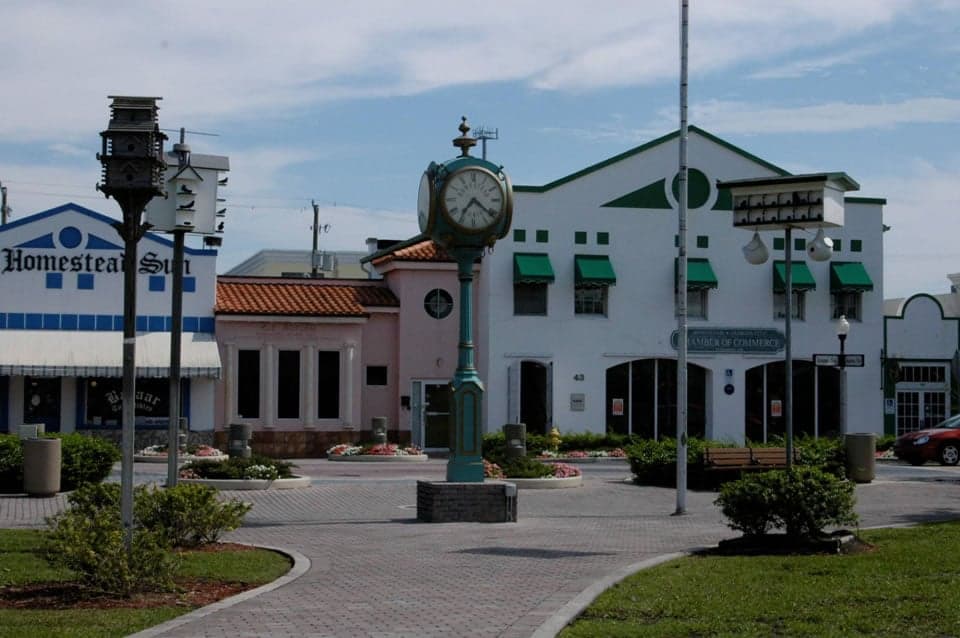
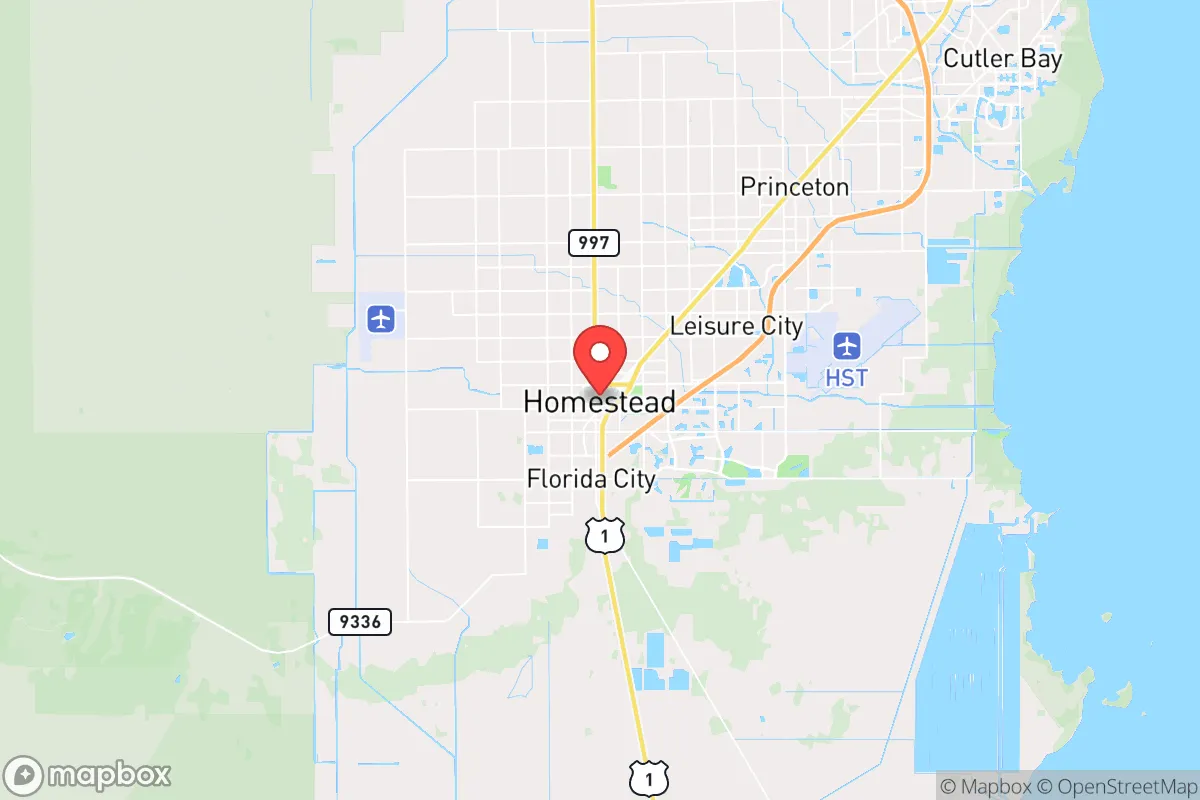
Photo: Wikipedia
Demographics of Homestead, FL
Affluence Level in Homestead, FL
A middle-class area roughly in line with national averages across income, home values, education, and employment.
People of Homestead, FL
Homestead, Florida, is a majority-Hispanic city of 80,725 residents, defined by its agricultural roots, a large immigrant workforce, and a growing Black middle class. The city is notably young and family-oriented, with a median age of 37.3 and a high proportion of households with children. Its population is overwhelmingly Hispanic (67.7%) and Black (19.2%), with a small White non-Hispanic population of just 9.8%, giving it a distinctly multicultural, working-to-middle-class character that sets it apart from the more affluent, retiree-heavy communities to the north.
How the city was settled and grew
Homestead was founded in the early 1900s as a railroad and agricultural hub, built on the promise of the Florida East Coast Railway and the rich, fertile soil of the Redland farming district. The original population was a mix of White Anglo farmers from the U.S. South and Midwest, along with a significant number of Black laborers who came to work the tomato, bean, and avocado fields. The historic Homestead Downtown District and the Modello neighborhood were the early anchors for these groups, with Modello becoming the historic heart of the city's Black community. By the 1940s, a wave of Bahamian and other Caribbean migrants joined the agricultural workforce, settling in the Florida City area (a separate municipality but functionally part of the same metro) and the southern edges of Homestead. The city remained a small, rural service center through the 1950s, with a population under 10,000, dominated by farming families and a small but established Black community.
Modern era (post-1965)
The post-1965 Immigration and Nationality Act, combined with the Mariel boatlift (1980) and subsequent waves of Cuban, Nicaraguan, and Central American migration, transformed Homestead. The city became a primary destination for working-class Hispanic immigrants, drawn by affordable housing and agricultural jobs. The Leisure City and Naranja neighborhoods (unincorporated but part of the Homestead area) absorbed much of this influx, becoming heavily Hispanic and Spanish-dominant. By the 1990s, the city's White non-Hispanic population had dropped sharply, falling from over 50% in 1980 to roughly 10% today. The Black population, meanwhile, diversified: native-born African Americans were joined by a growing number of Haitian and Jamaican immigrants, who settled in the Homestead Air Reserve Base area and the West Homestead corridor. The 1992 Hurricane Andrew devastated the city, but the rebuilding effort spurred a construction boom that attracted new domestic migrants from other parts of Florida and the Northeast. Today, the city's foreign-born share stands at 21.0%, with the largest groups being Cuban, Mexican, and Guatemalan. The college-educated share is low at 24.3%, reflecting the city's blue-collar, agricultural, and service-sector employment base.
The future
Homestead's population is projected to continue growing, driven by its relative affordability compared to Miami-Dade County's coastal cities and by the expansion of the Homestead Air Reserve Base and nearby industrial parks. The Hispanic share is likely to remain dominant, with continued immigration from Central America and the Caribbean, while the Black population is expected to grow modestly through both domestic migration from other parts of Florida and Caribbean immigration. The White non-Hispanic share will likely continue to shrink, as the city becomes increasingly homogenized as a Hispanic-majority, working-class community. However, there are signs of tribalization: newer, more affluent subdivisions like Redland and Silver Palm are attracting a mix of White and Hispanic professionals, while older neighborhoods like Modello and Leisure City remain predominantly Black and Hispanic, respectively. The city is not becoming a melting pot so much as a collection of distinct enclaves, each with its own ethnic and economic character. The next 10-20 years will likely see Homestead solidify its identity as a Hispanic-majority, family-oriented, blue-collar suburb of Miami, with a stable Black minority and a very small White presence.
For a conservative-leaning individual or family moving in now, Homestead offers a strongly family-oriented, religious, and community-focused environment, with a low cost of living and a growing job base in logistics, agriculture, and the military. The city is becoming more Hispanic and more working-class, but it remains a place where traditional values, homeownership, and local churches are central to daily life. The key trade-off is between affordability and distance from Miami's professional job centers, and between a tight-knit community and limited cultural or educational amenities.

* Values derived from national, state, county, city and local statistics and may differ in a specific area. Last updated: 2026-09-21T19:02:09.000Z
Narrative content on this page is AI-generated and may contain mistakes. Verify any details that matter before acting on them.
ReloMaps may earn a commission from affiliate links at no extra cost to you.

