 Popular
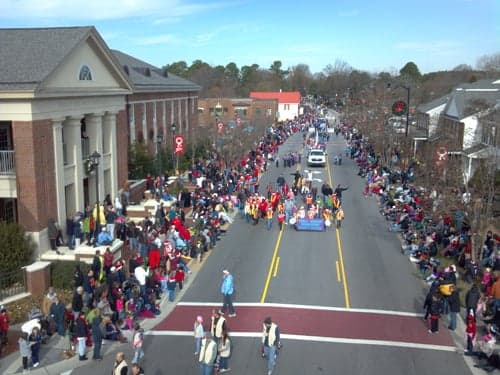
Photo: Wikipedia
Personal Sovereignty in Holly Springs, NC
Viable for self-reliance. Generally workable, though some barriers may limit total independence.
What does Personal Sovereignty tell us?
Personal Sovereignty measures your capacity for self-reliance and independence with minimal government friction. Higher scores mean fewer barriers between you and the way you want to live... but it assumes you have the space you need and good neighbors.
What does this tell us?
Personal Sovereignty measures your capacity for self-reliance and independence with minimal government friction. Higher scores mean fewer barriers between you and the way you want to live... but it assumes you have the space you need and good neighbors.
State Policy
Energy independence: Importer (15% of energy produced in-state)
Personal Liberty
Homesteading

Personal Liberty Analysis
Holly Springs, North Carolina, offers a notably high degree of personal sovereignty within a state that has deliberately cultivated a light-touch regulatory environment. For individuals and families prioritizing autonomy, the town provides a practical balance: access to the economic opportunities of the Research Triangle region while operating under state-level protections for self-defense, property rights, and limited taxation. The local governance in Wake County is more moderate than deeply rural areas, but the overall framework in Holly Springs leans toward individual discretion rather than heavy-handed oversight, making it a compelling option for those who value self-reliance.
Tax burden and regulatory posture in Wake County
North Carolina's tax structure is among the most favorable in the Southeast for those seeking to keep more of their earnings. The state has a flat personal income tax rate of 4.75% as of 2025, with a scheduled reduction to 3.99% by 2027, and no state-level tax on Social Security benefits. Property taxes in Holly Springs are set by Wake County at a rate of approximately $0.665 per $100 of assessed value, which is moderate for the region but higher than in more rural counties like Harnett or Johnston. The regulatory posture at the state level is deliberately restrained: North Carolina is a right-to-work state, has no state-level minimum wage above the federal $7.25, and imposes relatively few occupational licensing requirements compared to states like California or New York. Locally, Holly Springs enforces standard subdivision and zoning ordinances, but the town's planning department is known for being pragmatic rather than adversarial. There is no county-level business license tax for most small operations, and home-based businesses are generally permitted with a simple zoning permit, provided they do not generate excessive traffic or noise. The overall regulatory burden is light enough that a self-employed contractor or remote worker can operate without constant bureaucratic friction, though Wake County's building codes are enforced consistently for new construction.
Self-defense and gun law specifics in North Carolina
North Carolina is a shall-issue state for concealed carry permits, meaning that if an applicant meets objective criteria—age 21, completion of a firearms safety course, no disqualifying criminal record—the sheriff must issue the permit. Holly Springs is in Wake County, where the sheriff's office processes permits efficiently, typically within 45 to 90 days. The state allows open carry of handguns without a permit for anyone legally allowed to possess a firearm, and no permit is required to purchase a rifle, shotgun, or handgun from a private seller. Stand-your-ground laws are in effect: there is no duty to retreat before using deadly force in any place where the individual is lawfully present. Castle doctrine protections extend to occupied vehicles and workplaces, not just homes. Magazine capacity is unrestricted, and there is no state-level assault weapons ban. However, firearms are prohibited in certain locations by state law, including establishments that derive more than 30% of revenue from alcohol sales (unless the owner explicitly allows it), and on all public school property. Holly Springs itself has no local ordinances that further restrict gun rights beyond state law, and the town's police department generally respects lawful carry. For a family moving from a restrictive state like New Jersey or California, the shift in legal posture is dramatic and unambiguous.
Self-reliance and homesteading viability: lot sizes, zoning, off-grid feasibility
Holly Springs is a growing suburban town, not a rural homesteading hub, but self-reliance is still achievable within its boundaries. Standard residential lot sizes in newer subdivisions range from 0.25 to 0.5 acres, though older neighborhoods and some custom-home developments offer lots of one acre or more. The town's zoning code permits keeping chickens on residential lots of at least 0.25 acres, with a limit of six hens and no roosters. Beekeeping is allowed with registration, and vegetable gardens are unrestricted. Rainwater collection is legal in North Carolina without a permit for non-potable uses, though the state does have guidelines for cisterns. Off-grid living—meaning no connection to municipal water or sewer—is generally not feasible within the town limits, as most subdivisions require connection to public utilities. However, properties in the unincorporated areas of Wake County just outside Holly Springs, such as along Highway 55 south of town, can have wells and septic systems. Solar panels are permitted and encouraged, with no HOA restrictions in most subdivisions, though some newer communities have architectural guidelines that require ground-mounted panels to be screened. The town does not have any ordinance explicitly banning clotheslines or composting. For a family wanting to grow a significant portion of their own food and reduce reliance on the grid, a lot of one acre or more in the county's rural buffer zone is the practical minimum, and such properties are available within a 10-minute drive of downtown Holly Springs.
Personal liberties: parental rights, medical autonomy, speech, and property
North Carolina has strong legal protections for parental rights. State law explicitly affirms that parents have the fundamental right to direct the upbringing, education, and health care of their minor children. This includes the ability to opt children out of sex education or any curriculum the parent finds objectionable, and to homeschool without a teaching degree or state oversight beyond annual standardized testing. Medical autonomy is more nuanced: the state does not have a religious or philosophical exemption for childhood vaccine mandates in public schools, though medical exemptions are available. For adults, there is no state-level mandate for any medical treatment, and the state's certificate of need (CON) laws for healthcare facilities have been partially relaxed, increasing competition among providers. Free speech is robustly protected under the state constitution, and Holly Springs has no local noise or signage ordinances that would be considered unusually restrictive. Property rights are a strong point: North Carolina is a Dillon's Rule state, meaning local governments only have powers explicitly granted by the state legislature, which limits the ability of towns like Holly Springs to impose novel restrictions on land use. Eminent domain for private economic development is prohibited. There is no state-level rent control, and short-term rentals like Airbnb are permitted in Holly Springs with a simple registration process, though they are restricted in some residential zoning districts. For a family concerned about government overreach in daily life, the legal framework here provides a solid baseline of protection.
Compared to other areas in the Southeast, Holly Springs offers a strong balance of personal sovereignty and practical convenience. The tax burden is low and trending lower, gun laws are permissive and clear, and property rights are well-defended. The main trade-off is that true off-grid self-sufficiency requires moving slightly outside the town limits, and the suburban HOA culture in some neighborhoods can impose aesthetic restrictions that a libertarian-leaning homeowner might find irksome. But for a family or individual who wants the economic and social benefits of the Research Triangle while retaining a high degree of personal autonomy, Holly Springs ranks favorably against any similarly sized town in the region. The regulatory environment is light enough that a determined individual can live largely on their own terms, without the constant friction found in more heavily governed states.

* Values derived from national, state, county, city and local statistics and may differ in a specific area. Last updated: 2026-10-10T16:27:40.000Z
Narrative content on this page is AI-generated and may contain mistakes. Verify any details that matter before acting on them.
ReloMaps may earn a commission from affiliate links at no extra cost to you.

