
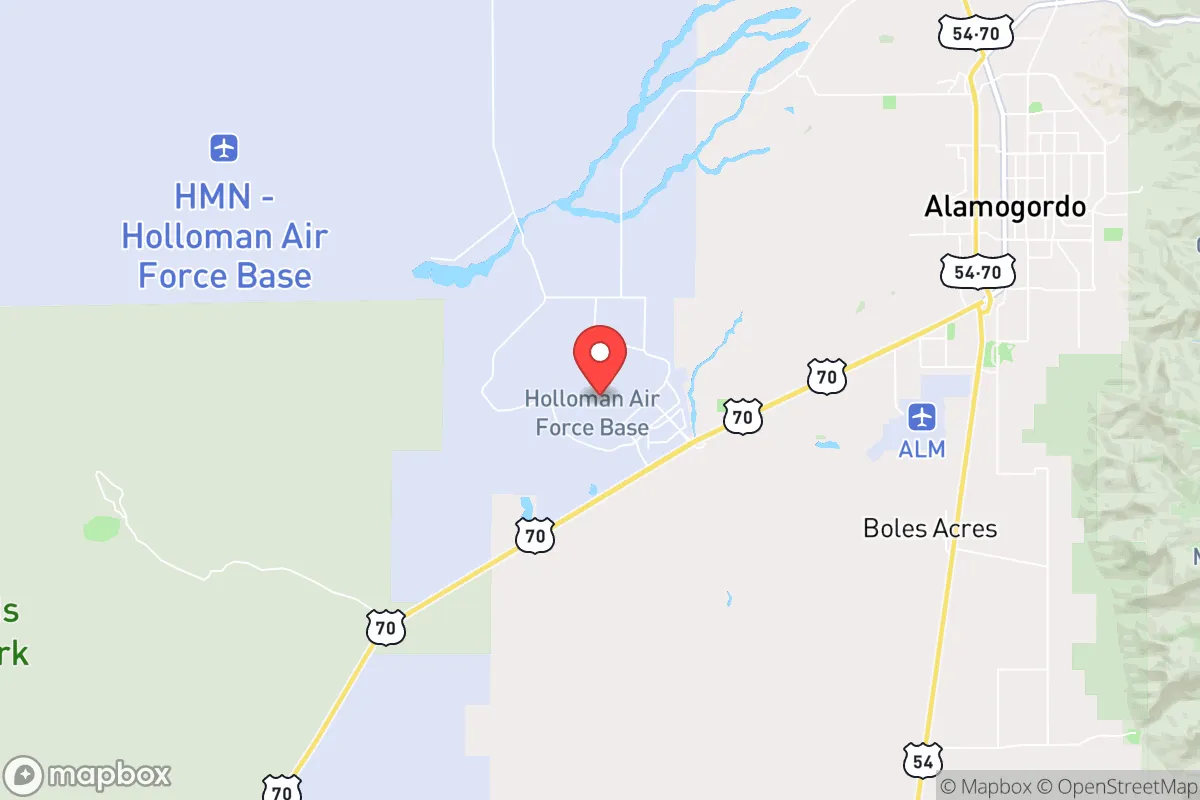
Photo: Wikipedia
Political ClimatePolitical Climate in Holloman Air Force Base, NM
District shown is the primary district for this city’s centroid. Cities may span multiple districts.
Inherited from parent county — no local data available.
* Lean and PVI are calculated from the surrounding county’s 2020 and 2024 presidential results, Cook-style — a finer measure here than its congressional district (NM-2).
Political rankings in New Mexico
- Most Conservative Cities in New Mexico
- Most Liberal Cities in New Mexico
- Best Liberal-Leaning Towns in the Mountain West
- Safest Liberal-Leaning Towns in the Mountain West
- Safest Conservative-Leaning Cities in the Mountain West
- Affordable Small Towns for Conservatives
- Most Affordable Liberal-Leaning Small Towns in the U.S.
- Safest Conservative-Leaning Cities in the U.S.
- Most Conservative Counties in New Mexico
- Most Liberal Counties in New Mexico
Local Political AnalysisPolitical Analysis of Holloman Air Force Base, NM
Holloman Air Force Base sits in a solidly conservative pocket of New Mexico, with a Cook PVI of R+14 that makes it one of the most reliably Republican areas in a state that leans Democratic overall (D+3). The base itself and the surrounding Otero County have voted for the GOP presidential candidate by double digits in every election since 2000, and that trend has only hardened in recent cycles. Locals will tell you that while the base's transient military population brings in folks from all over the country, the permanent civilian community in Alamogordo and the nearby unincorporated areas has a deep-rooted conservative identity that hasn't budged much, even as the rest of New Mexico has shifted leftward over the past two decades.
How it compares
The contrast between Holloman's immediate area and the rest of New Mexico is stark. Drive 90 minutes north to Albuquerque or two hours to Santa Fe, and you're in reliably blue territory — Bernalillo County went +17 for Biden in 2020, and Santa Fe County was +45. Even Las Cruces, about an hour west, is a purple-to-blue city that votes more in line with the state's Democratic lean. But here in Otero County, the politics feel closer to West Texas than to the rest of New Mexico. The county commission is all Republican, and local elections rarely see competitive Democratic candidates. The base's presence amplifies this: active-duty and retired military households tend to lean conservative, and the defense industry jobs at nearby White Sands Missile Range and Fort Bliss (just over the Texas line) reinforce a pro-military, fiscally conservative culture. That said, the area isn't a monolith — Alamogordo itself has a small but vocal progressive community, and the influx of younger airmen and their families occasionally nudges the local discourse on social issues.
What this means for residents
For conservative residents, life here is comfortable politically. Local government, school board meetings, and civic organizations generally reflect their values, and there's little friction in daily life around political signage, gun rights, or religious expression. The area's strong military ties mean that patriotism and service are celebrated without much pushback. For liberal residents, the reality is more nuanced. You'll find like-minded people — especially among the base's younger, more diverse population and in Alamogordo's small arts and education circles — but you won't see many Democratic campaign signs or progressive policy initiatives at the county level. Socially, most folks keep politics low-key in public settings; the "don't talk politics" norm is strong here, partly because the base brings together people from all backgrounds who need to work together. The practical effect is that while the area votes red, it's not a place where political arguments dominate everyday conversation.
One cultural distinction worth noting: the base's federal status creates a unique policy environment. Federal gun laws apply on base, and military housing and services operate under federal rules that can differ from state or county regulations. This means that while New Mexico has moved toward expanded abortion access and marijuana legalization, those policies have limited practical impact on base — federal law still governs military facilities. Off base, Alamogordo and Otero County have pushed back on some state mandates, particularly around gun control and COVID-era restrictions, creating a quiet tension between local conservative governance and state-level Democratic policies. Looking ahead, the area's political trajectory seems stable — the military and aerospace economy (with Space Force's growing presence at nearby White Sands) will keep the voter base conservative, but the state's overall blue lean means local Republicans will continue fighting state-level battles on education funding, water rights, and land use that don't always align with their federal representatives' priorities.

State Political ClimatePolitical Climate in New Mexico
State Political AnalysisPolitical Environment in the State
New Mexico carries a Cook PVI of D+3, making it a reliably Democratic state in presidential elections, but that label hides a deeply complex and often contradictory political reality. The state hasn't voted for a Republican presidential candidate since George W. Bush in 2004, yet it consistently elects a moderate Democratic governor and maintains one of the most competitive state legislative landscapes in the country, with rural conservative Democrats and libertarian-leaning independents holding real sway. Over the past 20 years, the dominant coalition has shifted from a conservative-leaning Democratic machine rooted in northern Hispanic communities to a more progressive, urban-driven coalition centered on Albuquerque, Santa Fe, and Las Cruces, while the oil-rich southeast and rural west have hardened into Republican strongholds.
Urban vs. rural divide
The political map of New Mexico is a study in stark contrasts. The state's Democratic majority is almost entirely generated by three metro areas: Albuquerque (Bernalillo County, roughly 40% of the state's population), Santa Fe (Santa Fe County, the most liberal county in the state), and Las Cruces (Doña Ana County). These three counties alone deliver enough votes to carry statewide races. In 2024, Bernalillo County voted +15 D, Santa Fe County +38 D, and Doña Ana County +12 D. Meanwhile, the southeastern corner—Hobbs, Carlsbad, and Roswell in Lea and Eddy counties—votes like Texas's Permian Basin, with Lea County going +45 R in 2024. The rural north, including Taos and Los Alamos, is a mix: Taos is deeply progressive, while Los Alamos, home to the national lab, leans moderate Republican or independent. The state's vast rural areas, from the plains of Clovis to the mountains of Silver City, are reliably red, but their populations are too small to offset the urban centers.
Policy environment
New Mexico's policy environment is a patchwork that reflects its divided nature. The state has a progressive income tax with rates from 1.7% to 5.9%, and a gross receipts tax (GRT) that functions like a sales tax but applies to many services, often pushing the combined rate above 8% in cities like Albuquerque. Property taxes are among the lowest in the nation, capped at about 1% of assessed value, which is a major draw for homeowners. The regulatory posture is mixed: the state has a renewable energy mandate (100% carbon-free electricity by 2045) and strict oil and gas regulations, but the Permian Basin's production continues to boom, providing roughly a third of the state's general fund revenue. Education policy is a perennial battleground—the state ranks near the bottom nationally in K-12 outcomes, and a 2023 law (SB 140) expanded early childhood education funding through a land-grant permanent fund, but school choice advocates have made limited inroads. Healthcare is dominated by the state's Medicaid expansion (about 40% of residents are on Medicaid), and a 2021 law created a public option health insurance plan. Election laws are relatively accessible: same-day voter registration, no-excuse absentee voting, and automatic voter registration at the DMV are all in place.
Recent policy direction
The last five years have seen a clear progressive shift in state law, but with notable exceptions. In 2021, the state legalized recreational cannabis for adults 21 and over (HB 2), with retail sales beginning in 2022—a move that has generated significant tax revenue but also drawn criticism from conservatives over public safety and youth access. On gun policy, the state passed a red flag law (SB 5) in 2020 and a 2023 law raising the minimum age to purchase semiautomatic rifles from 18 to 21, but it remains a shall-issue state for concealed carry permits, and there is no universal background check law. Parental and education rights have been a flashpoint: a 2023 law (HB 45) requires schools to provide instruction on "culturally and linguistically responsive" curricula, which conservatives argue sidelines parental input, while a 2024 law (SB 137) expanded access to abortion and gender-affirming care, including for out-of-state patients, making New Mexico a regional sanctuary for those procedures. Property rights are generally strong, but the state's Oil and Gas Act gives regulators broad authority to restrict drilling near homes and schools. On voting, a 2023 law (HB 4) restored voting rights to felons upon completion of their sentence, and the state has no voter ID requirement, which remains a point of contention among election integrity advocates.
Civil unrest & political movements
New Mexico has a history of low-boil political tension rather than large-scale civil unrest. The most visible flashpoint in recent years has been the immigration debate. The state is a major corridor for border crossings, and in 2019, the legislature passed a law (SB 318) prohibiting state and local law enforcement from detaining individuals solely for immigration status, effectively making New Mexico a sanctuary state. This has led to periodic standoffs between the state and border counties like Hidalgo and Luna, where sheriffs have publicly refused to enforce the law. In 2020, the Otero County commission (home to Alamogordo) briefly declared itself a "Second Amendment sanctuary" in response to the red flag law. The 2020 election saw no major fraud controversies in New Mexico, but the state's use of universal mail-in ballots (expanded during COVID) drew scrutiny from conservative groups, and a 2022 audit by the Secretary of State's office found no systemic issues. The 2023 legislative session saw a dramatic protest by gun rights advocates at the state capitol after the semiautomatic rifle age bill was introduced, but it remained peaceful. The Taos Pueblo and other tribal nations have also been active in land and water rights movements, particularly around the Rio Grande and the Gila River, which occasionally clash with state and federal resource management plans.
Projection
Over the next 5-10 years, New Mexico's political trajectory points toward a slow but steady consolidation of Democratic control at the state level, driven by demographic shifts. The state's Hispanic population, which makes up about 50% of residents, has been trending more Democratic among younger voters, while the older, more conservative Hispanic base is shrinking. In-migration from Texas and California is modest but growing, with Santa Fe and Las Cruces seeing an influx of remote workers and retirees—most of whom lean left. The oil and gas industry, which has historically anchored conservative power in the southeast, faces long-term uncertainty as the state's renewable mandates tighten and global energy transitions accelerate. However, the rural-urban divide is likely to deepen: as Albuquerque and Santa Fe become more progressive, rural counties like Lea, Eddy, and Chaves will become even more Republican, potentially fueling secessionist rhetoric (a "New Mexico 51st state" movement has been floated but remains fringe). The state's budget, heavily dependent on oil revenue, will be a key battleground—if oil prices drop, the progressive spending agenda will face serious constraints. A new resident moving in now should expect a state where the urban centers set the policy direction, but rural conservatives retain enough legislative seats to force compromise on taxes, energy, and education.
For a conservative relocating to New Mexico, the practical reality is that you'll live in a state with low property taxes, a booming energy sector in the southeast, and a gun-friendly culture in most areas outside Santa Fe and Albuquerque proper. You'll also face a state government that is increasingly progressive on social issues, with no voter ID, legal cannabis, and strong abortion protections. For a liberal relocating, you'll find a state that matches your values on healthcare, immigration, and the environment, but you'll need to accept that the state's economy is still heavily tied to fossil fuels and that many rural areas are deeply conservative. The bottom line: New Mexico is not a monolith. Your experience will depend heavily on whether you settle in the liberal bubble of Santa Fe, the moderate sprawl of Albuquerque's East Mountains, the conservative oil patch of Hobbs, or the independent-minded college town of Las Cruces. It's a state where you can find your political tribe, but you'll have to drive an hour to get there.
* Values derived from national, state, county, city and local statistics and may differ in a specific area. Last updated: 2026-11-16T20:34:02.000Z
Narrative content on this page is AI-generated and may contain mistakes. Verify any details that matter before acting on them.
ReloMaps may earn a commission from affiliate links at no extra cost to you.

