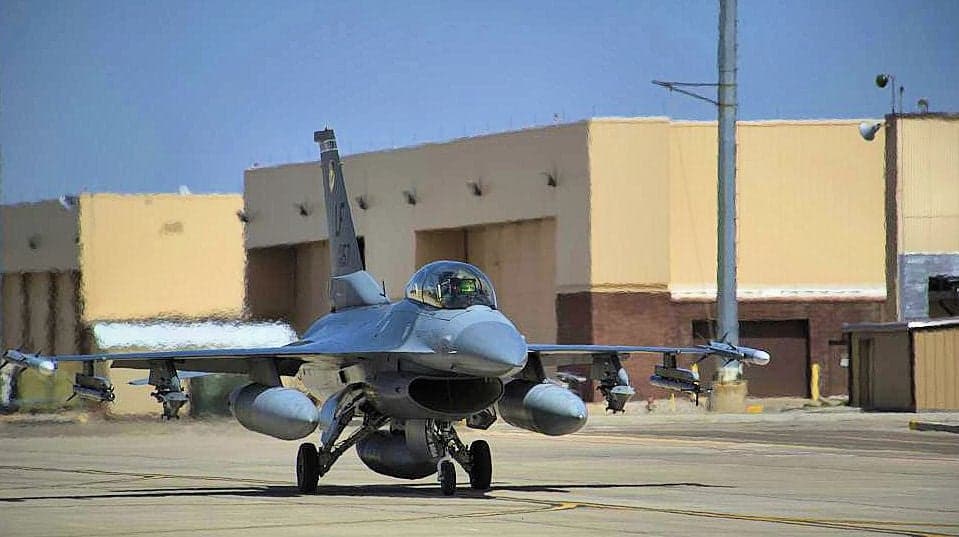
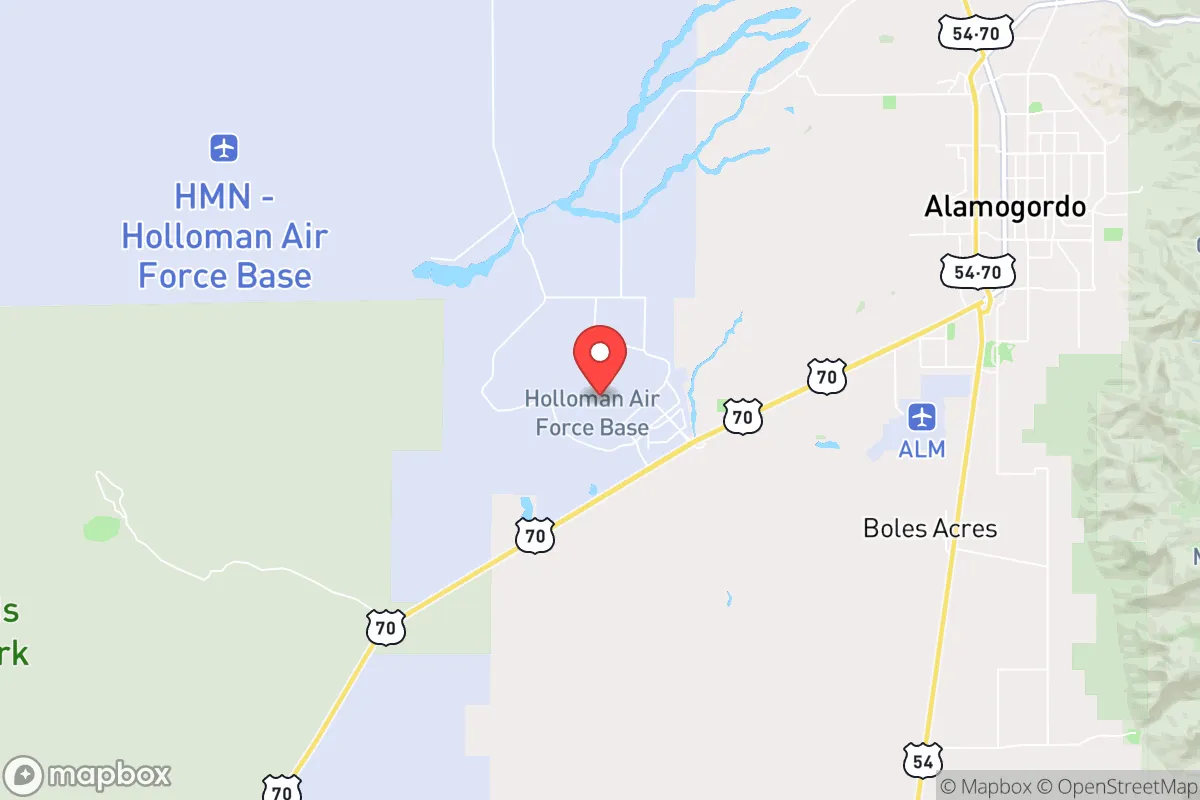
Photo: Wikipedia
Demographics of Holloman Air Force Base, NM
Affluence Level in Holloman Air Force Base, NM
A middle-class area roughly in line with national averages across income, home values, education, and employment.
People of Holloman Air Force Base, NM
The people of Holloman Air Force Base, New Mexico, form a small, transient, and highly structured community of 735 residents defined almost entirely by active-duty military service, civilian defense employment, and their families. Distinctive identity markers include a young median age, a high proportion of college-educated adults at 33.3%, and a demographic profile that is majority White (58.2%) with a significant Hispanic presence (29.7%), reflecting both national military recruitment patterns and the base's location in southern New Mexico. Unlike a traditional city, this is a federally managed installation where population churn is constant, with most residents staying only two to four years before reassignment.
How the city was settled and grew
Holloman Air Force Base was established in 1942 as the Alamogordo Army Air Field, a direct product of World War II mobilization. The original population consisted entirely of military personnel and civilian contractors drawn to the remote Tularosa Basin for pilot training and, later, guided missile testing. Unlike a civilian town that grew organically, Holloman's population was planned from the start: barracks and support facilities were built to house a rotating force of several thousand. The first major wave of residents—predominantly White and Hispanic men from the Southwest—arrived during the war and stayed through the Cold War expansion of the 1950s. The base's historic core, now referred to as Old Base Housing (the original 1940s-era quarters near the main gate), housed these early personnel and their families. A second wave came in the 1960s with the development of the High Speed Test Track and the German rocket scientists brought in under Project Paperclip, a small but influential group that concentrated in Officers' Row, the set of larger homes near the base headquarters. By 1970, the base population had stabilized at roughly 4,000 military and civilian residents, though the housing footprint remained compact.
Modern era (post-1965)
The post-1965 era brought significant demographic shifts to Holloman, driven by the all-volunteer force (post-1973) and the base's evolving mission. The 1970s and 1980s saw an influx of Black and Hispanic service members as the military became a primary avenue of upward mobility for minority communities. Today, Black residents make up 5.7% of the population, and Hispanic residents 29.7%, a share that has grown steadily since the 1990s as the Air Force diversified its recruitment. The base's housing stock expanded in the 1980s with the construction of Thunderbird Estates, a neighborhood of single-family homes built for non-commissioned officers and their families, which absorbed much of the growing Hispanic and Black military population. East/Southeast Asian residents (3.3%) are a newer addition, largely arriving since 2000 through technical and engineering roles tied to the base's test and evaluation mission; they tend to concentrate in Hercules Village, the newer privatized housing area built in the 2010s. The foreign-born share remains very low at 1.4%, reflecting the base's status as a domestic assignment hub rather than a gateway for immigrants. The Indian subcontinent population is 0.0%, meaning no measurable community exists.
The future
The population of Holloman Air Force Base is heading toward modest diversification, though it will remain majority White and Hispanic for the foreseeable future. The base's mission—primarily the 49th Wing's MQ-9 Reaper drone operations and the High Speed Test Track—is stable, meaning no dramatic expansion or contraction is expected. However, the trend toward privatized housing and longer assignments for drone operators (often three to four years) is creating a slightly more settled population than the transient Cold War model. Newer housing developments like White Sands Village, built in 2020, are designed for families and are attracting a slightly more diverse mix of younger officers and enlisted personnel, including more East/Southeast Asian and Black families. The Hispanic share is likely to grow further, mirroring New Mexico's broader demographic trajectory, while the White share will continue a slow decline. The base's cultural identity is evolving from a purely military enclave into a more family-oriented, suburban-style community, though it remains fundamentally a place of temporary assignment rather than permanent roots.
For someone moving in now, Holloman Air Force Base offers a tightly knit, mission-focused community where diversity is present but not dominant, and where the population's character is shaped more by military rank and job function than by ethnic or cultural background. The base is becoming slightly more diverse and family-oriented, but its core identity as a transient, federally managed installation will not change. New residents should expect a population that is young, educated, and accustomed to frequent turnover, with a social life centered on base amenities and the nearby city of Alamogordo.

* Values derived from national, state, county, city and local statistics and may differ in a specific area. Last updated: 2026-11-16T20:34:02.000Z
Narrative content on this page is AI-generated and may contain mistakes. Verify any details that matter before acting on them.
ReloMaps may earn a commission from affiliate links at no extra cost to you.

