
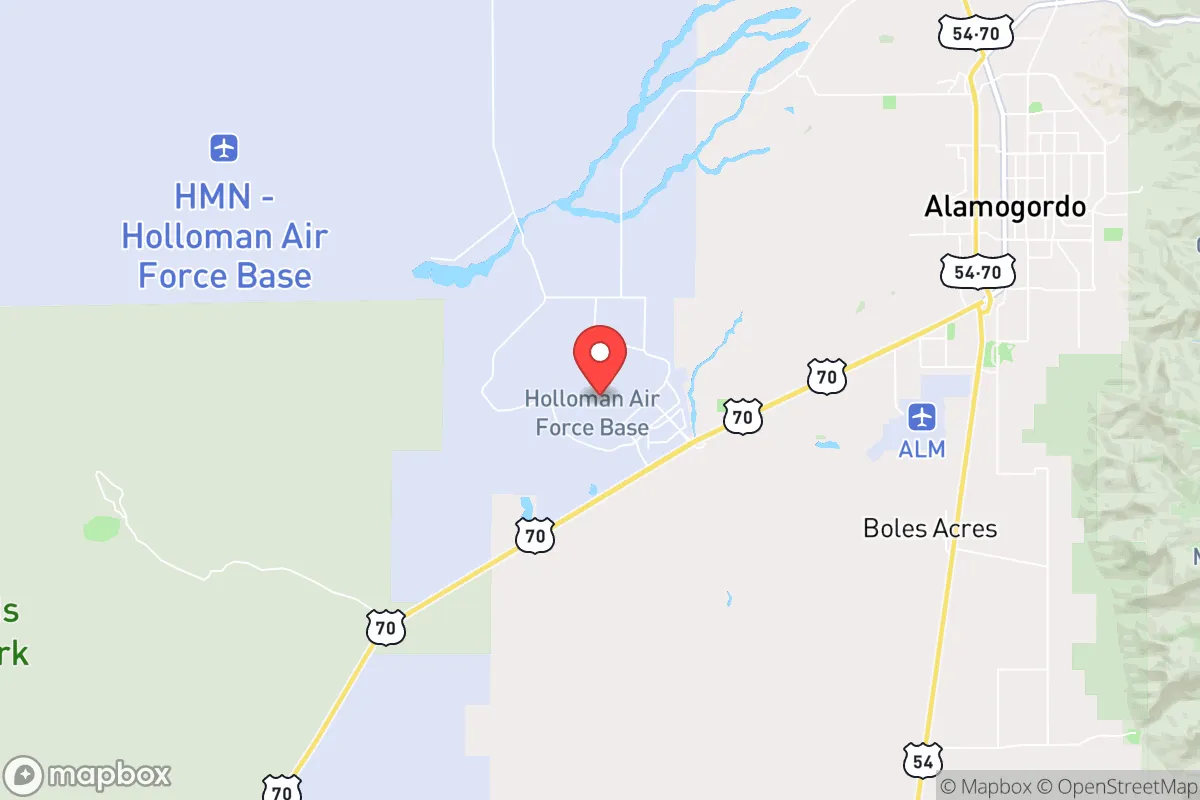
Photo: Wikipedia
Personal Sovereignty in Holloman Air Force Base, NM
Viable for self-reliance. Generally workable, though some barriers may limit total independence.
What does Personal Sovereignty tell us?
Personal Sovereignty measures your capacity for self-reliance and independence with minimal government friction. Higher scores mean fewer barriers between you and the way you want to live... but it assumes you have the space you need and good neighbors.
What does this tell us?
Personal Sovereignty measures your capacity for self-reliance and independence with minimal government friction. Higher scores mean fewer barriers between you and the way you want to live... but it assumes you have the space you need and good neighbors.
State Policy
Energy independence: Net exporter (1246% of energy produced in-state)
Personal Liberty
Homesteading
Personal Liberty Analysis
Holloman Air Force Base, located near Alamogordo in Otero County, New Mexico, offers a unique personal sovereignty environment shaped by its military installation status and the broader state’s regulatory landscape. While the base itself imposes federal rules on housing and conduct, the surrounding area provides a notably light-touch atmosphere for those who prioritize autonomy, with New Mexico’s generally permissive stance on self-defense and property rights balanced against a moderate tax burden. For single individuals and families relocating here, the key trade-off is between the structured military community and the open, low-regulation lifestyle available just outside the gates.
Tax burden and regulatory posture in Otero County
New Mexico’s tax structure is moderate compared to neighboring states, and Otero County leans toward fiscal conservatism. The state’s personal income tax rates range from 1.7% to 5.9% as of 2026, with a standard deduction that benefits middle-income earners. Property taxes are notably low: Otero County’s effective rate averages around 0.6% of assessed value, one of the lowest in the Southwest, meaning a $250,000 home carries roughly $1,500 annually in property tax. There is no state-level sales tax on groceries or prescription drugs, though the combined state and local sales tax in Alamogordo is about 8.5%. Regulatory posture is generally business-friendly in the county, with no county-level zoning in unincorporated areas—a significant advantage for those wanting to run a home-based business or keep livestock without bureaucratic hurdles. However, the base itself enforces federal housing standards, including pet restrictions and noise ordinances, so living on-post means less autonomy in daily choices.
Self-defense and gun law specifics in New Mexico
New Mexico is a shall-issue state for concealed carry permits, and as of 2026, it remains a constitutional carry state for law-abiding residents aged 21 and older—no permit needed to carry a concealed handgun in most public places. Otero County’s sheriff’s office is known for a pro-Second Amendment stance, and there are no county-level restrictions beyond state law. The state does require background checks for all firearm purchases from licensed dealers, but private sales between individuals are not regulated. Stand-your-ground laws are in effect, with no duty to retreat in any place where a person has a legal right to be. For military families, this means that personal defense choices are largely unrestricted off-base, though federal law prohibits carrying firearms on military installations without specific authorization. The nearest gun ranges and retailers are within a 15-minute drive in Alamogordo, and the area’s low crime rate (violent crime in Otero County is about 30% below the national average) means self-defense is more about preparedness than daily necessity.
Self-reliance and homesteading viability: lot sizes, zoning, and off-grid feasibility
The rural character of Otero County makes it a viable location for homesteading and off-grid living, especially in unincorporated areas east and south of the base. Minimum lot sizes in the county’s rural zones are typically 1 to 5 acres, with no county-wide zoning in many areas—meaning you can build a home, keep chickens, goats, or even horses without special permits. Off-grid feasibility is high: New Mexico law does not prohibit rainwater harvesting, and the state offers a tax credit for solar energy systems (up to 10% of cost, capped at $6,000). The county’s building codes are minimal in unincorporated areas, though a permit is required for any structure over 200 square feet. Water access is the main constraint—well drilling is allowed, but depths of 300 to 500 feet are common, costing $10,000 to $20,000. The arid climate (about 10 inches of annual rainfall) means gardening requires irrigation, but the long growing season (April to October) supports vegetables and fruit trees. For those wanting to be fully off-grid, the county does not enforce occupancy requirements for alternative housing like tiny homes or RVs, provided they meet basic septic and electrical codes. The base’s proximity (within 10 miles) means you can live rurally while still commuting to work.
Personal liberties: parental rights, medical autonomy, speech, and property
New Mexico’s legal framework generally supports personal liberties, though with some notable exceptions. Parental rights are strong: the state does not have a mandatory vaccination law for school attendance (parents can claim a personal belief exemption), and there is no state-level curriculum mandate that overrides local school board decisions. Otero County’s school district, Alamogordo Public Schools, has a conservative-leaning board that has resisted controversial sex education materials. Medical autonomy is mixed—New Mexico has legalized recreational cannabis and allows medical marijuana for a broad list of conditions, but it also has a state-run health insurance exchange that some conservatives view as overreach. Speech is fully protected under the First Amendment, and the area’s military culture means open political expression is common, with no local ordinances restricting public assembly or signage. Property rights are robust: there is no state-level rent control, and the county does not impose short-term rental restrictions, so owning a home and renting it out on Airbnb is straightforward. The main limitation on personal liberty is the base itself, where housing rules, curfews, and security protocols apply to active-duty personnel and their families living on-post. Off-base, however, the regulatory environment is among the lightest in the Southwest.
Overall, personal sovereignty in the Holloman AFB area is high relative to most U.S. regions, particularly for those who choose to live off-base in Otero County’s unincorporated areas. The combination of low property taxes, constitutional carry, minimal zoning, and strong parental rights creates an environment where self-reliance is both feasible and legally supported. The primary constraint is the military installation’s internal rules, but for civilians and military families living off-post, the area offers a level of autonomy that rivals more famously libertarian states like Arizona or Texas. For a relocation researcher targeting a conservative-leaning audience, Holloman AFB’s surroundings represent a solid choice for those who value personal freedom without the high costs or heavy regulations found in coastal or urban areas.

* Values derived from national, state, county, city and local statistics and may differ in a specific area. Last updated: 2026-11-16T20:34:02.000Z
Narrative content on this page is AI-generated and may contain mistakes. Verify any details that matter before acting on them.
ReloMaps may earn a commission from affiliate links at no extra cost to you.

