
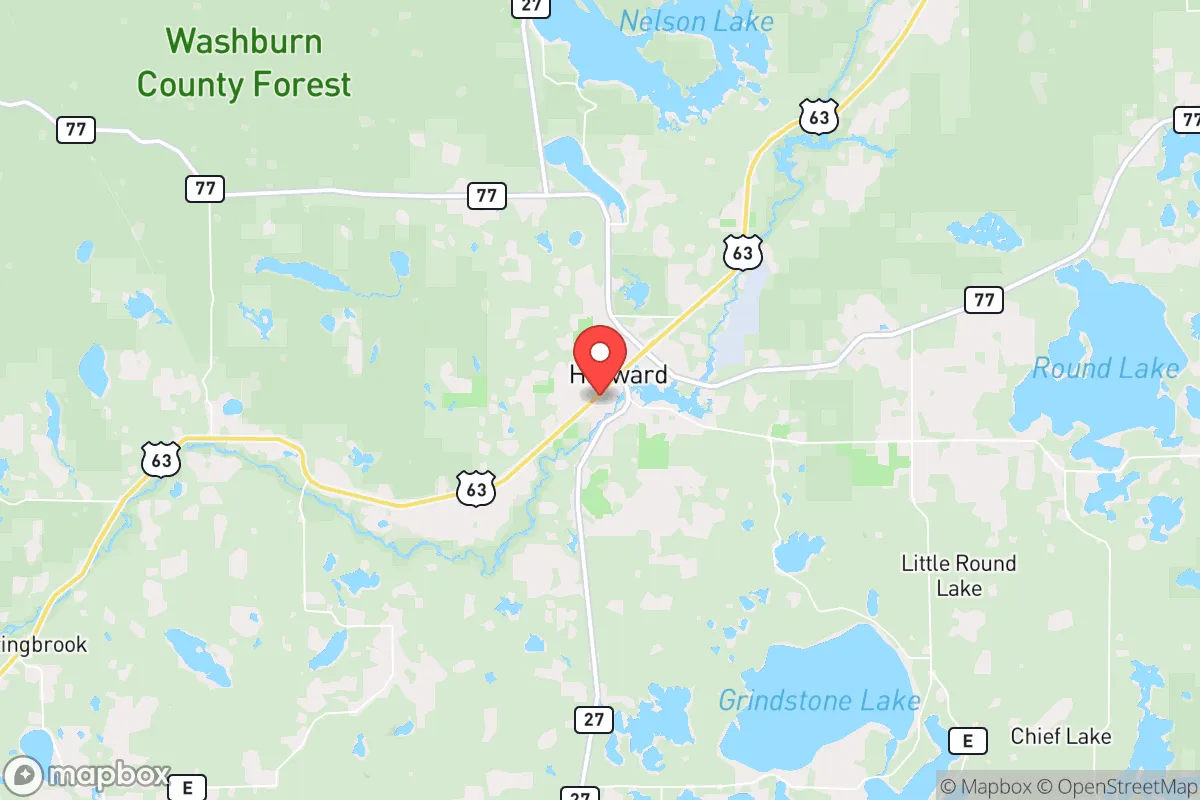
Photo: Wikipedia
Political ClimatePolitical Climate in Hayward, WI
District shown is the primary district for this city’s centroid. Cities may span multiple districts.
Inherited from parent county — no local data available.
* Lean and PVI are calculated from Hayward, WI’s own 2020 presidential results (precinct returns summed to the city), with 2024 estimated from the surrounding county’s 2020–2024 shift, Cook-style. Sources: state election offices; VEST 2020 precinct results (CC BY 4.0).
Political rankings in Wisconsin
- Most Conservative Cities in Wisconsin
- Most Liberal Cities in Wisconsin
- Best Liberal-Leaning Towns in the Midwest
- Safest Liberal-Leaning Towns in the Midwest
- Safest Conservative-Leaning Towns in the Midwest
- Affordable Small Towns for Conservatives
- Most Affordable Liberal-Leaning Small Towns in the U.S.
- Safest Conservative-Leaning Cities in the U.S.
- Most Conservative Counties in Wisconsin
- Most Liberal Counties in Wisconsin
Local Political AnalysisPolitical Analysis of Hayward, WI
Hayward, Wisconsin, leans solidly Republican, with a Cook PVI of R+8, meaning the area consistently votes about eight points more conservative than the national average. This isn't a recent shift; the surrounding Sawyer County has been a GOP stronghold for decades, though the margin has tightened slightly in the last two presidential cycles as the broader state of Wisconsin has become a pure toss-up, with its own Cook PVI sitting at EVEN. You'll see the difference most clearly when you compare Hayward to places like Washburn or Ashland, which are about an hour north and lean more Democratic, or even to the liberal college town of Eau Claire, about 90 minutes south. In Hayward, the political conversation is quieter, more consensus-driven, and heavily influenced by local issues like tourism, logging, and lake access, rather than the national firefights you get in the suburbs of Madison or Milwaukee.
How it compares
Hayward's R+8 rating puts it in a different political universe from the state as a whole, which is now a pure battleground. In 2020, Sawyer County voted for Donald Trump by about 16 points, while Wisconsin statewide was decided by just 20,000 votes. That gap is the story: Hayward is reliably red in a purple state. The contrast is even sharper when you look at the city of Hayward itself versus the surrounding townships. The city proper, with its seasonal population and more service-industry workers, is slightly more moderate than the rural townships like Bass Lake or Couderay, where you'll find fewer Biden signs and more Trump flags even in 2024. The biggest political dividing line here isn't really Democrat vs. Republican—it's more about how you feel about growth and development. Longtime locals, regardless of party, tend to be skeptical of new subdivisions and chain stores, while newer arrivals from the Twin Cities often push for more amenities and services.
What this means for residents
For conservative residents, Hayward feels like a comfortable fit. Local government, county board, and school board elections are usually won by Republicans or conservative-leaning independents. You won't feel out of place at the local diner or hardware store talking about hunting, property taxes, or the Second Amendment. For liberal residents, the reality is more nuanced. You're not going to be shunned, but you'll be in the minority. Most political conversations in public are polite, but you'll learn to pick your spots. The upside is that because the area is so politically homogeneous, there's less of the constant partisan bickering you'd find in a swing suburb. People here tend to judge you by your character and your willingness to help a neighbor, not by your bumper sticker. The biggest practical impact of the lean is on policy: property taxes are relatively low, there's no local income tax, and the county generally resists state or federal mandates on land use and environmental regulations.
One cultural distinction worth noting is the influence of the Lac Courte Oreilles Ojibwe reservation, which sits just south of Hayward. Tribal politics are a separate and significant force here, often intersecting with county and state issues over fishing rights, land use, and casino revenue. This creates a unique political dynamic you won't find in most other R+8 counties in Wisconsin. The tribe tends to lean Democratic in national elections, but locally, their priorities are about sovereignty and economic development, which can align with or against either party depending on the issue. Looking ahead, I'd expect Hayward to stay R+8 or maybe drift a point or two redder as more conservative retirees from the Twin Cities move in, but the state as a whole will remain a toss-up for the foreseeable future. That means your vote in Hayward matters less for the presidential race, but it matters a lot for local races and for the state legislature, where Sawyer County is part of a competitive district.

State Political ClimatePolitical Climate in Wisconsin
State Political AnalysisPolitical Environment in the State
Wisconsin is the quintessential swing state, carrying a Cook Partisan Voting Index of EVEN, meaning it votes almost exactly with the national average in presidential elections. Over the last 20 years, the state has shifted from a reliably blue-leaning battleground (voting for Democrats in six of seven elections from 1988 to 2012) to a dead-even toss-up, with margins decided by fewer than 25,000 votes in both 2016 and 2020. The dominant coalitions are a deeply entrenched Democratic stronghold in the urban southeast (Milwaukee, Madison, and their suburbs) versus a sprawling, increasingly Republican rural and exurban north and west, with the critical swing bloc residing in the WOW counties (Waukesha, Ozaukee, Washington) and the Fox Valley region around Green Bay and Appleton.
Urban vs. rural divide
The political map of Wisconsin is a study in stark geographic polarization. Milwaukee County, home to the state's largest city, delivers massive Democratic margins—often exceeding 60-70% of the vote—driven by a diverse, union-heavy, and historically liberal electorate. Dane County, anchored by Madison and the University of Wisconsin, is the state's most reliably Democratic stronghold, regularly voting 75%+ for Democratic candidates. In contrast, the rural northern tier (Vilas, Oneida, Lincoln counties) and the western Driftless region (Crawford, Vernon, Richland counties) have swung hard to the right over the past decade, fueled by opposition to COVID-19 restrictions, gun control, and environmental regulations. The critical battleground is the suburban WOW counties (Waukesha, Ozaukee, Washington) surrounding Milwaukee. These areas were once moderate Republican but have become deeply conservative, often voting 60-65% Republican, and they are the engine of the GOP's statewide viability. The Fox Valley—cities like Green Bay, Appleton, and Oshkosh—is the true swing region, where working-class voters, many with union ties, have trended Republican in recent cycles, though local races remain competitive.
Policy environment
Wisconsin's policy environment is a patchwork reflecting its divided government. The state has a flat income tax rate of 4.4% (as of 2025, down from 7.65% in 2011), and property taxes are among the highest in the Midwest, averaging around 1.6% of home value. The regulatory posture is generally business-friendly, with a right-to-work law passed in 2015 and a relatively low corporate tax rate. Education policy is a flashpoint: the state has a robust school choice program (the nation's oldest, dating to 1990) that allows vouchers for private and religious schools, but public school funding has been a perennial battle, with per-pupil spending lagging the national average. Healthcare is dominated by a mix of large systems (Aurora, UW Health, Marshfield Clinic), and the state did not expand Medicaid under the Affordable Care Act, leaving a coverage gap for roughly 80,000 low-income adults. Election laws are moderately restrictive: voter ID is required, same-day registration is allowed, and absentee voting was heavily litigated after 2020, with the state Supreme Court currently weighing rules on drop boxes and witness signatures.
Recent policy direction
Over the past five years, Wisconsin has moved decisively in a conservative direction on several fronts, though the pace is constrained by divided government (Democratic Governor Tony Evers has vetoed numerous GOP bills). On gun rights, the state is a "shall-issue" concealed carry state with no permit required for open carry, and in 2024, the legislature passed a bill (vetoed by Evers) to allow permitless concealed carry. Self-defense law follows the Castle Doctrine, with no duty to retreat in one's home or vehicle. Parental rights have been a major focus: in 2023, the legislature passed a bill (vetoed) requiring schools to notify parents of a child's gender identity changes, and a 2024 law (signed) bans gender-affirming care for minors, though it is currently blocked by a court order. On education, the state expanded the school choice program in 2023 to near-universal eligibility, and a 2024 law (vetoed) would have banned critical race theory and diversity training in K-12 schools. Privacy and surveillance are moderate: Wisconsin has a strong open records law, but no comprehensive data privacy statute. Medical autonomy is constrained: abortion is legal up to 20 weeks (a 1849 law banning it was struck down in 2023 by a Dane County judge, with the state Supreme Court likely to rule on the issue). Property rights are generally strong, with no statewide rent control and limited eminent domain abuse. Voting access has been tightened: the 2020 election saw a surge in absentee voting, leading to a 2022 law (upheld by the state Supreme Court) that bans most private funding for election administration and restricts drop box locations.
Civil unrest & political movements
Wisconsin has been a flashpoint for political unrest, most notably the 2011 protests against Act 10 (the union bargaining law), which drew over 100,000 people to the state capitol and sparked a national movement. The 2020 Kenosha unrest, following the shooting of Jacob Blake, saw two nights of riots, arson, and the killing of two protesters by Kyle Rittenhouse, which became a national flashpoint for self-defense and Second Amendment debates. Organized movements are active on both sides: the left has a strong presence in Madison and Milwaukee through groups like the Wisconsin Alliance for Retired Americans and the Democratic Party of Wisconsin, while the right is anchored by the Wisconsin Family Action (social conservative), the Wisconsin Institute for Law & Liberty (legal advocacy), and the state's robust gun rights community. Immigration politics are relatively quiet compared to border states, but the state has no sanctuary city policies, and a 2023 law (vetoed) would have required local law enforcement to cooperate with ICE. Election integrity remains a live issue: the 2020 election saw Trump's campaign challenge results in Milwaukee and Dane counties, leading to a partial recount and ongoing litigation over ballot drop boxes and witness signatures. A new resident would notice the heavy presence of political yard signs, especially in the WOW counties and the Fox Valley, and the frequent protests at the state capitol during legislative sessions.
Projection
Over the next 5-10 years, Wisconsin is likely to remain a toss-up state, but the demographic trends favor a slight rightward tilt. The urban cores (Milwaukee, Madison) are aging and losing population, while the WOW counties and the Fox Valley are growing, driven by suburban expansion and in-migration from Illinois. The state's Hispanic population is growing (now about 7% of the population), concentrated in Milwaukee and the Fox Valley, and could become a swing bloc. The state Supreme Court flipped to a 4-3 liberal majority in 2023, which will likely protect abortion access and voting rights for the near term, but the legislature is heavily gerrymandered toward Republicans (the state assembly map was struck down in 2024, but a new map is still being litigated). The key wildcard is the 2026 gubernatorial election: if a Republican wins, expect a wave of conservative legislation on guns, education, and election laws. A new resident moving in now should expect a state that is politically competitive but increasingly polarized, with a legislature that is reliably conservative and a governorship that is a toss-up. The practical reality is that your vote will matter more here than in almost any other state, and the political climate will be a constant topic of conversation.
For a new resident, the bottom line is that Wisconsin offers a balanced political environment where your vote carries real weight, but the trade-off is a state that is perpetually in campaign mode. Conservatives will find a friendly legislature and a strong school choice system, but will need to contend with a Democratic governor who can veto their priorities. Liberals will find safe havens in Madison and Milwaukee, but will face a gerrymandered legislature that limits their statewide influence. The state's moderate tax burden, strong property rights, and robust self-defense laws appeal to many, while the ongoing fights over abortion, education, and election integrity mean that the political landscape is never settled. If you value being in a state where your voice can actually swing an election, Wisconsin is hard to beat—but be prepared for the noise that comes with it.
* Values derived from national, state, county, city and local statistics and may differ in a specific area. Last updated: 2026-11-22T19:14:57.000Z
Narrative content on this page is AI-generated and may contain mistakes. Verify any details that matter before acting on them.
ReloMaps may earn a commission from affiliate links at no extra cost to you.

