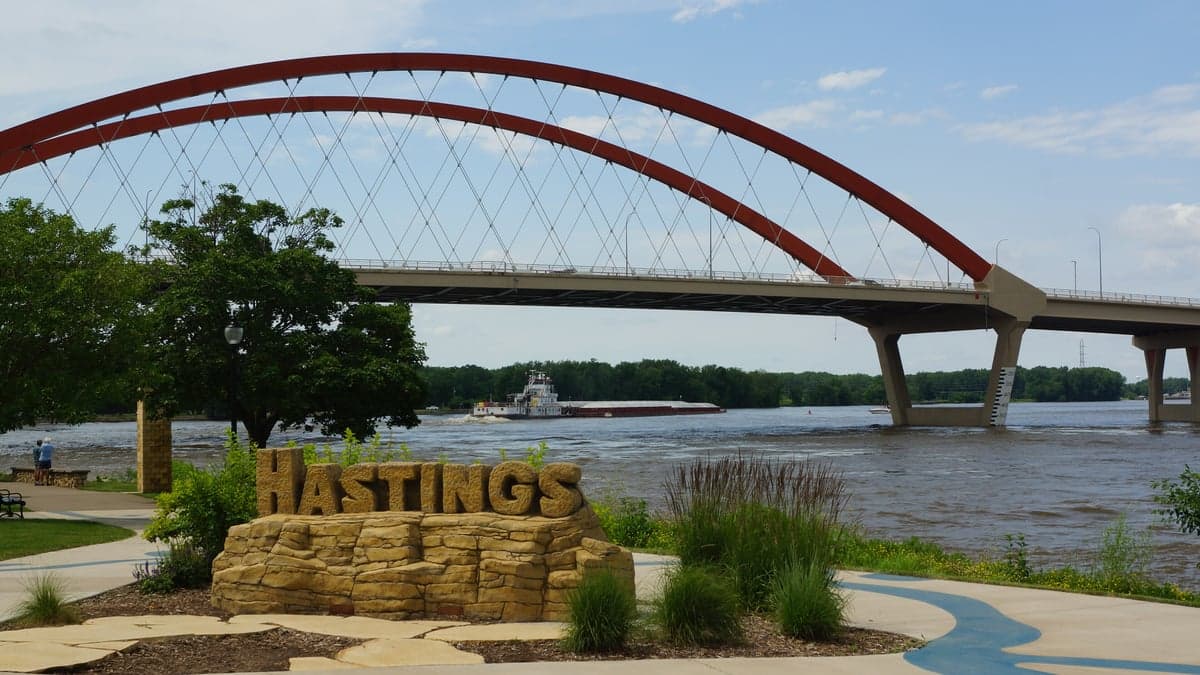
Photo: Wikipedia
Political ClimatePolitical Climate in Hastings, MN
District shown is the primary district for this city’s centroid. Cities may span multiple districts.
Lean and PVI are calculated from Hastings, MN’s own 2020 and 2024 presidential results, Cook-style. Sources: state election offices; VEST 2020 precinct results (CC BY 4.0).
Political rankings in Minnesota
- Most Conservative Cities in Minnesota
- Most Liberal Cities in Minnesota
- Best Liberal-Leaning Towns in the Midwest
- Safest Liberal-Leaning Towns in the Midwest
- Safest Conservative-Leaning Towns in the Midwest
- Affordable Small Towns for Conservatives
- Most Affordable Liberal-Leaning Small Towns in the U.S.
- Safest Conservative-Leaning Cities in the U.S.
- Most Conservative Counties in Minnesota
- Most Liberal Counties in Minnesota
Local Political AnalysisPolitical Analysis of Hastings, MN
Hastings, Minnesota, sits in a bit of a political sweet spot, leaning slightly Democratic with a Cook PVI of D+3, but it’s not the deep-blue territory you’d find in the core of Minneapolis or St. Paul. Over the last decade, the city has held fairly steady, trending a touch more Democratic than the surrounding rural areas but not swinging as hard left as the inner-ring suburbs. In the 2020 presidential election, Hastings voted for Joe Biden by a narrow margin, a shift from 2016 when it went for Hillary Clinton by a similar sliver. Locals will tell you the town has a quiet, independent streak—it’s not a place where you see a lot of yard signs or heated political arguments at the coffee shop, but the numbers show a community that’s reliably blue-leaning in a state that’s become a Democratic stronghold.
How it compares
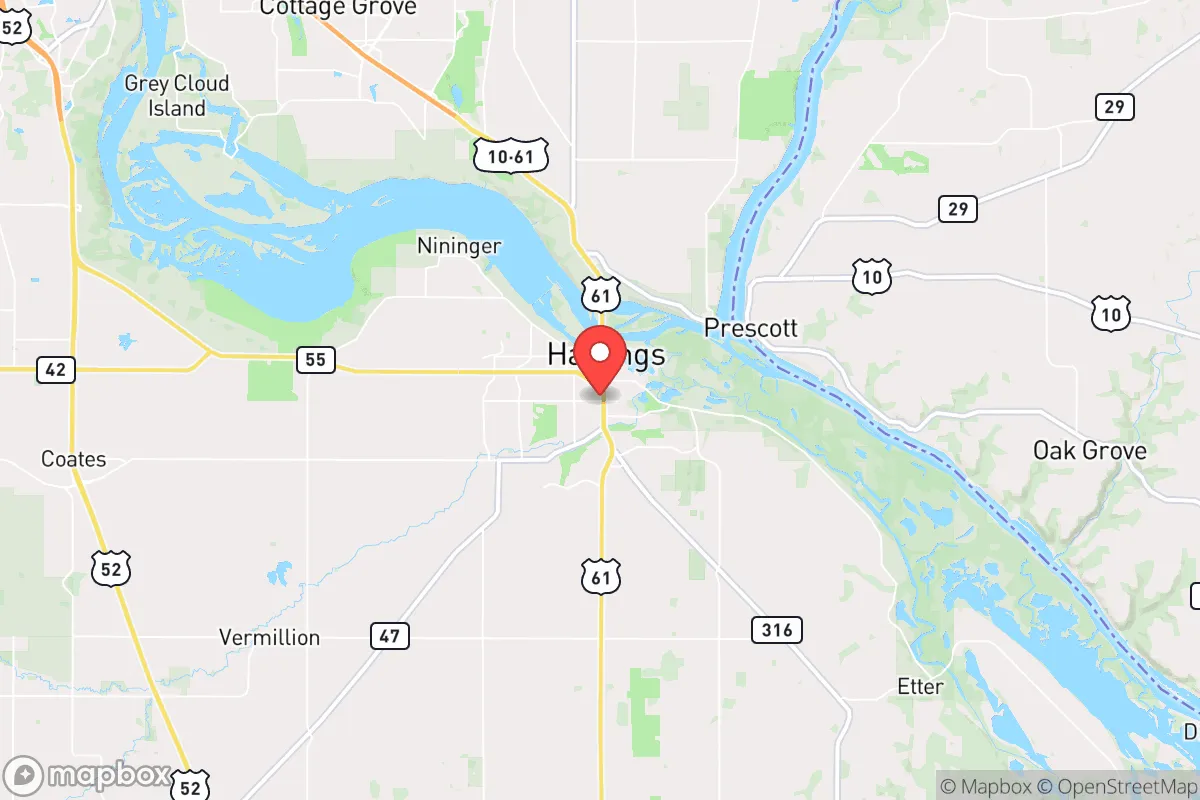
Compared to Minnesota as a whole, Hastings is a bit more moderate. The state’s Cook PVI is unknown, but statewide results show Minnesota has voted Democratic in every presidential election since 1976, often by margins of 5 to 10 points. Hastings’ D+3 rating puts it slightly to the right of the state average, meaning it’s less reliably blue than places like Hennepin County (home to Minneapolis) or Ramsey County (St. Paul). Drive 15 minutes south to Red Wing, and you’ll find a more conservative tilt—that city leans Republican by a similar margin. Head 20 minutes west to Lakeville, and you’re in a suburban area that’s been trending redder, with a Cook PVI around R+4. Hastings sits right in the middle, a kind of political buffer zone between the liberal metro core and the conservative farm country of Goodhue and Dakota counties. It’s a place where a Republican candidate can win a local race if they’re moderate, but a Democrat has a solid base to build on.
What this means for residents
For conservative residents, Hastings isn’t hostile territory. You’ll find plenty of neighbors who share your views, especially in the older neighborhoods and the more rural edges of town. Local elections often hinge on personality and local issues—like the debate over the Mississippi River bluff development or school funding—rather than national party labels. For liberal residents, you’re in a community where your vote counts in a close race, but you won’t feel like you’re in a bubble. The city council and school board tend to be pragmatic, with members from both sides working together on things like the recent downtown revitalization project. The practical reality is that Hastings is a place where you can have a civil conversation about politics over a beer at the Spiral Brewery, and most folks are more concerned about potholes and property taxes than the latest national drama.
Culturally, Hastings stands out from the rest of Minnesota in a few ways. It’s got a strong sense of local identity—the city’s historic downtown, the riverfront, and the annual Rivertown Days festival feel more like a small town than a suburb. There’s less of the “Minnesota nice” passive-aggression you sometimes get in the Twin Cities; people here are more direct. Policy-wise, the city has been slower to adopt some of the progressive measures seen in Minneapolis, like rent control or police reform, but it’s not resistant to change either. The school district has a growing immigrant population, and the community has generally been welcoming. Looking ahead, Hastings will likely stay in its D+3 lane, but if the state continues to polarize, it could become a key swing area—a place where both parties will have to work for every vote. For now, it’s a comfortable middle ground, where the political climate is as balanced as the town itself.

State Political ClimatePolitical Climate in Minnesota
State Political AnalysisPolitical Environment in the State
Minnesota has shifted from a reliably purple battleground to a solidly blue state over the past two decades, driven by the explosive growth of the Twin Cities metro and a sharpening urban-rural divide. In 2024, Kamala Harris won the state by about 7 points, a margin that has held steady since 2016, but down from the double-digit wins of Barack Obama. The state’s political center of gravity is now firmly in the Minneapolis-St. Paul metro, which casts roughly 55% of the vote and leans heavily Democratic, while Greater Minnesota has swung hard toward Republicans. For a conservative relocator, this means living in a state where state government is controlled by Democrats, but where local politics can vary dramatically depending on whether you settle in a suburb like Lakeville or a rural county like Otter Tail.
Urban vs. rural divide
The political map of Minnesota is a tale of two states. The Twin Cities metro—including Hennepin, Ramsey, and Dakota counties—is the engine of Democratic power, with Minneapolis and St. Paul routinely delivering 70-80% of their votes to Democratic candidates. Suburbs like Edina and Bloomington have trended bluer over the last decade, while outer-ring suburbs like Lakeville and Woodbury remain more competitive but are shifting left. Meanwhile, Greater Minnesota is overwhelmingly Republican. Counties like Stearns (St. Cloud), Olmsted (Rochester), and Washington (east metro) are the only real exceptions, and even those are trending redder. The Iron Range, once a Democratic stronghold, has flipped hard to the GOP, with St. Louis County (Duluth) now the only reliably blue area outside the metro. This divide means a conservative family moving to a town like Fergus Falls or Alexandria will find a deeply red community, while a move to a Minneapolis suburb means living in a blue bubble.
Policy environment
Minnesota’s state-level policy environment is distinctly progressive, with a tax structure that is among the most progressive in the nation. The state has a graduated income tax with a top rate of 9.85% on income over $200,000 (single filers), and property taxes are moderate but vary widely by county. The regulatory posture is business-friendly in some sectors (agriculture, mining) but heavily regulated in others (environmental permitting, labor). Education policy is a mixed bag: Minnesota has strong public schools and a robust open enrollment system, but also one of the nation’s largest achievement gaps. Healthcare is dominated by large systems like Mayo Clinic and HealthPartners, and the state has a robust Medicaid expansion and a state-run health insurance exchange. Election laws are among the most accessible in the country, with same-day voter registration, no-excuse absentee voting, and automatic voter registration at DMVs. For a conservative, the policy environment can feel like a headwind, especially on taxes and regulation, but the state’s strong economy and high quality of life often offset those concerns.
Recent policy direction
The 2023-2024 legislative session was a watershed for progressive policy in Minnesota, with Democrats (the DFL) holding a trifecta and passing a sweeping agenda. Key laws include a paid family and medical leave program funded by a payroll tax, a ban on non-compete agreements, and a law requiring all new residential buildings to be electric-ready. On gun policy, the state passed universal background checks and a red-flag law, while also preempting local ordinances that would restrict firearm possession in public spaces. On education, the state eliminated high-stakes testing requirements for graduation and expanded funding for public schools, but also passed a law requiring schools to provide free menstrual products. On privacy, Minnesota passed a consumer data privacy law, but also expanded government surveillance powers in certain contexts. On medical autonomy, the state codified abortion rights into law and passed a shield law protecting providers who serve patients from states with bans. On voting, the state restored voting rights for felons upon release from prison and expanded early voting. For a conservative, these policies represent a clear shift leftward, but the state has also maintained a strong property rights framework and has not imposed rent control or statewide zoning mandates.
Civil unrest & political movements
Minnesota has been a flashpoint for political activism on both sides. The 2020 murder of George Floyd in Minneapolis sparked the largest protests in state history, leading to a national reckoning on policing and a wave of local reforms, including a failed ballot measure to replace the police department. The state has a strong and visible progressive activist infrastructure, including groups like the Minnesota Freedom Fund and the DSA, which have been active in local elections and policy fights. On the right, the state has a robust conservative movement, with groups like the Minnesota Gun Owners Caucus and the Minnesota Family Council active in legislative battles. The state has also seen a rise in election integrity activism, with some counties (like Anoka) facing scrutiny over ballot processing. Immigration politics are less heated than in border states, but Minnesota has a sanctuary state law that limits local cooperation with federal immigration enforcement, which has been a flashpoint in some suburbs. A new resident will notice the political divide in everyday life—yard signs, bumper stickers, and local news coverage are all highly polarized.
Projection
Over the next 5-10 years, Minnesota is likely to remain a blue state, but the margin may narrow as the Twin Cities metro continues to grow and diversify, while rural areas continue to depopulate. In-migration patterns are mixed: the state is losing population to warmer states like Texas and Florida, but gaining from other Midwest states and from international immigration, particularly in the metro. The DFL’s recent legislative wins are likely to be durable, as they have created new programs and constituencies that will be hard to repeal. However, the state’s high cost of living and tax burden may continue to drive out some conservative-leaning residents, while attracting progressive-leaning newcomers. A conservative moving in now should expect to live in a state where the political culture is increasingly blue, but where local communities—especially in Greater Minnesota—remain deeply red. The state’s political future will be shaped by the ongoing battle over the state budget, which is currently running a surplus, and by the next round of redistricting in 2030.
For a conservative relocator, the bottom line is this: Minnesota offers a high quality of life, strong schools, and a robust economy, but you will be living in a state where your vote for president or governor is unlikely to matter much. Your local vote, however, can still be decisive, especially in competitive suburbs or rural counties. If you value low taxes and limited government, you will find the state’s policy environment frustrating, but if you prioritize community, outdoor recreation, and a strong job market, Minnesota can still be a great fit. Just know that you’ll be in the minority politically, and that the state’s direction is unlikely to change anytime soon.
* Values derived from national, state, county, city and local statistics and may differ in a specific area. Last updated: 2026-11-23T04:53:47.000Z
Narrative content on this page is AI-generated and may contain mistakes. Verify any details that matter before acting on them.
ReloMaps may earn a commission from affiliate links at no extra cost to you.

