Photo: Wikipedia
Demographics of Hastings, MN
Affluence Level in Hastings, MN
An upper-middle-class area. Household wealth, education levels, and homeownership run ahead of national benchmarks.
People of Hastings, MN
The people of Hastings, Minnesota, today number 22,050 and form a predominantly white (85.3%) community with a small but growing Hispanic (5.4%) and East/Southeast Asian (2.0%) presence. The city’s identity is rooted in its historic river town character, with a lower foreign-born share (0.9%) than the state average and a college attainment rate (28.9%) that trails the Twin Cities metro. Residents often describe Hastings as a place where long-established families mix with newcomers seeking affordable riverfront living and a slower pace than the suburban sprawl to the west.
How the city was settled and grew
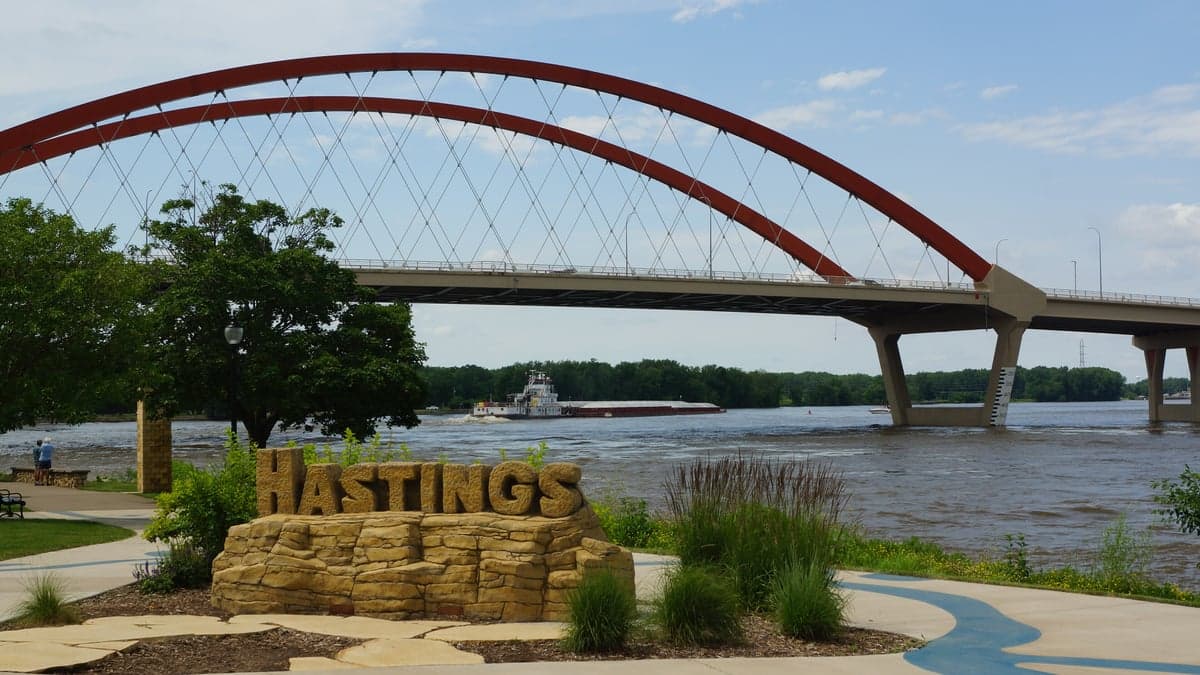
Hastings was founded in the 1850s at the confluence of the Mississippi and St. Croix rivers, a location that made it a natural hub for steamboat traffic and early milling. The original European settlers were primarily German, Irish, and Scandinavian immigrants drawn by the promise of farmland and jobs in the lumber and flour mills. The West Side neighborhood, west of the Vermillion River, became the early heart of German Catholic settlement, with St. Boniface Church anchoring the community. Irish immigrants concentrated near the riverfront in the Downtown Historic District, working the docks and rail yards. By the late 19th century, Swedish and Norwegian families had established themselves in the Northwood area, building small farms and the area’s first Lutheran congregations. The city’s population grew steadily through the early 1900s, reaching about 5,000 by 1930, as the railroad and the Hastings State Hospital (opened 1899) provided stable employment.
Modern era (post-1965)
The post-1965 period brought modest demographic change. The 1965 Hart-Cellar Act had little immediate effect on Hastings, as the city’s industrial base—primarily manufacturing and agriculture—did not attract the large immigrant flows seen in Minneapolis or St. Paul. Instead, the city grew through domestic in-migration from the Twin Cities metro, particularly after the construction of Highway 61 and the Wakota Bridge in the 1980s improved commuter access. The River Hills subdivision, developed in the 1970s and 1980s, attracted white-collar commuters from the metro, while the Pleasant Hill area saw an influx of younger families seeking affordable starter homes. The Hispanic population began to grow noticeably in the 1990s, concentrated in the Southwest Hastings area near the industrial parks, where manufacturing and food processing jobs offered entry-level employment. The East/Southeast Asian population, primarily Hmong and Vietnamese families, arrived in smaller numbers during the 2000s, settling mostly in the Downtown and West Side rental stock. The Black population remains small (1.5%), with no single neighborhood concentration. The Indian subcontinent population is effectively zero (0.0%), reflecting Hastings’ distance from the professional-class job centers that attract Indian families to the western suburbs.
The future
Hastings’ population is projected to grow modestly, reaching roughly 25,000 by 2040, driven by continued spillover from the Twin Cities metro and new housing developments along the Highway 61 corridor. The city is becoming slightly more diverse, with the Hispanic share expected to rise to 8-10% and the East/Southeast Asian share to 3-4% by 2040, while the white share declines to the low 80s. New communities are dispersing rather than concentrating, as recent subdivisions like Riverview Estates and Vermillion Heights attract a mix of young families and retirees without strong ethnic clustering. The foreign-born share will likely remain below 3%, as Hastings lacks the dense ethnic networks and service infrastructure that draw immigrants to larger cities. The city’s cultural identity is evolving from a quiet river town into a more diverse exurban community, though the pace of change is slow enough that long-term residents still dominate local politics and civic life.
For someone moving in now, Hastings offers a predominantly white, family-oriented community with modest diversity that is gradually increasing. The city is becoming more connected to the Twin Cities metro, but retains a distinct small-town character that appeals to those seeking lower housing costs and a slower pace. The demographic future points toward slow diversification rather than rapid transformation, making Hastings a stable choice for families who value continuity over cosmopolitan change.

* Values derived from national, state, county, city and local statistics and may differ in a specific area. Last updated: 2026-11-23T04:53:47.000Z
Narrative content on this page is AI-generated and may contain mistakes. Verify any details that matter before acting on them.
ReloMaps may earn a commission from affiliate links at no extra cost to you.

