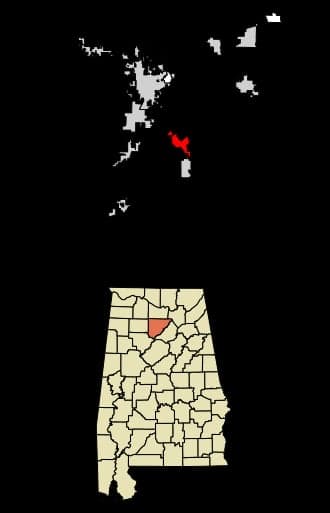
Photo: Wikipedia
Political ClimatePolitical Climate in Hanceville, AL
District shown is the primary district for this city’s centroid. Cities may span multiple districts.
Local Political AnalysisPolitical Analysis of Hanceville, AL
Hanceville is about as deep red as it gets in Alabama, and that’s saying something. The town sits in Cullman County, which has a Cook Partisan Voting Index of R+33, meaning Republican candidates routinely win by a 33-point margin over the national average. That’s not just conservative—that’s among the most reliably Republican areas in the entire state. If you look at the 2024 presidential race, Cullman County gave Donald Trump over 85% of the vote, which is consistent with how the area has voted for decades. The trajectory here isn’t shifting left or right in any dramatic way; it’s been solidly Republican for as long as most folks can remember, and there’s no sign of that changing anytime soon.
How it compares
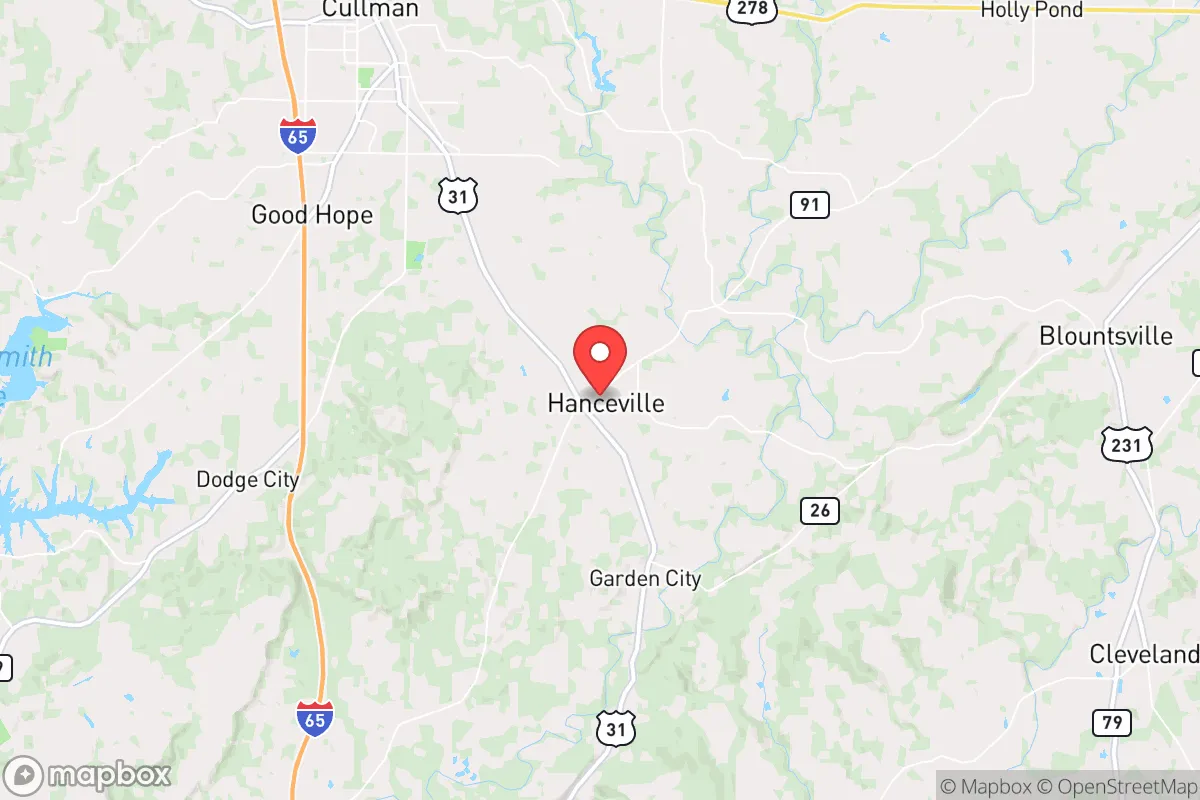
Compared to Alabama as a whole, Hanceville is noticeably more conservative. The state itself has a Cook PVI of R+15, which is already heavily Republican, but Cullman County is more than twice as Republican-leaning as the state average. That gap matters when you look at local elections and policy. For example, while Alabama has a few blue dots—like Jefferson County (Birmingham) and Montgomery County—Hanceville is surrounded by areas that share its deep-red politics. Drive 20 minutes south to Cullman city, and you’ll find a similar political vibe. Head 45 minutes north to Huntsville, and you’ll see a more moderate, tech-driven conservatism. But Hanceville itself is rural, agricultural, and culturally traditional, which keeps its politics anchored firmly to the right. There’s no real political contrast within the immediate area; even the nearest towns like Garden City and Holly Pond vote the same way.
What this means for residents
For conservative residents, Hanceville is a comfortable fit. Local government, school board decisions, and law enforcement priorities tend to align with traditional values. Taxes are low, gun rights are broadly supported, and there’s little political friction in daily life. For liberal residents, the reality is different. You’ll likely be in the minority, and that can feel isolating at times, especially in social settings or local civic groups. That said, Hanceville isn’t hostile—people are generally polite and neighborly regardless of party. But if you’re looking for progressive policy or a politically diverse community, you’d probably find more of that in Birmingham or even Tuscaloosa. The practical effect is that local elections are often decided in the Republican primary, so the general election is rarely competitive. That means the real political action happens in the spring, not November.
Culturally, Hanceville is shaped by its strong religious and agricultural roots. Church attendance is high, and community events often center around faith-based or family-oriented activities. There’s a noticeable emphasis on self-reliance and local control, which shows up in everything from zoning to school funding. One distinction worth noting: Hanceville is home to Wallace State Community College, which brings in a slightly younger and more diverse population than the surrounding rural areas. That doesn’t shift the political needle much, but it does create a small pocket where you’ll find a wider range of viewpoints than in the county’s more remote corners. Overall, the political climate here is stable, predictable, and deeply conservative—and that’s exactly how most residents prefer it.

State Political ClimatePolitical Climate in Alabama
State Political AnalysisPolitical Environment in the State
Alabama is one of the most reliably Republican states in the country, with a deep-red partisan lean that has only solidified over the past two decades. The state has voted for the GOP presidential candidate by double digits in every election since 2004, and Republicans hold every statewide office, supermajorities in both legislative chambers, and all seven U.S. House seats. The dominant coalition is a blend of rural white conservatives, evangelical Christians, and suburban voters in metro areas like Birmingham and Mobile, while the Democratic base is largely confined to the Black Belt counties and a handful of urban centers. Over the last 10-20 years, the state has shifted rightward on cultural and economic issues, even as national trends have pulled in other directions, making it a place where conservative policy moves quickly and with little organized resistance.
Urban vs. rural divide
The political map of Alabama is starkly divided between its few urban centers and the vast rural expanse. Jefferson County, home to Birmingham, is the state's most populous county and a Democratic stronghold, delivering about 60% of its vote to Joe Biden in 2020. Mobile County, anchored by the port city of Mobile, is more competitive but has trended Republican in recent cycles, while Huntsville, in Madison County, is a fast-growing conservative-leaning area driven by defense and aerospace jobs. The Black Belt, a crescent of counties stretching from the Mississippi border to the Georgia line, is overwhelmingly Democratic and predominantly African American, with counties like Dallas and Greene routinely voting 80% or more for Democrats. Meanwhile, rural counties in the northern part of the state, such as DeKalb and Marshall, are deeply Republican, often voting 80-85% for Donald Trump. The divide is not just geographic but cultural: urban and Black Belt voters prioritize economic equity and civil rights, while rural and suburban voters focus on gun rights, religious liberty, and limited government.
Policy environment
Alabama's policy environment is shaped by a low-tax, low-regulation philosophy that appeals to conservative relocators. The state has a flat income tax of 5%, a sales tax that averages around 9% when local levies are included, and property taxes that are among the lowest in the nation, typically under 0.5% of assessed value. There is no state-level estate or inheritance tax. Education policy is dominated by school choice: the state has a robust charter school law, a tax-credit scholarship program for private school tuition, and a growing network of public magnet schools in cities like Huntsville and Mobile. Healthcare policy is more limited, with Alabama being one of the 12 states that has not expanded Medicaid under the Affordable Care Act, leaving roughly 300,000 low-income adults without coverage. Election laws are restrictive by national standards: voter ID is required, early voting is limited to absentee ballots with an excuse, and same-day registration is not allowed. The state also has a near-total ban on abortion, enacted in 2019 and triggered by the Dobbs decision, with no exceptions for rape or incest.
Recent policy direction
In the last five years, Alabama has moved aggressively on a range of liberty-related issues that matter to relocators. On gun rights, the state passed constitutional carry in 2022, allowing permitless carry of concealed handguns, and has a strong Stand Your Ground law. On parental and education rights, the 2022 Alabama Parental Rights Act requires schools to notify parents of any changes to a child's mental or physical health, effectively restricting discussions of gender identity in classrooms. On speech and privacy, the state passed a law in 2023 banning TikTok on government devices and has debated but not yet passed broad social media content moderation restrictions. Medical and bodily autonomy is tightly constrained: in addition to the abortion ban, the state has restricted gender-affirming care for minors and allows pharmacists to refuse to dispense medications for moral or religious reasons. Property rights are strong, with no statewide zoning mandates and a low property tax burden that discourages displacement. Taxation has been trending downward, with a 2023 law cutting the state grocery tax from 4% to 3% and a 2024 law reducing the income tax rate from 5% to 4% over several years. Voting and ballot access remain restrictive, with no expansion of early voting or mail-in voting despite repeated legislative proposals.
Civil unrest & political movements
Alabama has a history of civil rights activism that continues to shape its political landscape, though large-scale protests are less common than in states like Georgia or Texas. The most visible recent flashpoint was the 2023 debate over the state's new congressional map, which a federal court ruled diluted Black voting power; the resulting special session and redrawn map drew national attention and protests from voting rights groups. Immigration politics are relatively low-key compared to border states, but local law enforcement in counties like Marshall and DeKalb has cooperated with federal immigration authorities, and the state passed a strict anti-sanctuary law in 2011 that remains on the books. Election integrity controversies flared after the 2020 election, with some Republican officials questioning the security of mail-in voting, but no major fraud was found. Organized activist movements include the Alabama Arise coalition, which pushes for Medicaid expansion and tax reform on the left, and the Alabama Policy Institute, which advocates for limited government on the right. A new resident would notice the strong presence of churches in political life, with pastors often endorsing candidates from the pulpit and religious liberty being a central issue in local elections.
Projection
Over the next 5-10 years, Alabama is likely to remain deeply Republican, but demographic shifts could introduce subtle changes. The Huntsville metro area is growing rapidly, attracting out-of-state professionals in tech and aerospace who tend to be more moderate than the rural base, potentially nudging Madison County toward a more competitive posture. The Black Belt continues to lose population, which weakens the Democratic base, while the Gulf Coast counties like Baldwin are booming with retirees and remote workers from Florida and the Midwest, reinforcing conservative dominance. In-migration from blue states is modest compared to Texas or Florida, but it is concentrated in suburbs around Birmingham and Huntsville, where school quality and job opportunities are highest. The most likely scenario is that Alabama stays solidly red, with occasional intra-party fights between establishment Republicans and more populist, Trump-aligned factions. For a new resident, this means a stable policy environment where conservative priorities are enacted quickly, but where progressive residents will find limited political representation and few avenues for change at the state level.
For someone moving to Alabama, the bottom line is that the state offers a predictable, low-tax, culturally conservative environment where policy moves in one direction. Conservative families will find strong gun rights, school choice, and religious liberty protections, while liberal residents will face a political system that is largely unresponsive to their priorities. The urban-rural divide means that daily life in Birmingham or Huntsville feels different from rural Cullman or Dothan, but the state-level policy is uniformly conservative. If you value low taxes, minimal regulation, and a government that aligns with traditional social values, Alabama is a natural fit. If you are looking for a place with robust public services, progressive social policies, or competitive elections, you will likely find the state frustrating. Either way, the trajectory is clear: Alabama is not trending purple anytime soon.
* Values derived from national, state, county, city and local statistics and may differ in a specific area. Last updated: 2026-07-15T22:09:22.000Z
Narrative content on this page is AI-generated and may contain mistakes. Verify any details that matter before acting on them.
ReloMaps may earn a commission from affiliate links at no extra cost to you.

